
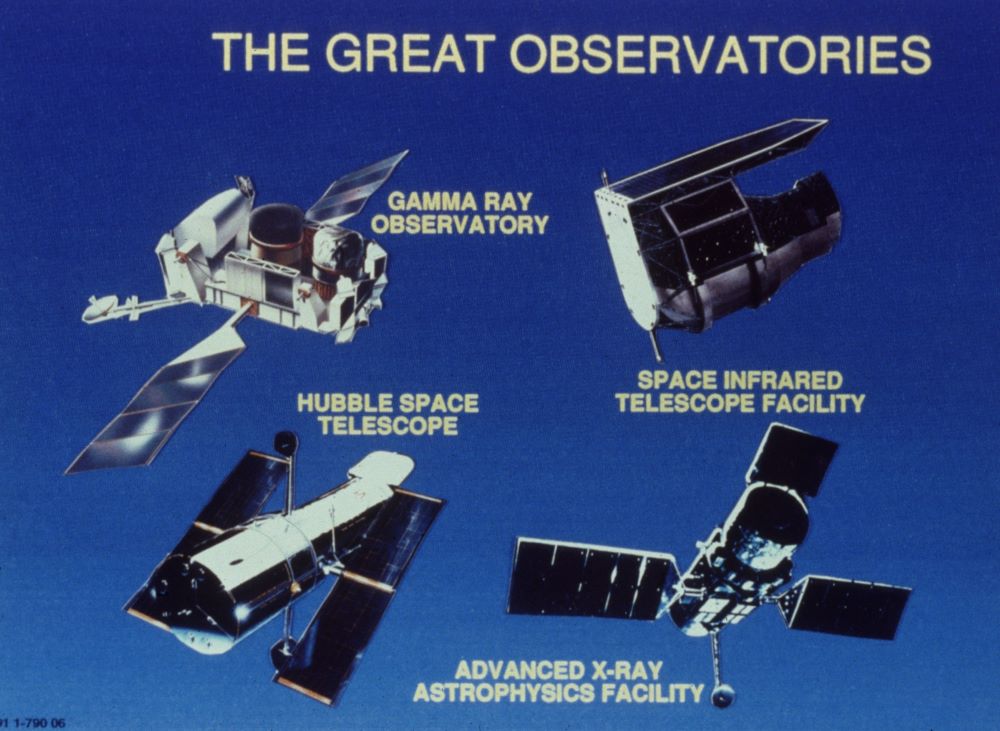

In March 2024, NASA’s budget for space science was announced and contained a serious threat to Chandra, the X-ray space telescope. Chandra (AXAF) was one of the four ‘Great Observatories’ planned in the 1980s (Fig. 1), along with the Hubble Space Telescope, the Spitzer infrared one and the Compton gamma-ray observatory, the last two of which are gone. Chandra was launched in 1999 (Fig. 2) and is still working perfectly (Fig. 3), but processing data from it is becoming increasingly costly as technology and computing moves on.


NASA anticipates annual cuts to Chandra’s budget, to 10% of the current value in 2029, and there are no replacements planned until far into the 2030s. Chandra’s not the only programme in danger: for example, a choice may have to be made between two members of the Extremely Large Telescope project, the Giant Magellan Telescope and the Thirty Metre Telescope. (Monisha Ravisetti, ‘The Chandra X-ray spacecraft may soon go dark, threatening a great deal of astronomy’, Space.com online, March 25th 2024.) Even though both are already under way, the Constitutional requirement for annual review of all government spending means that things like this are always liable to happen.

A Chandra image taken 7 years ago (Fig. 4) accompanies a new article about the mystery object Cygnus X-3, by Keith Cooper, the editor of Astronomy Now. (‘Why is mystery object Cygnus X-3 so bright? Astronomers may now have the answer’, Space.com, 26th June 2024.) Cygnus X-3 was discovered in the 1970s and identified as a binary object emitting high-energy jets (Fig. 5), drawing attention from the outset because of its very high emission levels.

In the early 1980s it was suggested that it could even be the source of high-energy cosmic rays, which are nuclei of heavy elements. We’re shielded from them by the Earth’s magnetic field and atmosphere, but they have very nasty effects on central nervous tissue – three years of unshielded exposure at the level they have here would produce effects like being punch-drunk – impaired concentration and coordination, slurred speech, memory loss etc.. It was thought then that they originated primarily from supernovae, and were then scattered and distributed by the Galaxy’s magnetic field.


If they came from Cygnus X-3 there were two possible explanations. The object was definitely binary, a red giant star orbited by an ultradense companion which was then thought to be a neutron star. Primary cosmic rays could result either from matter being pulled off the primary on to the companion (Fig. 6), or as nuclei of heavy elements knocked off the rim of the giant star by the companion’s radiation, if it was a pulsar and the source of the jets (Fig. 7). The first explanation is now known to be correct: the red giant is a Wolf-Rayet star, subject to violent outbursts at the end of its life – which may be sooner rather than later. The fierce x-ray emission is generated by matter spiralling via a funnel-shaped cavity (Fig. 8) into the companion star, which is probably a black hole about five times the mass of the Sun. Back in the early 1980s, it was thought that if accretion was the explanation, the red giant could be pulled apart in as little as a century.

If that were the case, primary cosmic rays could be an intermittent phenomenon. They were first discovered on balloon flights in 1912, and their onset might then have been fairly recent. But it could have a bearing on an anomaly I had spotted in the Drake Equation, the one which allows an estimate of the number of high-technology ‘communicative’ civilisations in the Galaxy (Fig. 9). Rearranging the terms, one gets an apparent statement that the average lifetime of civilisations is inversely proportional to the rate of formation of stars (Fig. 10), even though one might expect the timescales involved to be hugely different. I raised the point with Carl Sagan during his 1985 Gifford Lectures at Glasgow University, but he wasn’t disposed to accept it, perhaps because he didn’t like the possible implications.


If primary cosmic rays were generated in rare events like Cygnus X-3, with large gaps in between, it would be expected that the majority of civilisations would embark on space travel when there were none. Their development would be like the 1950s visions of spaceflight: unshielded spaceships (Fig. 11), space stations (Fig. 12), lunar settlements (Fig. 13), and Mars colonies (Fig. 14), described by Arthur C. Clarke in The Sands of Mars (see ‘Martian Dust Storms’, ON 23rd June 2024).


The lunar city of The Exploration of the Moon, by Arthur C. Clarke and R.A. Smith (Fig. 15), described in Clarke’s 1955 novel Earthlight (Fig. 16), was placed underground to shield it from temperature extremes and meteorites, not radiation, and the majority of settlements would be on the open surface.


The effects of primary cosmic rays were first detected when the Apollo astronauts reported flashes in their eyes, as the particles passed through their heads killing every cell in their path. For extraterrestrial spacefarers they might come on too subtly to be noticed, or so intensely that the astronauts couldn’t see the controls, depending on how far away the source was. The effects on children and embryos don’t bear thinking about. And the results would be that their space programmes would collapse, with effects on their planets which would depend on how dependent on space technology they had become, particularly for materials and energy supply. We might not be alone in the Galaxy, but we might spend the next 20-30 million years finding them all, telling them what their problems had been and that it was safe to come out. I published the idea as ‘Fermi Paradox – the Final Solution?’ in Analog, May 1986, and that was when a furious reader denounced me for supposedly having made the whole problem up. I did get a somewhat grudging apology when I supplied him with the references.
And now the good news. Continuing study of meteorites and moonrocks established that the tracks of cosmic rays in them are not intermittent, at least not over the last several billion years since the formation of the Solar System. They make space travel less convenient, but there are answers to the problems they present, and they’re not a threat that could sneak up on anyone. It turns out that they originate from star-forming regions, some of them in Cygnus (Figs. 17 and 18), and from the outer layers of supernova remnants like Cassiopeia A (‘Tycho’s Star’ of 1572), which was the first object to be imaged in x-rays by Chandra (Fig. 19). It’s still not obvious why increased star formation should shorten the lifetimes of civilisations; it turns out that the major episodes of star formation in the Milky Way have resulted from collision with dwarf galaxies, and the most recent episode ended less than 3 billion years back, when life on Earth was doing very nicely, thank you, though not yet multicellular and on the way to civilisation. (Evan Gough, ‘The Milky Way’s Last Merger Event Was More Recent Than Thought’, Universe Today, online, June 10th 2024.)


When I spoke on ‘The Fermi Paradox’ (Where is everybody?) at the Edinburgh International Science Festival in April 1995, I was able to begin with the cosmic ray hypothesis and rule it out as an explanation for the apparent absence of communicating civilisations. It’s nice to have a definite answer to one of my big ideas, rather than the ‘not proven’ which has happened with so many of them. But I’m not disappointed, either: the thought of all those civilisations coming to tragic ends was one I was very glad to have ruled out. It wasn’t Chandra that ruled it out; but it does demonstrate why we need those eyes in the sky out there. As Sir Arthur Conan Doyle said, at the end of The Poison Belt, one of his sequels to The Lost World, “how narrow is the path of our material existence, and what abysses may lie to either side of it”. We need the likes of Chandra to keep watch for us.
Duncan Lunan’s recent books are available through Amazon. For more information see Duncan’s website, www.duncanlunan.com.




Leave a Reply to The Sky Above You, March 2025 – The Orkney NewsCancel reply