
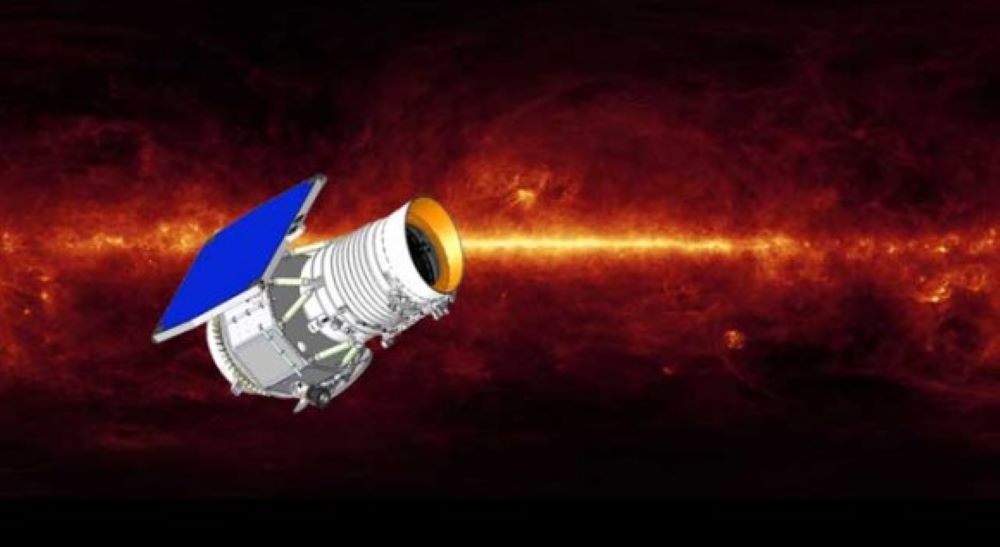
November began on a sad note, when the WISE infrared space telescope (Figs. 1 & 2), latterly known as NEOWISE, re-entered Earth’s atmosphere and burned up on November 1st. Like the Skylab space station, back in 1979, its end was due to increased atmospheric drag, caused by expansion due to increased solar heating as the Sun reached the maximum of its 11-year cycle of activity. But the spacecraft had a good run, launched in December 2009 on a United Launch Alliance Delta II. A NASA mission survey states that it found “the most luminous galaxies in the cosmos, finding millions of hidden black holes, and discovering the coolest class of star” (Elizabeth Howell, ‘NASA’s 15-year-old NEOWISE asteroid hunter meets fiery doom by burning up in Earth’s atmosphere’, Space.com, online, November 5th 2024).


The first infrared space telescope, IRAS (Fig. 3) was launched in January 1973 and compiled four detailed maps of the sky in the infrared over the next 10 months (Figs. 4 & 5), as well as imaging specific targets such as the Great Nebula in Andromeda (Fig. 6), the first view through the clouds of dust which hide the Galactic Centre from us (Figs. 7 & 8), and spectacular views of supernova remnants over the constellation Orion (Fig. 9).


Among its many discoveries it found discs of dusty material around Vega, the brightest star of the Summer Triangle (Figs. 10 & 11), Fomalhaut (Fig. 12) and Beta Pictoris (Fig. 13).


Until now those would have been called ‘protoplanetary discs’, and many more have been found around new stars, but at the beginning of November this year it was announced that Vega’s disc is completely smooth. (Anon, ‘Famous Disk around Vega Shows No Planets’, EarthSky online, November 2nd 2024). Combined observations by the James Webb Space Telescope and the Hubble have shown that there’s no evidence of clumping, let alone of newly generated planets clearing lanes in the disc, out to distances of 100 billion miles, far beyond the size of the Solar System (Fig. 14).

This is extraordinary because Fomalhaut, which is a very similar star, does have such lanes and even newly formed planets (Figs. 15 & 16), and so do Beta Pictoris and many others.


IRAS ran out of coolant and ceased operations after only 10 months, and its success led to calls by Freeman Dyson and others for NASA to repeat it, rather than have a long wait designing and building more advanced instruments. Nevertheless NASA then embarked on the four Great Observatories (Fig. 17), of which only the Hubble Space Telescope and the Chandra X-ray Observatory are still operational (see ‘The Need to Save Chandra’, ON, 30th June 2024).


The Hubble has near-infrared capability (Fig. 18), but the major infrared observatory was SIRTF (Spitzer, Fig.19), whose views of the Galactic Centre (Fig. 20) and the Andromeda Nebula were still more detailed (Fig. 21), and so were composite views superimposing images from HST, Spitzer and Chandra (Fig. 22). Spitzer had a very successful run from its launch in 2003 to its end in 2020, despite gradually diminishing capability as its coolant ran out (Fig. 23).


WISE, the Wide-Field Infrared Survey Explorer, was launched in December 2009 and in its first 18 months it stacked up a run of successes, compiling a fresh all-sky view in infrared (Fig. 24), within which a huge number of black holes were detected (Fig. 25), and previous targets like the Andromeda Nebula were imaged at still higher resolutions (Fig. 26).


I had a small involvement with it myself in this phase, because in a 1985 prize-winning essay called ‘Shadows on the Milky Way’ (Griffith Observer, December 1986), I had suggested that an otherwise unaccounted-for absorption feature in the constellation Cepheus might be a dust envelope around what was then called ‘Planet X’, the large outer ‘planet 10’ first postulated by Percival Lowell, whose search for it led to the discovery of the much smaller Pluto, still considered to be a planet at the time. The dust shroud might be due to volcanic activity on a large satellite in retrograde orbit, as well as a patchy ring around the planet, as the Soviet astronomer Vsekhvyatskiy had suggested for Neptune and had just turned out to be the case. Fascinatingly, the IRAS chart of point infrared sources (Fig. 5) showed a small ring of them at that location; it coincided with a small nebula designated NGC (New General Catalogue) 7822, unidentified but looking like a flattened ring. There wasn’t any reason why that should be so prominent in the IRAS data, and the late Chris Boyce suggested it might be because the 10th planet was passing in front of it – an unlikely coincidence, but those do happen in astronomy. I was invited to lecture on it to the Cardiff Astronomical Society in 2011, and I said that I was looking forward to publication of that part of the WISE all-sky survey. When it came (Fig. 27), the nebula proved to have no infrared point sources and to be otherwise undistinguished, so the imagined planet might indeed have moved away from it. Unfortunately in that time it would have moved about 30 degrees to the eastward and without more detailed information, it would be hard to find again.

Searches for what’s now called ‘Planet 9’ are continuing, however, and from study of the orbits of objects in the Kuiper Belt, it’s now thought that if it exists it must be at least three times more massive and a great deal further out. But in addition to the prize money, I got a story out of it, ‘Out of the Ecliptic’, which I sold to Sydney Jordan and was the last complete story to appear in the Daily Record’s ‘Lance McLane’ comic strip before its termination in 1988 (Fig. 28). So the idea did stand me in good stead.

WISE ran out of coolant and was put into hibernation in February 2011, but wisely it was not switched off, because it could still be used to search for Solar System objects, and in December 2013 it was reactivated and designated NEOWISE, NEO standing for ‘Near Earth Objects’ (Fig. 29). In 2005 NASA had been mandated to locate all such objects with diameters greater than 140 metres, but the funding had never been allocated and there was little chance of meeting the objective until NEOWISE took over. The telescope came out of hibernation in December 2013 and continued for another four years, observing 158,000 asteroids (Fig. 30), 34,000 of them previously unknown, among them the first ‘Trojan’ asteroid sharing the Earth’s orbit. It’s estimated that around 98% of the major hazards, objects over 1 km in diameter, have now been identified, along with many smaller ones (Fig. 31), though the percentages are still much lower for ‘city-buster’ objects of 100 metres or less. NEOWISE remained active and working until summer this year, when it was put back into hibernation to await its fall into the atmosphere.


IRAS was the first satellite to discover a comet, sharing the honours with the Japanese ‘comet-hunter’ Araki and Britain’s George Alcock (Fig. 32). Nowadays such events are common, with the SOHO probe at the Sun-Earth L1 point having discovered thousands of ‘sun-grazing’ comets (see ‘The Sky Above You’, 1st November 2024). NEOWISE discovered over 290 of them, including a major comet which was named after it and dramatically imaged by the Parker Solar Probe on July 5th 2020 (Fig. 33). The US election eclipsed the news that the Parker probe was scheduled to make its last flyby of Venus on the same day (Fig. 34), setting it on course for its closest encounter with the Sun, 3.8 million miles from the surface, on Christmas Eve this year, a little earlier than first planned (Fig. 35). As hinted in Fig. 34, in previous encounters scientists were surprised to see that Parker’s instruments could see through the fog of Venus’s clouds and make out major features on the surface, and the effect has been studied more fully this time to provide more data for upcoming Venus missions such as VERITAS, now probably for launch in 2029.


For now the mantle of infrared space astronomy falls on the James Webb Space Telescope, which is preforming well three years after launch. JWST isn’t specifically hunting for NEOs, but that task will be taken over by NEO Surveyor, scheduled for 2027. It’s to be hoped that it will hunt down the last few undetected major hazards and confirm that no such ‘planet-buster’ impacts will happen for at least 100 years. The lists of ‘nation-busters’ and ‘city-busters’ will also become more complete, reducing the possibility that one could sneak up on us. For the next hundred years, that is, and assuming none of them land in water, which would be much worse. And the risk from comets remains unpredictable, with the exception of Comet Swift-Tuttle, which is going to make very close passes in 2126 and 2261. We’ve come a long way towards safety, but we’re not there yet.
Duncan Lunan’s book Incoming Asteroid! What could we do about it? (Springer, 2013) is available from the publishers or through Amazon. Details of it and his other books are on his website, http://www.duncanlunan.com.

Leave a Reply