
by Duncan Lunan, with Alan Martin, 2021.

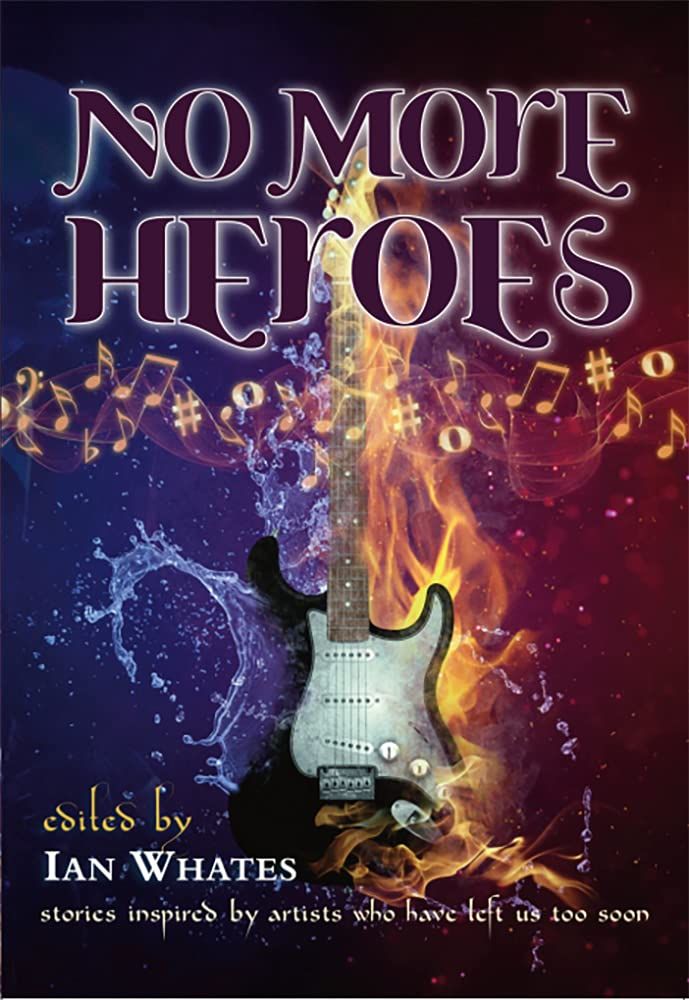
Ian Whates, ed., “No More Heroes”, hbk, 296 pp. + 12, £25, signed edition £35, PS Publishing, 2021.
In 50 years as a professional reviewer, I have been stumped by a book only once before, and it was Alfred Bester’s Golem100 in 1980. Fortunately it was one of several books which I had to cover in a monthly review for the Glasgow Herald, which the paper headed, ‘Musical Twist to the Supernatural’. Funnily enough much of No More Heroes is too, though my problem this time wasn’t with the obscurity of the text, as such.
Music has played a big part in my life, both professionally and personally. I’ve covered many of the connections in notes to my own recent books, and I’ve been asked to expand on them for other publications. But my involvement with the live music scene has been mainly with traditional music (I ran folk clubs in Ayrshire for 16 years), later with the Glasgow jazz scene, as a regular for 17 years, and with the classical scene throughout – mainly through musicians with a foot in one or more worlds, but I took full advantage of the opportunities when I worked in the Press Centre during Glasgow’s year and more as European City of Culture. When I reviewed Peter Crowther’s collection Things I Never Knew My Father Knew, for ParSec # 1, the stories I liked best were ‘The Musician of Bremen, GA’, told by the last survivor of a jazz quartet, and ‘Too Short a Death’, which tells a similar tale about poetry. When I read that No More Heroes was all stories about musicians, and edited by Ian Whates, the editor of Parsec, I expected to be on similar ground.
However I had lost interest in rock and pop music during the 70s, definitely by 1982, and No More Heroes is almost all about or dedicated to rock musicians whose careers I haven’t followed. Ironically the only exceptions were Dave Swarbrick, whom I knew slightly, mostly from the 60s and 70s, and Sandy Denny, whom I met at an outstanding solo blues night she gave at the Neilston Folk Club not long before her death. ‘The Great Gig in the Sky’ by Una McCormack is set in an alternate reality where Swarbrick’s band never made it out of the folk club/student union circuit, and their Sandy was not Sandy Denny but a man, their songwriter, who similarly died young. But in most of the stories, even when I recognised the protagonists’ names, or at least those of the bands they were in, I didn’t know their work well enough to relate the stories to it. I recognised No More Heroes as a song title, but couldn’t have told you by whom (the Stranglers, I now know). So I’m grateful to Alan Martin, then Chair of the Astronomers of the Future Club in Troon, for providing the notes on which most of what follows is based; armed with them, I found the notes and comments by Ian Whates and the authors of the stories more helpful on a second reading, because they all assume a familiarity with the music, which Alan has.
The first story, ‘Session Man’ by Keith Brooke, was one I could relate to, because quite a few of the musicians I knew played backing tracks or depped for famous bands, or even for orchestras, on film scores and the like. But this one seems to bring death to the stars he backs up, and perhaps it’s inevitable that his last gig was Amy Winehouse’s last concert – which he remembers differently from other people, as if the one he played at was in a different reality.
I remembered Leonard Cohen’s Marianne from way back, and Storm Constantine’s ‘So Long, Marianne’ captures the mood I remembered. I never seem to have encountered the other, upbeat side of Cohen’s work which his fans keep telling me I’m missing. Jaine Fenn’s ‘Ninety-seven-point-six’ is dedicated to Glen Frey of the Eagles, and retells Hotel California as a haunted space station which is also a gateway to the stars. In her notes, Fenn says that she wrote it because ‘every time I hear Hotel California I think ‘just WTF is going on here?’ In my mind I’ve always associated that song with A Whiter Shade of Pale, and recently I was asked by a colleague in Italy to explain that one to him. I couldn’t be much help – and that was like the difficulty I had with most of the other stories, so I’m going to draw heavily on Alan’s notes from now on.
The book’s second story, ‘So We Beat On’ by Ron Warom, illustrates the problem. It’s the story of a shell-shocked survivor of World War One, who drifts through the seedy side of postwar Soho and falls prey to a group of genuine devil-worshippers. It’s dedicated to Freddie Mercury, but what’s the connection? He had no military service, let alone saw combat, and wasn’t made vulnerable by it to the temptations to which the protagonist succumbs in his search for release. I was worried that I’d make a fool of myself by not seeing a link, but apparently there is no explicit one at that level. Warom writes that it is built around a Mercury composition called My Fairy King, ‘with those subtle nods to Browning’s Pied Piper of Hamelin’.
Alan Martin summarises ‘Renegade’ by Tom Lebbon as “a tribute to Phil Lynott of Thin Lizzy, a tale of someone surviving with Phil’s help” – coming back from the dead to preserve a victim of a coach crash, and leaving him with a new perspective on his own life.
‘Let’s Dance’ by Alison Littlewood: “a post-modern version of Cinderella, dedicated to David Bowie”. She writes, ‘What seemed a simple pop tune back then is so much more complex and layered: the commentary on racism in the video, for example. But the mention of red shoes immediately suggested something else to me. It carries the resonance of a fairy tale, albeit a dark one, and with the suggestion of fear behind it…’ It’s reminiscent of the retold stories in Jane Yolen’s The Midnight Circus (Tachyon, 2020), and that’s high praise.
‘The Birth of Liquid Plejades’ by Stephen Palmer: “an account of a hallucinogenic Tangerine Dream concert, dedicated to Edgar Froese and his Dali-like surrealism”. The author notes, ‘In accordance with the Gleichschaltung of Edgar Froese, part of this story was written using an automatic surreal writing process’, and I would say that it shows.
‘Motörhead on the Orient Express’ by Gavin G. Smith: “a bizarre twist on the Agatha Christie story, dedicated to Lemmy in the Uber Poirot rôle” and to two other members of the band. The real question is not, ‘Who committed the murder?’, but ‘Why is he working towards his own death?’, in a dream on a train which fills up with other dead musicians towards the end.
‘Naught’s Reckoning’ by Maura McHugh: “For Dolores O’Riordan of the Cranberries, what else but an outsider zombie story?” Ian Whates writes, ‘O’ Riordan’s song Zombie was a huge international hit and has become an anti-war anthem… Much has changed in Ireland’s political landscape, but the threat of a reincarnation of the troubles still persists’. I found it to be so, when I was there in 2019.
‘Tyranny Unleashed, Doctrines Overthrown, The Mirror Shattered’ by Michael Cobley: “a dark fantasy based on The Blue Oyster Cult’s Sandy Pearlman and Allen Lanier (possibly the book’s most obscure music references)”. I remember Mike Cobley showing me up with his knowledge of SF in pop music, or vice versa, at a convention many years ago, and he would have made a better reviewer here, were he not himself a contributor.
‘The Odessa File’ by Alan Ashley: “in another time and world, Robin Gibb of the Bee Gees lives as a troubled, genius artist”, in a family of artists pushing him to conform to financial pressures, and with a muse in the trees reminiscent of Robert Holdstock’s Mythago Wood.
‘A Stranger Shade…’ by Vaughan Stanger: in another version of Strangers on a Train, encounters with Steve Strange of Visage (whom he met on a train in real life) leads to saving a relationship.
‘The Sound of Smoke’ by Neil Williamson (himself a musician, who might also have been a candidate for reviewer) is dedicated to Jon Lord of Deep Purple, but is really another story about a conflict between music on one hand, constantly acquiring more old equipment and looking for an exact combination of sounds (I know a musician just like that), and on the other, saving a relationship – all built around Hammond organs, by which Neil was very impressed when he heard Lord and others play them in the 70s.
‘Parfitt: Knight’ by Adam Roberts portrays a fantasy tournament, a struggle between life and death for Rick Parfitt of Status Quo, inspired by Chaucer’s describing the narrator of The Knight’s Tale as ‘a verray parfit gentle knyght’. Reviewing a reprint of A Game of Thrones elsewhere, I compared it with The Hedge Knight (in George R.R. Martin’s anthology Dreamsongs, Orion, 2006), which he introduces as ‘a prequel… set amongst the Seven Kingdoms of Westeros about ninety years prior to A Game of Thrones’. I pointed out that in those 90 years, fundamentally, nothing has changed. Like so many of its subsequent imitators, the series is set effectively in mediaeval Europe before the Black Death, but frozen in time. They all have silk from the east, but never gunpowder; towns, merchants and guilds, but not the kind of social changes which came with the windmill and the horse-collar in the 12th century (see Jean Gimpel, The Mediaeval Machine, Gollancz, 1977) or the explosion of new fashions that followed the invention of buttons and pockets in the 14th (Ian Mortimer, The Time-Traveller’s Guide to Medieval England, Vintage Books, 2009). In particular the tournament scenes of A Game of Thrones and The Hedge Knight are interchangeable, though in real life there were huge changes in armour and much else in that length of time. I gave up reviewing and even reading fantasy because I got so bored with that standard setting, so it was a real pleasure to find Adam Roberts playing it for laughs, with some very nice images and wordplay. An Esquire guitar becomes a battle-horse, other guitars literally become axes, plectra become spurs… Yet it’s a fight to the death, which Parfitt loses, but he goes out on a high, thinking Over and Out, the title of his posthumously released solo LP.
‘Fanning the Flames’ by Martin Sketchley: “the revenge of a troubled fan on disco diva Pete Burns, with a hint of redemption to the tale”. Sketchley writes, ‘His colourful life represents a prime backdrop for an alternate history in which things weren’t quite as they seemed’.
‘The Day the World Turned’ by Andrew Hook: “a fairly straightforward, heartfelt biog of Poly Styrene of X-Ray Specs,” whose Germfree Adolescents Hook considers to be ‘a defining punk album of that era’.
‘Thieves in the Temple’ by Bryony Pearce: “a strange SF tale based on three Prince songs – not that you would know it!” It’s the one story in the collection which can be read purely as SF, though Jaine Fenn’s comes close.
‘Onward’ by Ian Whates: “time-travelling to London in search of Chris Squire’s bass guitar, with choices to be made between now and the late 1960s”. The Wiki notes on Squire, his music and his guitar are very helpful here. I could believe it was special – I remember Dave Goulder’s reaction to the destruction of a vintage guitar by a careless driver, and United Breaks Guitars has been a big hit for Dave Carroll more recently, but I had to find out why this one was special. Most of what’s in the story is true, but Whates literally takes it to another reality.
‘Siren’s Song’ by Donna Scott: “a lament for Chris Cornell of Soundgarden, with just a hint of Jonathan Livingstone Seagull about it”. Scott herself writes, ‘I realised I couldn’t write about CC, or Seattle, without including the effect his friend Andrew Wood’s death had on him. It’s as intrinsic to the story as the closeness of the sea to the city.’
When a reviewer talks about the cover of a book, it can be a sign of desperation, or even that he or she hasn’t read it! It’s not always the case: Chris Priest used the 1973 Bruce Pennington cover to make some important points in his review of Arthur C. Clarke’s Rendezvous with Rama. In this case it would be remiss not to mention the cover art by Ian Whates, based on an image by AB-Designer, which is perfect for the book – and good though Michael Smith’s cover design is, it’s a big bonus that the image is reproduced on the front cover of the hardback, without lettering. It makes the book a collector’s item, and the hardback price well worth paying.
Alan’s closing comments are:
“A collection of vignettes and homage to dead pop stars, musicians and song writers, which to be understood requires a certain knowledge of each artist’s work. A book by music fans for music fans, in fantastical settings and styles, replete with respect, reverence and at times a hint of whimsy.
“Who would I have included? Scottish folk rebel and troubadour John Martyn; madcap Syd Barrett of Pink Floyd; Motorik drummer Klaus Dinger of Neu! Wait a minute… that’s Vol. 2.”




Leave a Reply