
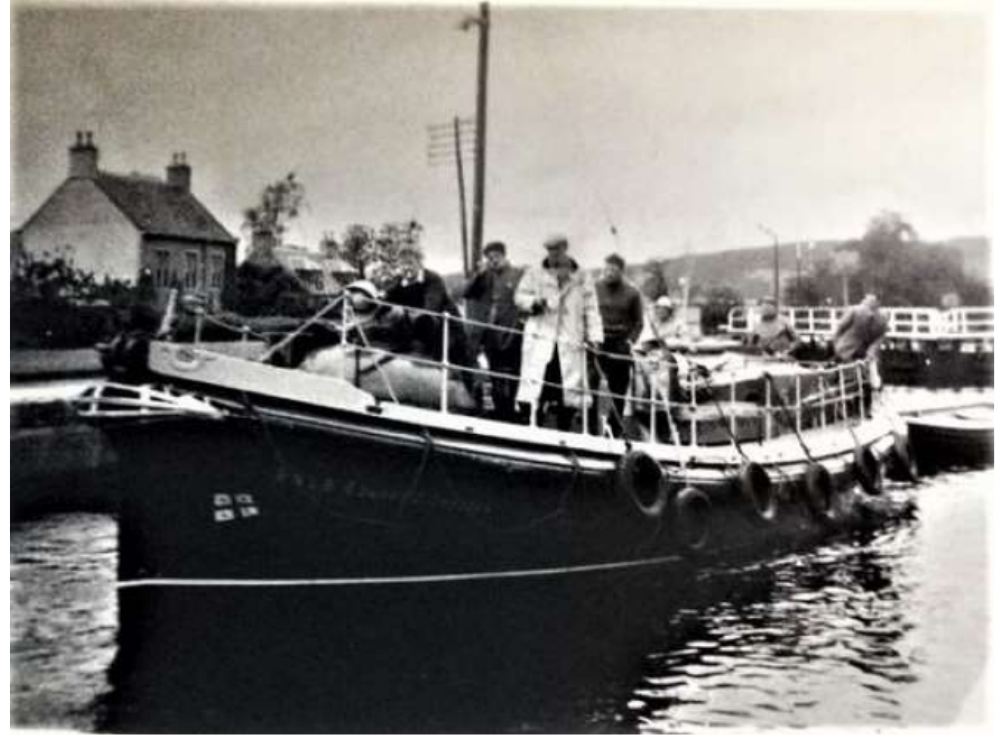
By Ian Cooper, from his excellent series ‘Records of a Bygone Age’, first published in The Stronsay Limpet, and re-published here with their kind permission.
Last month’s article detailed the arrangements made for the re-opening of the Stronsay Station and the arrival from the RNLI reserve fleet of Stronsay’s new lifeboat, the 45½ ft Watson class Edward Z Dresden. We’ll now take a look at some of the main events over the following years.
One of the first recorded missions for the Edward Z Dresden was destined to interrupt the lifeboat’s visit to the neighbouring island of Sanday for their local Lifeboat Guild’s Flag Day. She had been berthed at the Sanday Pier for about 2½ hours, with a steady stream of visitors being given a tour of this new lifeboat, when she was tasked to search for a missing Shetland boat, a mission with a happy ending as recorded in the ‘Lifeboat’ magazine of the time:
At 8.36 on the evening of the 22nd of May, 1953, the Kirkwall coastguard rang up the Stronsay life-boat station to say that three men who had left Walls, Shetland, for Kirkwall in the thirty-feet motor boat Vaila the previous evening, had not arrived. The Vaila had last been seen east of Fair Isle at three o’clock that morning. The life-boat Edward Z. Dresden was due to go to Sanday on the 23rd on a trip for the island’s life-boat flag day, and the coastguard said he would keep in touch with her in case she might be needed. At 11.15 she left for Sanday with the honorary secretary, Captain E. H. Clements, D.S.C., on board. Aircraft carried out a search for the Vaila, and about one o’clock in the afternoon reported that unidentified wreckage could be seen 41 miles east-by-south of Tresness, Sanday. The coastguard rang Captain Clements at Sanday, and at 2.30 the Stronsay lifeboat put to sea, with the honorary secretary on board, in a slight sea with a moderate south-easterly breeze blowing. She searched widely, but found nothing and returned to Stronsay for fuel, arriving at 2.30 early on the 24th. A Danish motor vessel found the Vaila fifteen miles east-by-south of Auskerry. The fishing boat had engine trouble, and the motor vessel towed her to the entrance to Stronsay harbour, arriving at 4.10. The lifeboat then put out again, towed the Vaila in, and secured her at Stronsay pier, reaching her station at five o’clock.
In May 1954 a new 42ft Watson Class lifeboat, the first of its type, was allocated to Coverack, a small fishing village on the south-east coast of the Lizard Peninsula in Cornwall.
This new lifeboat, the William Taylor of Oldham, was making an exhibition trip visiting many of the lifeboat stations around the coast of Britain, and Stronsay had the distinction of providing two of the crew for the Scottish legs of this tour. These two crewmen were Jimmy Stout, who was later to be the coxswain of the Edward Z Dresden, and bowman Ernie Fiddler. This trip took them up the east coast of Scotland, visiting lifeboat stations at Dunbar, Arbroath, Aberdeen, Whitehills, Buckie and Inverness, then through the Caledonian Canal to the west coast where they visited Oban, Campbeltown and Troon before returning home, while the lifeboat continued on down the west coast to her new station in Cornwall.
Jimmy Stout and Ernie Fiddler were again called into action to help crew a lifeboat and take her far from home when, together with others of the Stronsay crew, they took the Edward Z Dresden down the east coast, through the Caledonian Canal and on to Campbeltown on the Kintyre Peninsula to undergo a refit.

Soon after her return from refit the Stronsay Lifeboat was involved in an extensive search, sadly unsuccessful, for a missing Stronsay fisherman and his boat.
Thomas Sinclair, from St Catherine’s in the Rothiesholm district, had left Stronsay in his 18ft (5.5m) dinghy about 5.30 p.m. on 26th September 1954. He was heading for Kirkwall and was expected to arrive there about 8 p.m. that night, but he never arrived. An alert was put out late that evening, and the following day a full-scale air and sea search involving lifeboats from both Stronsay and Stromness and an RAF Shackleton aircraft, along with a number of local boats, combed the area. No trace of Mr Sinclair or his boat was found but the following day, the 28th, some wreckage was spotted on the neighbouring island of Shapinsay which was identified as being part of the missing boat, although Tom Sinclair’s body was never recovered.
This tragic event was also recorded in the Lifeboat magazine:
At 10.24 on the night of the 26th of May, 1954, the Kirkwall coastguard telephoned the Stronsay life-boat station that a man had left St. Catherine’s Bay in a motor boat for Kirkwall at five o’clock, but had not arrived. The coastguard made enquiries, but nothing more had been heard of the man, and at 11.23 the life-boat Edward Z. Dresden put to sea. She searched widely in a rough sea and fresh south-south-east breeze, but found nothing and arrived back at Stronsay for fuel at 11.40 on the morning of the 27th.
At 10.35 that morning, the coastguard had asked if the Stromness life-boat J.J.K.S.W. would help in the search, and at 10.50 she was launched. She made a search in company with an aircraft, and at 12.40 the Stronsay life-boat put to sea again. She found the boat’s mast and other wreckage near Black Craig, Shapinsay, but no sign of the man was seen. The life- boats continued searching until late that night but without success. In the end they returned to their stations, Stronsay arriving at 10.35 that night and Stromness at 1.43 early on the 28th. The Stronsay life-boat had been at sea for twenty-three hours.

The two children playing on the beach are Elizabeth and Bruce Swanney.
By the end of 1954 it was announced that Stronsay was to get a newly built lifeboat and more details soon followed. The completed lifeboat was lying at the shipyard at Cowes, on the Isle of Wight, where she had been built, and was ready for collection by her new crew.
The crew members who made the long journey to the south of England to pick up the new lifeboat were coxswain Tom Carter, mechanic Sydney Swanney and crew members Jim Work jnr and Willie Rendall.
This lifeboat, named the John Gellatly Hyndman, left Cowes with its Stronsay crew under Tom Carter’s command on 12th February 1955 in the company of a new lifeboat for Troon, the James and Barbara Aitken, for a good part of the way. On the voyage north both vessels stopped off at Brixham in Devon, Newlyn in Cornwall, Fishguard in Pembrokeshire, Holyhead in Anglesey, Donaghadee in County Down and Troon in Ayrshire where her companion’s voyage was complete. The John Gellatly Hyndman then continued on her way north, stopping off at Ardishaig in Argyll, passing through the Crinan Canal to Corpach near Fort William, then through the Caledonian Canal to Inverness and eventually onward to Stronsay where she arrived on 22nd February 1955. This completed a mammoth 10 day journey taking in England, Wales, Northern Ireland and Scotland before reaching her home port in the North Isles of Orkney!

The Edward Z Dresden remained in Stronsay until the arrival of the new lifeboat then, in April 1955, she was transferred to the relief fleet where she continued to operate until being sold out of service in 1968. Bought by a Mr William Cope for £3,000 and renamed the St Peter, she underwent a major refit after which she was barely recognisable as the lifeboat she once was. She changed hands at least four times over the following years, being refitted and adapted for various uses, but sadly sank off the coast of Aran in 1984.

The John Gellatly Hyndman was built at J Samuel White’s boatyard at Cowes on the Isle of Wight, funded by a legacy from Miss Elise Amelia Hyndman, the last of an old Greenock seafaring family, at a cost of around £34,500. She was a 52 ft Barnett class lifeboat, powered by two 60hp Fairey engines. These engines were to be replaced in 1969 by newer and, at 72hp, more powerful Thornycroft engines.

Part 3 next month.



Leave a Reply