
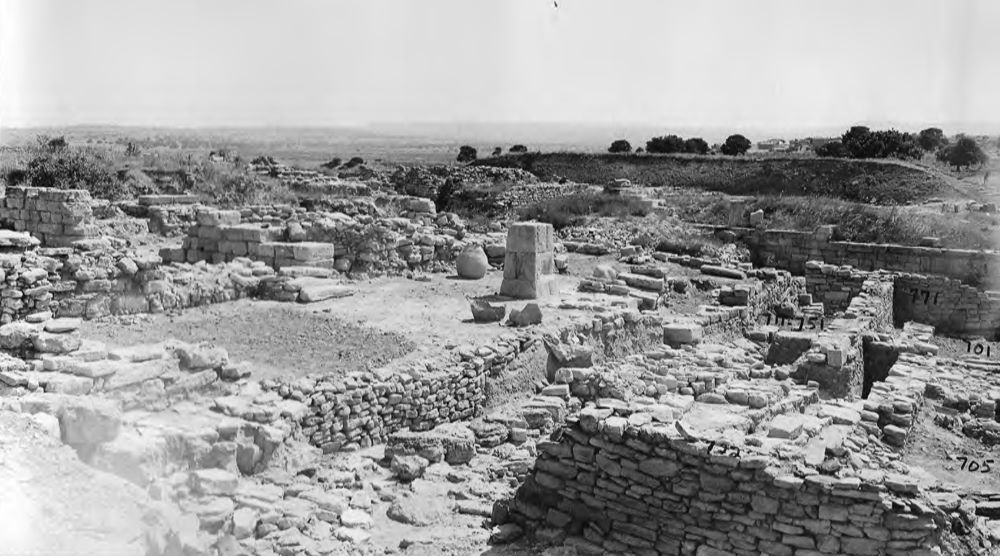
“All the big excavations owe their results to these individuals who are unheralded and unacknowledged. They’re not given their due. They’re simply not mentioned.” – Jeff Kramer, archivist

Jeff Kramer an archivist and research associate in University of Cincinnati’s Department of Classics has been delving into the past of the UC’s historic excavation at Troy, Those excavations employed many unnamed workers who did the digging out of the remains under the leadership of UC archaeologist Carl Blegen in the 1930’s. The excavations were extremely important and identified nine periods of reconstruction and evidence of a great battle and fiery devastation that some historians said was suggestive of the ransacking of Troy. Four volumes of published material were produced and photographs which Jeff Kramer has digitised.
What Kramer came to realise was the number of people, mostly unknown, who worked on the dig. This was quite normal for excavations in the past but he is now redressing the imbalance to acknowledge the important contribution the diggers had to the understanding of ancient civilisations.
“All the big excavations owe their results to these individuals who are unheralded and unacknowledged,” he said. “They’re not given their due. They’re simply not mentioned.”
One worker in particular stood out in the extensive documentation from the seven-year project: an Albanian laborer named Emin Kani Barin who went by Kani. Kramer wrote about him and the broader question of acknowledging the invisible workers of archaeology in a paper published in the journal Bulletin of the History of Archaeology.

“These are the people who put shovels in the ground and swung the picks. They were the ones who pulled the artifacts out of the ground,” he said.
The Story of Troy

Troy was the backdrop for one of Greek mythology’s most dramatic stories: the Trojan War between the Greeks and Trojans and the ransacking of Troy mentioned in Virgil’s Aeneid.
Stories of Troy in Homer’s Iliad and Odyssey tell of the mythic figures Odysseus, Hector, Ajax and Achilles, cut down by an arrow to his heel. And its legends persist today, particularly that of the Trojan horse sculpture within which the Greeks allegedly hid to gain entry to the fortified city.
The ancient cities of Troy were first unearthed in the 1870s and studied again in expeditions over the next 20 years before UC’s Blegen arrived on the site in the early 1930s.
“This was an unbelievably vast undertaking,” Kramer said.
Despite the Great Depression, amateur archaeologist and heiress Louis Taft Semple funded the expedition. She was wife to William T. Semple, the head of UC’s Department of Classics, and niece to President William Howard Taft, who served as dean of UC’s College of Law.
Semple and his wife took part in the excavations throughout the project. When they were away, Blegen kept Semple apprised of developments via telegram, including this 1936 update: “Digging begun, still believe in Helen.”
Kramer said this was a cheeky reference to Helen of Troy, “the most beautiful woman in the world,” according to legend, whose abduction by Paris launched the Trojan War.
The Story of Emin Kani Barin
In 1914 another war had erupted across Europe. Kani’s family had sent him to Canada, where he learned English. He later moved to Akron, Ohio, where as a teenager he worked at a tire-rubber plant. He had a knack for languages and learned English, Polish and Russian from his factory co-workers.
After the war, he returned to Albania to find it fundamentally changed, Kramer said.
With the local economy in shambles, Kani and his new wife and child fled to Greece. But they found no refuge there. Instead, they were deported to Turkey as part of the 1923 compulsory population exchange in which Greece forcibly expelled more than 400,000 Muslims while Turkey deported an estimated 2 million Greek Orthodox Christians in what amounted to mutual ethnic cleansing.
“This compulsory population exchange resulted in a great deal of poverty in both countries,” Kramer said.
When Kani applied to work at Troy, Blegen wrote in his excavation log, he was “particularly ragged, unshaved, and seedy-looking.” But “employee No. 62,” as he was identified in the excavation records, quickly made himself indispensable to the project, Kramer said.
Kani helped Blegen translate instructions to the worker refugees. He was assigned with other skilled workers to mend pots broken over the millennia. He demonstrated such prowess that by his third year he was training others in the painstaking process of rebuilding the pots from tiny fragments.

In 1935 Kani was promoted to foreman where he took over bookkeeping duties and was entrusted with purchasing supplies. He also supervised the construction of the site guardhouse, a pottery room annex, a railway storeroom and a prefabricated house Blegen shipped from the United States.
And because of his knack for languages, he served as tour guide to visitors at the site when the UC representatives were not available.
Kramer said while just one photo of the workers was published in Blegen’s scholarly works documenting the excavation, Kani shows up in dozens of other photos the expedition captured of the archaeological site and daily life at Troy.
“If you look at the photos, you see he was everywhere. His energy was boundless,” Kramer said. “And in the daily journals, it’s clear when they needed something to be done they would call on Kani and his response was, ‘On it.’”
More than that, Kramer said, the photos and documents and Blegen’s later address to the Cincinnati Literary Club where he calls Kani the dig’s most important worker show a genuine fondness.
“It showed not just his interest in Kani’s story but also their friendship,” Kramer said.
Eric Cline, a professor at George Washington University, said the work of laborers was often overlooked in published scholarship because of class bias.
“It was a very colonialist attitude but common for the day,” he said.

Allison Mickel, an associate professor at Lehigh University, examined the unrecognized work of archaeology laborers in her 2021 book “Why Those who Shovel are Silent.”
“Archaeological excavations are, in many ways, microcosms of broader power structures in science and society,” she said.
Mickel said archaeology projects today are far more inclusive and typically include members of the community as valued partners in all stages of the project’s planning and execution.
“Luckily, I think a lot of archaeologists are really interested in building a more inclusive archaeology because that is the bedrock of better science,” she said.
After the excavation concluded in 1938, Kani continued to correspond with Blegen, noting that he had taken a job with the British American Tobacco Co.
Kramer said the tale of Kani’s life spanning continents, war, love, loss and tragedy was emblematic of this volatile time in world history.
“He was caught up in this stream that was so highly representative of what was being faced by millions of people,” Kramer said. “So I saw how remarkable his life was but also how his life reflected what was going on in Greece and Turkey at that time.”
Click on this link to access, Digging Up Troy: The Workers of the University of Cincinnati Expedition to the Troad, published in the Bulletin of the History of Archaeology



Leave a Reply to berniebell1955Cancel reply