
Reducing the use of fossil fuels which we have become reliant upon requires investment, research, and a desire to implement new technologies – although some of those, like using wind and water power, have been around in one form or another from pre-historical times.
Research and development is key to ensuring new technologies improve energy production and moves it away from fossil fuels.
Greenhouse gases emitted by human activities alter Earth’s energy balance and thus its climate. Humans also affect climate by changing the nature of the land surfaces (for example by clearing forests for farming) and through the emission of pollutants that affect the amount and type of particles in the atmosphere. Scientists have determined that, when all human and natural factors are considered, Earth’s climate balance has been altered towards warming, with the biggest contributor being increases in CO2. The Royal Society
Green Hydrogen production is one of the new technologies, produced by the electrolysis of water, using renewable electricity, and has great potential in working towards cleaner energy production. In August 2017, EMEC, based in Stromness, Orkney, produced hydrogen gas using electricity generated from tidal energy in Orkney. This was the first time that hydrogen has been created from tidal energy anywhere in the world.
The Scottish Government has a £10 million Hydrogen Innovation Scheme for projects which will help to develop and demonstrate renewable hydrogen technologies.
The £10 million Hydrogen Innovation Scheme funded projects to help develop and demonstrate renewable hydrogen technologies.
- Stream 1 provided funding for feasibility studies or technical demonstration of hydrogen production, distribution or storage solutions
- Stream 2 provided support for the development of test and demonstration facilities and equipment
Some of those projects funded in 2023 include:
The Orkney sea water electrolysis project run by Locogen Ltd which was awarded £112,838 by the Scottish Government as to investigate the feasibility of using seawater as the feedwater to an electrolyser system.
EMEC, based in Stromness, which was awarded £150,000 for their HySKUA project which studies the offshore production of green hydrogen on a floating hydrogen production hub (HySKUA) co-located with Scottish offshore windfarms.
New Approaches
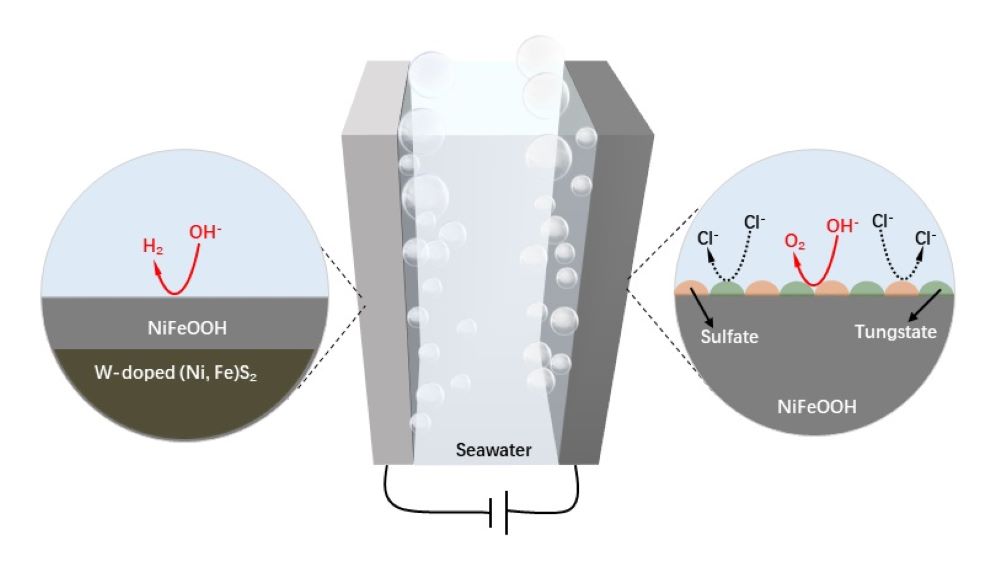
The production of Green Hydrogen is both expensive and challenging. In new research conducted by Prof. Hong Chen (Southern University of Science and Technology in China), Prof. Bing-Jie Ni (University of New South Wales in Australia), and Prof. Zongping Shao (Curtin University in Australia) a new approach was devised to enhance the stability of NiFe-based electrodes in seawater electrolysis.
Self-supported nickel-iron (NiFe) materials have emerged as attractive bifunctional catalysts for both hydrogen evolution and oxygen evolution due to their high intrinsic activity and affordability. Wood-based carbon (WC) structures have gained attention as an ideal substrate for these active materials due to their hierarchical porous nature and excellent conductivity. When Tungsten was introduced into the active NiFe-based catalysts, the anti-corrosion properties and stability of the anodes were significantly improved. The innovative WC-supported W-doped NiFe sulfide (W-NiFeS/WC) electrode was developed for efficient overall seawater electrolysis through a specialized preparation method involving impregnation and sulfidation.

The researchers say that their study not only underscores the importance of structure reconstruction for energy conversion reactions but also showcases the potential of wood waste-derived carbon structures in advanced electrochemical device design. In addition, by repurposing abundant wood waste into efficient catalysts for seawater electrolysis, this work embodies a circular economy approach, minimizing waste generation, and promoting sustainable green hydrogen production from seawater.
Hydrogen from Solar
Scientists at Paderborn University, Germany, are working on a new research project to examine how hydrogen could be obtained from solar energy using specific carbon materials – in other words, thoroughly green. This project, entitled ‘C2-SPORT’ (standing for ‘Carbon Composites as Direct Z-Scheme Photocatalysts for Overall Water Splitting’), is receiving around 20,000 euros of funding as part of Paderborn University’s internal Wissenschaftskolleg.
Junior Professor Maria Nieves López Salas of the Department of Chemistry at Paderborn University, who is heading up the project with Dr. Ying Pan, also from the Department of Chemistry explained:
‘Using sunlight for water splitting in hydrogen and oxygen brings us a step closer to the ideal concept of a profitable, environmentally friendly energy source.’
Their concept is based on what is known as the ‘direct Z-scheme’, a method inspired by natural photosynthesis. In simple terms, this involves combining two types of semiconductors. What makes this process special is that it incorporates the strengths of both types, achieving a previously unheard-of level of efficiency in water splitting.
López Salas continued:
‘Semiconductor-based photocatalytic water splitting using solar energy to produce hydrogen and oxygen from water has proven to be a promising solution for tackling energy and environmental issues’.
However, there are still obstacles to overcome: for example, splitting water entirely into hydrogen and oxygen using just one catalyst material is extremely difficult.
‘In photocatalytic reactions, light absorption, charge carrier separation and the surface reactions of catalysts work together to create hydrogen from sunlight. To ensure high efficiency, these catalysts must be able to absorb light and separate charges efficiently, among other things.’
The currently available semiconductors that consist of a single material struggle to meet these requirements.
Artificial Leaf Green Hydrogen
A research team at Helmholtz-Zentrum Berlin für Materialien und En (HZB), Germany, has been looking into the use of photoelectrodes that convert sunlight into voltage for electrolysis in so called photoelectrochemical cells (PEC cells). They suggest that the efficiency of PEC cells can be significantly increased under pressure.
Some call it an ‘artificial leaf’: instead of the natural Photosystem II complex that green leaves in nature use to split water with sunlight, photoelectrochemical cells, or PEC cells for short, use artificial, inorganic photoelectrodes to generate the voltage required for the electrolytic splitting of water from sunlight.
The team from the Institute for Solar Fuels at HZB has now investigated water splitting at elevated pressure under PEC-relevant conditions. They used gas to pressurise PEC flow cells to between 1 and 10 bar and recorded a number of different parameters during electrolysis. They also developed a multiphysics model of the PEC process and compared it with experimental data at normal and elevated pressure.
Their analysis shows that increasing the operating pressure to 8 bar halves the total energy loss, which could lead to a relative increase of 5-10 percent in the overall efficiency.
Dr Feng Liang explained:
“The optical scattering losses can be almost completely avoided at this pressure. We also saw a significant reduction in product cross-over, especially the transfer of oxygen to the counter electrode”.
At higher pressures, however, there is no advantage, so the team suggests 6-8 bar as the optimum operating pressure range for PEC electrolysers.
“These findings, and in particular the multiphysics model, can be extended to other systems and will help us to increase the efficiencies of both electrochemical and photocatalytic devices,” says Prof. Dr. Roel van de Krol, who heads the Institute for Solar Fuels at HZB.
Fiona Grahame



Leave a Reply