
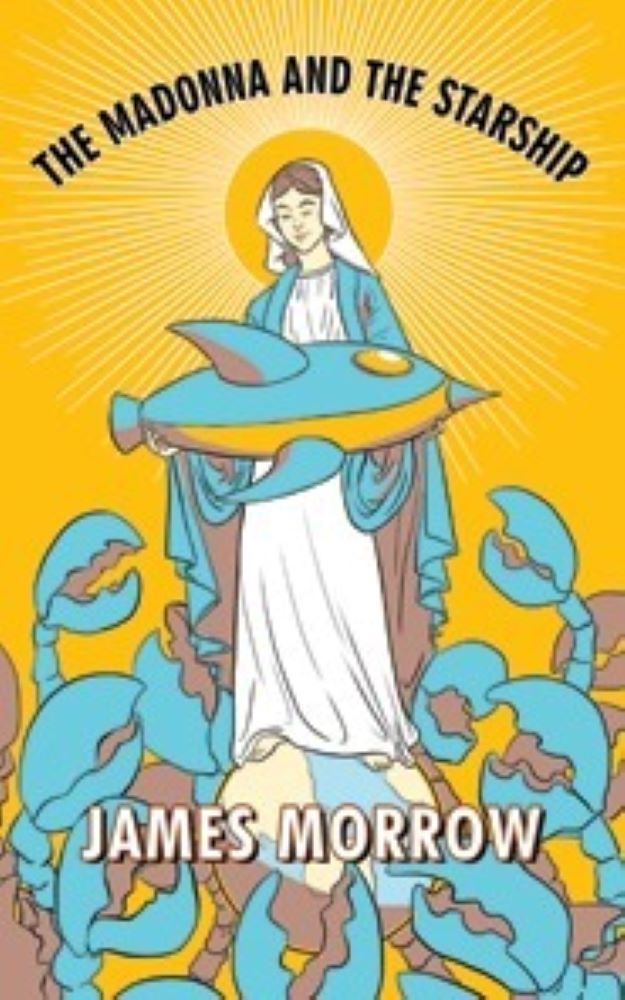

James Morrow, “The Madonna and the Starship”, Tachyon Publications, San Francisco, $14.95, paperback, 192 pp.
First published in different form in Interzone 253, July-Aug 2014.
One respect in which SF differs from reality is that most stories take place in a world which has no science fiction, so the characters are unprepared for whatever they find to be happening. The exceptions tend to involve media sci-fi rather than written SF: in Mark Clifton’s When They Come from Space (Fig. 2, 1962), ETs who’ve been watching our television broadcasts turn up in the form they expect us to expect. In Galaxy Quest, the cast of a long-running and strangely familiar TV series are abducted by aliens who think it’s all true. In Arthur C. Clarke’s story ‘Armaments Race’ (1954), one of the Tales from the White Hart (Fig. 3), the special effects team of a US TV series have to produce a succession of ever-more-impressive death rays until they come up with a disintegrator which actually works. It’s probably no coincidence that most of The Madonna and the Starship takes place on the New York set of a very similar series in 1953. Dylan Thomas dies offstage halfway through the book, rather disappointingly since the characters know him and keep quoting him – in one scene going all round the line from And Death Shall Have No Dominion which James Blish used as a title for They Shall Have Stars, the second of his ‘Cities in Flight’ novels, just at that time.


The series may be imaginary but the sponsors are real: ‘BROCK BARTON AND HIS ROCKET RANGERS! Brought to you by Kellogg’s Sugar Corn Pops, with the sweetenin’ already on it, and Ovaltine, the hot chocolaty breakfast drink schoolteachers recommend!’ In Britain at that time few homes had television (we watched the Coronation in a local hotel) but we did have Dick Barton on radio and Dan Dare on Radio Luxembourg, sponsored by Horlicks (Figs. 4 & 5), and its deservedly forgotten rival sponsored by Ovaltine, which featured a flying saucer crewed by very Young Adults and armed with a nuclear weapon – used to trigger a volcanic eruption, much like the one on page 17 of this book. There was also a pretty dire US comic strip called Brick Bradford, published in the UK in the 1956 News of the World comic Rocket, which was just a year ahead of its time. James Morrow is only two years younger than myself; in the acknowledgements he claims that the inspiration for this book came from research rather than childhood memories, but I wonder.


“…even the grottiest pulp SF performs a salutary cultural function”, writes Morrow in his afterword. His characters do take their young audience seriously, to the extent that each episode is followed by a short science lesson from ‘Uncle Wonder’, urging their child star and their viewers to try experiments at home, always ending with the mantra ‘Safety first!’ In consequence they are visited by a delegation of Qualimosians – “by-God extraterrestrials, complete with crustacean physiognomy, insectile eyes and an antisocial agenda”. They’ve come to present the show with an award for its values, but also to wipe out irrationality (in their view) wherever they find it, especially in the form of religious belief. Unfortunately Brock Barton shares studio facilities with a Sunday morning religious show called Not By Bread Alone, and the only way to save the world is to subvert it and present a ‘special’ portraying the Christian story as a hoax.
In The Encyclopedia of Science Fiction, John Clute’s entry on Morrow concludes, “JM’s work has been likened to that of Kurt Vonnegut, and similarities are indeed very evident [as they are in what the Barton team do to Not By Bread Alone – DL]… But while Vonnegut never disbelieves in the medium of his art, JM has great difficulty giving credence to the artifices of fiction. This may be the price paid for passion and clarity of mind; and it may be a price worth paying.” The metafiction of The Madonna and the Starship might have been written in answer to that. Its central character is Kurt Jastrow, sharing his first name with you-know-who, but his last name with a distinguished astronomer and science writer, the author of Red Giants and White Dwarfs (Fig. 6, “a masterpiece of science”, according to Wernher von Braun), Until the Sun Dies and The Enchanted Loom. Paddy Chayefsky called him “the greatest writer on science alive today” and Sir Bernard Lovell said of him, “Very few scientists are capable of writing as fearlessly and honestly as Dr. Jastrow”. Calling the character ‘Sagan’ would have been too obvious… but to whatever extent the Qualimosians represent the spirit of Richard Dawkins’s The God Delusion, the ‘live and let live’ moral of The Madonna and the Starship is closer to Sagan’s The Demon-Haunted World (Fig. 7). And what’s more, it’s funny! My one regret is that we don’t see more of the child star, Andy Tuckerman, who gets only one good line but whose similarity to ‘Zuckerman’, the passionate opponent of nuclear proliferation, suggests Andy might have been intended for a bigger rôle. But if his part in the story had to be abridged for publication, maybe that, too, was a price worth paying.





Leave a Reply