
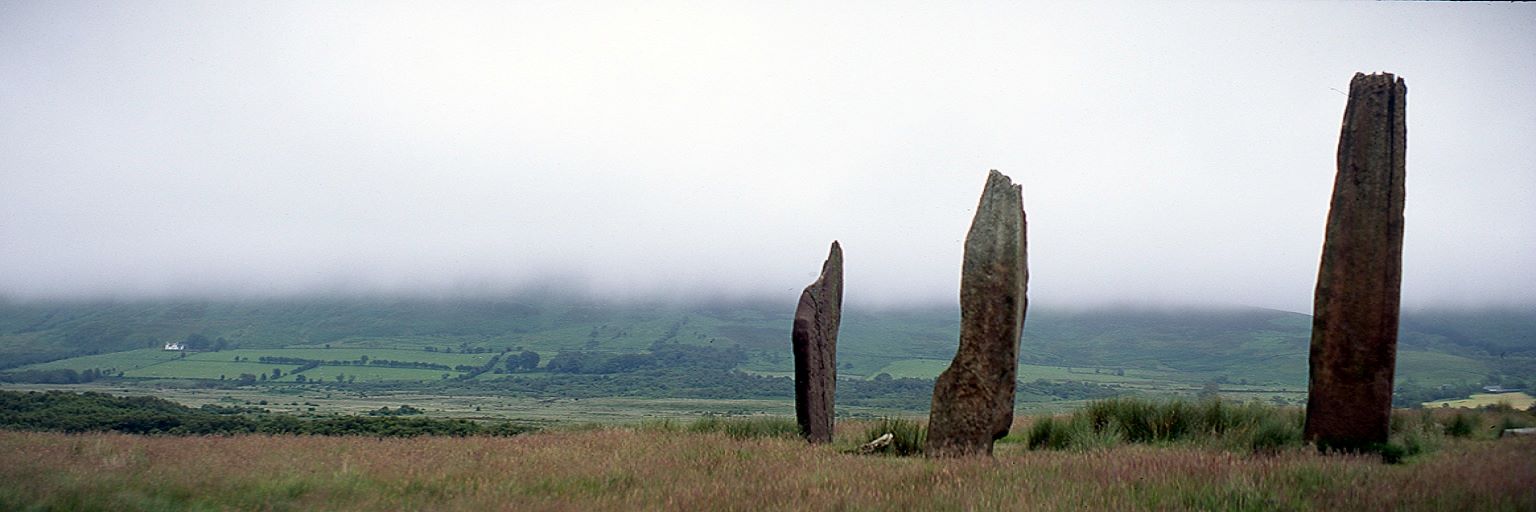
Surprising as it may seem, when I became Manager of the Glasgow Parks Astronomy Project in March 1978, charged with building what became the first astronomically aligned stone circle for 3000 years, I hadn’t been to any Neolithic sites except Stonehenge. I had studied ancient astronomy under the late Drs. (as they then were) Archie E. Roy and Michael Ovenden, in 1963-65, and in the summer of 1965 I visited Stonehenge with my US friend Jerry Bigham, at the time when there was still full access to it. My interest was renewed at the urging of the late Capt. Alan Evans (see obituary, ON, May 22nd 2022), and I went back there twice with him in 1976, also reading the books on ancient astronomy by the late Prof. Alexander Thom and Dr. Euan MacKie, whom I invited to lecture to the spaceflight society ASTRA in early 1978. Knowing my renewed interest was what prompted Archie Roy to suggest me as Manager for the Parks Project. Critics might suggest a parallel with a certain ferry company, whose Directors have yet to travel on their busiest route, or in some cases to visit any of the ports they operate from (Colin Smeeton, ‘FOI Request Reveals CalMac Board Has Never Visited Arran’, Arran Banner, July 19th 2024), but I did at least set about to close the gaps in my experience.

In June 1978 I went with Archie Roy and Euan MacKie on a tour organised by the Astronomical Society of Glasgow, visiting their work at Brainport Bay on Loch Fyne (Fig. 1), as well as the lunar observatory at Kilmartin Glen, and Euan’s work on the solar observing site at Kintraw. I followed that with a seminar in October at the Third Eye Centre (now the Centre for Contemporary Arts) accompanying an exhibition by the top-ranking megalithic photographer Chris Jennings, whom the late John Braithwaite (my Technical Supervisor) and I had already been to visit. In 1979, under the auspices of the Astronomy Project, I made a more thorough study of the sites I had visited by that time on Colonsay in the Inner Hebrides. In 1982 I arranged for all those and others to be photographed on the aerial archaeology flight on which I was co-ordinator (‘Archaeoastronomy from the Air’, ON, July 17th, 2022).


In the late 1980s I visited Castle Rigg in Cumbria with Tony Crerar, one of the advisors on the former Astronomy Project, and went with him to several standing stones which particular interested him, in Powys. I was back at Castle Rigg for the final Leonid meteor shower of 2002 (Fig. 2). Meanwhile, in 1989 I had been with Archie Roy to Euan Mackie’s excavation of the elliptical ring at Cultoon on Islay (Fig. 3), and in 1992 I visited Callanish and Carloway Broch on Lewis with John Braithwaite. I tracked down several small circles, solo stones and cup-and-ring carvings in Sutherland after my family moved up there in the early 2000s. After I married Linda in 2010, we went to Avebury that year (Fig. 4) , and in 2011 we visited the Seahenge timbers, in Norfolk, the Eisteddfod stones at Llangollen, the Mote of Skirk in County Leix, and Newgrange, Knowth and Dowth in County Meath (Fig. 5), to which we went back in 2019, as well as visiting the Drombeg circle in County Cork in 2017 (Fig. 6). In 2022, after several attempts, we made it to Orkney, visiting the Ring of Brodgar, Stenness and Skara Brae, though Maes Howe and the Ness of Brodgar were closed at the time (‘Visit to Orkney’, ON, July 3rd, 2022).


In all of this, the conspicuous omission is Machrie Moor on Arran – though not for lack of trying, over the last 60 years. In 1964 and again in 1965, I was booked on class visits organised by Archie Roy, but I had to miss the 1964 one due to a road accident and something has prevented me from going every time it’s been arranged since. In my previous hillwalking days there was a running joke among my climbing friends, that I would never get to the top of a Munro, because although I’d twice been up Goat Fell, it isn’t high enough, and several times I’d been frustrated near the tops of Munros because I was in hiking boots, unsuitable for climbing the last stage. Eventually I went up Ben Lomond (twice), and that put a stop to it. There seems to be a similar jinx about the Ballochroy stones on the Kintyre Peninsula, which were always included in talks, books and articles about ancient astronomy, and where I have even been booked to lecture, but all attempted visits have been prevented, usually by bad weather.
Having moved to Arran in March this year, however, Linda and I were determined to visit Machrie Moor early on. When Archie Roy asked us to cover it on the aerial archaeology flight, the photographs by Chris Stanley were excellent, but they’re low-level close-ups of the stones from different angles and don’t add up to an overall picture. When I wrote up the flight for the Griffith Observer (November 1986), I had to rely on its expert editor Dr. Ed Krupp for captions of those images, and another source of confusion was that only 5 rings were known at that time, but now there are at least 11, with another destroyed after its discovery in 1832, and there may well be more hidden by bracken or marsh. ‘Circle 1A’, discovered by Aubrey Burl in 1978, is now designated ‘Circle 11’ – just one change, but enough to throw me off. When I was completing The Stones and the Stars for Springer in 2012, the opportunity came up to move from Glasgow to Troon at short notice. I had to ask Springer for a month’s extension of the deadline (the only time I’ve done that in my professional career), and even so I had to interpolate the article as a chapter virtually without alteration, except that Ed Krupp’s detailed captions had to be abridged. My friend Chris O’Kane kindly let me use some photos he had taken on an Astronomical Society of Glasgow visit (one of the ones I couldn’t go on), but they were taken on an overcast day with the clouds down over the hills and the sight-lines weren’t visible (Fig. 7). But standing on the moor with Keith Robertson, and armed with Geoff Holder’s The Guide to Mysterious Arran (The History Press, 2011, Fig. 8), I have finally matched the major ones up.


The visit took a bit of arranging because we don’t have a car, and Arran bus services are subject to variation, especially because roads near Machrie Moor were being closed intermittently for repairs. We had been offered a trip to the stones after I gave a talk on the Sighthill circle to the University of the Third Age in Brodick, but the date for it was uncertain. Linda advertised for a tour guide and we found an excellent one in Keith Robertson from Kildonan, and after several postponements due to weather, we had an excellent day on July 31st. It was still a major undertaking, my first hillwalk in 15 years, and Linda’s first time off the beaten track since her eye problems began a year ago. We had plenty of well-meant advice, not all of it helpful: one lady said bluntly that the going would be too rough for Linda, but against that, The Guide to Mysterious Arran said that with determination you could get a wheelchair round the site, and having given Geoff Holder some help with The Guide to Mysterious Glasgow, I was inclined to take his word. At the other extreme another frequent visitor to the site said it was flat all the way, but he must go by a different route to ours, which proved to be mostly uphill. We had also been warned that the site could be very wet and muddy, and had armed ourselves with new boots, but in the event it was bone-dry for our visit (Fig. 9).


Approaching from the west, as we did, the first prominent feature is the Moss Farm Road stone circle, sometimes designated ‘Circle 10’ (Fig. 10), but possibly a ring surrounded a chambered cairn now largely demolished (Fig. 11). The Guide to Mysterious Arran describes another ruined chambered cairn to the south as ‘swamped by bracken’ in summer, and as I couldn’t see it and had been well warned about ticks, I didn’t make the attempt. In folklore the main site is called ‘Fingal’s Court of Justice’, and one stone traditionally was ‘the Panel stone’ where the accused was arraigned.
Machrie Moor was the site of a major settlement in Neolithic times. In his novel Deadlight (John Long, 1968), Archie Roy wrote, “I looked out over the Moss and tried to imagine life in those days, almost four millennia ago, two hundred generations of men away from us. From air photos, I knew that apart from the stone circles, the Moor was covered with hut circles; the whole area must have supported a largeish community of fishermen, hunters and primitive farmers. And at night, the only illumination would be the stars and the Moon and the fires before the huts. No TV, no adverts… Perhaps for the first time I began to appreciate the appeal these stones, the long cultural echoes of the ancient people of Arran, could have.”


There are at least 12 stone rings on Machrie Moor, five of them particularly prominent (Fig. 12), others like Circle 6 hidden by swamp or bracken, to the extent that I’ve yet to find out where Circles 8 and 9 are. Coming in by the remains of Moss Farm, we came next to the double ring of ‘Fingal’s Cauldron Stones’, photographed from the air in 1982 (Fig. 13). The inner ring is elliptical, the first to be discovered by Archie Roy (over 26 are now known around the UK), and its short axis marks the equinox sunrise, as Dr. Krupp demonstrated in one of his additions to my Griffith Observer article (Fig. 14). One stone has a hole bored in it, said to be where Fingal tethered his dogs Bran and Scaolain. From the air it looked flat, but at ground level it was surprisingly uneven (Fig. 15). Linda’s overall comment was that she couldn’t really appreciate the views because of the need to be constantly watching her footing, despite having her white stick to probe for changes in level.


Circle 4, ‘The Four-Poster’, which we came to next, has just four fairly small, white granite stones (Fig. 16), but has a dramatic view to the northeast (Fig. 17), of which more below. In 1861 a small kist was found in the centre, supposedly the grave of one of Fingal’s dogs.

Continuing east brought us to Circles 1 and 11 (the numbering is not helpful, whichever way you go round from the farm). Both had recently been excavated in 1982 (Fig. 18), but the turf is now fully regrown. Circle 1 is another ellipse, of alternating elongated and rounded stones, and it too points to equinoctial sunrise (Fig. 19). Circle 11 is the one newly discovered by Aubrey Burl in 1978 (Fig. 20). We returned to them on the way back, intending to have a picnic, but a swarm of flies descended on us and we moved on.


Circle 2 is a dramatic reminder of the much larger circle which once stood there, with three remaining stones out of seven or more, up to 18 feet high (Fig. 21), like the sarsen uprights of Stonehenge (Fig. 22), of red sandstone and brought from some distance, unlike the smaller white granite stones of the other circles. Another stone was cut up in the attempt to make a pair of millstones, one of which broke (Fig. 23), so they were abandoned where they lay. Two of the survivors frame a large single stone to the west (Fig. 24), beginning the equinox sunrise alignment which runs through Circle 1.


Looking back from between Circles 2 and 3, there’s a prominent notch on a peak which could be a lunar minor standstill rising alignment (Fig. 25) – see below..

Circle 3, completing our loop, has only one surviving stone (Fig. 26), out of 12 alternating in shape like Circle 1’s, and of different forms of granite, the finer ones again brought from a distance. It’s thought they may have represented male and female forms, like the stones of Avebury’s West Kennet Avenue. In the partial demolition of the circle, one fallen stone has subsequently been drilled almost in two, showing the effort which has gone into making them into lintels and the like.

Although I had a compass and a small portable sundial with me, I didn’t try to identify astronomical alignments on this visit. Descriptions of the possible ones are frustratingly vague: The Guide to Mysterious Arran says ‘In 1978 John Barnett suggested that Circles 1, 2, 4 and 11 were in general alignment on the very prominent notch to the north-east, where Machrie Glen divides in to two – the notch being where, at the time of construction of the circles, the midsummer sun rose…’ Well, yes, but the notch is so wide that the event could be anywhere in that ‘general alignment’ (Fig. 27). Archie Roy suggests that the notch indicated by the centres of Circles 3 and 2 marks the equinoctial rise (Fig. 28), also indicated by the ellipses as above, and that raises the question why that particular event was important enough to be marked three times. ‘Barnett claimed that the Machrie Glen notch also indicated the rising full moon at the minor standstill (as seen from circles 3 and 5’, adding ‘and a second notch to the north-west, visible only from Circle 5, marks the setting winter full moon at the time of the major standstill’. But does he mean the northerly or southerly setting? I looked for the second notch on the way back, but didn’t spot it, unless it’s the one of Fig. 25, which definitely is visible from Circle 3 as well (Fig. 29).


Euan MacKie’s book Professor Challenger and His Lost Neolithic World (Archeopress Publishing, 2020, Fig. 30), subtitled ‘The compelling story of Alexander Thom and British archaeoastronomy’, highlights what a pity it is that Prof. Thom never visited Machrie Moor.

The front cover shows a notch which is signposted by the centres of circles 4 and 2, which Euan reckons to mark minor standstill northerly moonrise, and ‘the indicated slope seems very convincing’. Well, yes, but it’s been calculated from GPS grid references and a clinometer, comparable to the very basic survey which I did on Colonsay in 1979 (with OS map instead of GPS). Even Prof. Thom’s preliminary sketches on Colonsay, which he never got back to complete, were far more precise than that, and his actual surveys were meticulous. When John Braithwaite showed Thom’s instructions for setting up to his father Bill (a friend of the professor’s, and model-maker on Phase 2 of the Astronomy Project), his comment was “That’s not how you set up a theodolite, it’s how you align a transit telescope”, a much more demanding undertaking. When I go back to Machrie Moor, I don’t intend to do anything on that level, but I shall try to be, literally, more sure of my ground.
The Stones and the Stars, Building Scotland’s Newest Megalith, by Duncan Lunan (Springer 2012), is available from the publishers or from Amazon, like all Duncan’s most recent books. For more details see Duncan’s website, http://www.duncanlunan.com.


Leave a Reply