
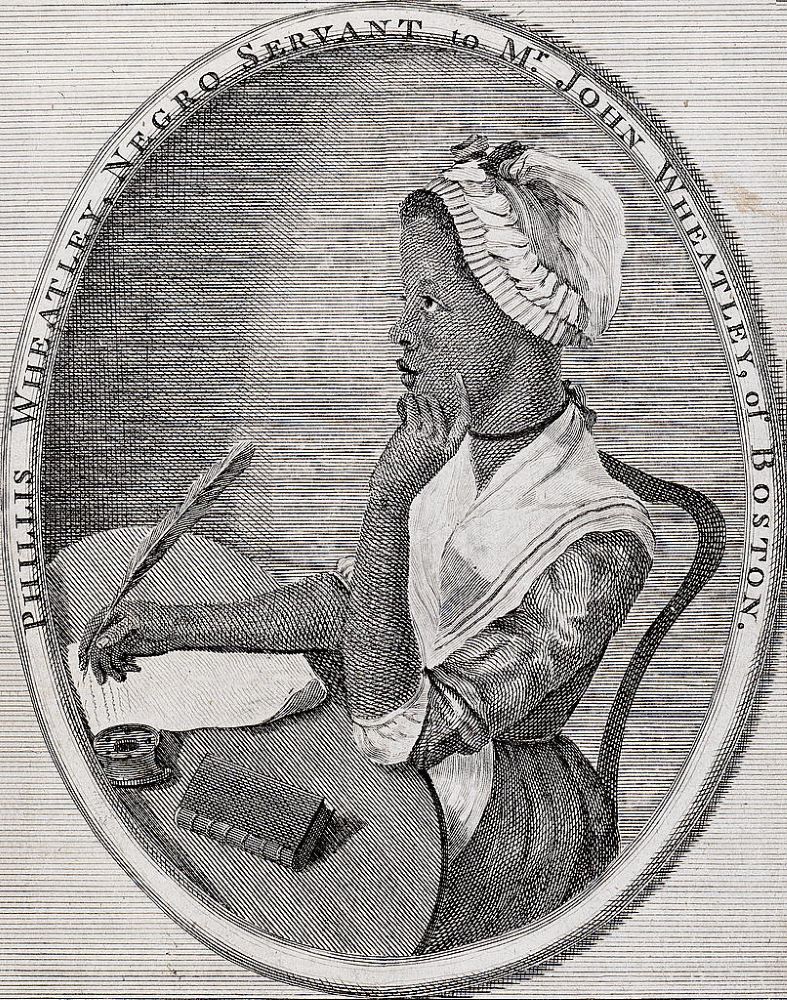
On 1st of September 1773 “Poems on Various Subjects, Religious and Moral” by American slave Phillis Wheatley was published in the UK – the first known book of poetry published by a Black woman.

Born around 1753 in Gambia, Africa, Wheatley was captured by enslavers and brought to America in 1761. Upon arrival, she was sold to the Wheatley family in Boston, Massachusetts. Her first name Phillis was derived from the ship that brought her to America, “the Phillis.”
The Wheatley family educated her and within sixteen months of her arrival in America she could read the Bible, Greek and Latin classics, and British literature. She also studied astronomy and geography. In her early teenage years, Wheatley began to write poetry, publishing her first poem in 1767. Publication of “An Elegiac Poem, on the Death of the Celebrated Divine George Whitefield” in 1770 brought her great notoriety. In 1773, with financial support from the English Countess of Huntingdon, Wheatley travelled to London with the Wheatley’s son to publish her first collection of poems, Poems on Various Subjects, Religious and Moral—the first book written by an enslaved Black woman in America. It included a forward, signed by John Hancock and other Boston notables—as well as a portrait of Wheatley—all designed to prove that the work was indeed written by a Black woman. She was emancipated shortly thereafter. Phillis Wheatley National Women’s History
Click on this link for her poems: Academy of American Poets
An Hymn to the Evening
Soon as the sun forsook the eastern main
The pealing thunder shook the heav’nly plain;
Majestic grandeur! From the zephyr’s wing,
Exhales the incense of the blooming spring,
Soft purl the streams, the birds renew their notes,
And through the air their mingled music floats.
   Through all the heav’ns what beauteous dies are spread!
But the west glories in the deepest red:
So may our breasts with every virtue glow,
The living temples of our God below!
   Fill’d with the praise of him who gives the light,
And draws the sable curtains of the night,
Let placid slumbers soothe each weary mind,
At morn to wake more heav’nly, more refin’d;
So shall the labors of the day begin
More pure, more guarded from the snares of sin.
   Night’s leaden sceptre seals my drowsy eyes,
Then cease, my song, till fair Aurora rise.

This poem is in the public domain. Published in Poem-a-Day on December 2, 2018, by the Academy of American Poets.




Leave a Reply