
By Ian Cooper, from his excellent series ‘Records of a Bygone Age’, first published in The Stronsay Limpet, and republished here with permission.
Part 1 – Runrig, clibbers and cubbies
A feature of much of the Orkney countryside, and of nearly all of the island of Stronsay, is the pattern of fields scattered across the landscape. Although most appear to be neatly arranged squares and rectangles all fitting snugly together, closer inspection shows some with sides of differing lengths, while others are odd little triangles and, where field boundaries meet adjacent farms, natural features or follow the coastline, some are fashioned into some very strange shapes indeed. These fields and patterns break up what can be a very bleak winter landscape but as we move into spring and on through the farming year they can also provide a kaleidoscope of colour. From the initial tinge of green in early spring we see that first flush of dark green grass slowly change to a lighter shade as the cows, newly turned out of the byres, enjoy gorging themselves on this first flush of spring grass while at the same time the rich brown of newly ploughed fields are transformed through a shimmering green tinge of newly sprouted grain into healthy young plants. Soon, with fields being cut for silage, that dark green is quickly turned to the yellow of newly shorn grass and then, almost while you watch, returning once more to green. At the same time the grain is gradually growing and changing colour into the golden yellow of ripe crops awaiting the combine.
I had never really given much thought as to how this landscape we all tend to take for granted came to look as it does until recently when I was reading an article on the old ‘runrig’ system of agriculture in existence in Orkney in the 17th and 18th centuries. This was a time when threequarters of the island was termed as ‘King’s Land and the remaining quarter as ‘Kirk Land’, describing ownership at the time. In this system, some of the better land was divided into long narrow strips, with the various tenants being allocated a set number of strips, often some distance from each other. These strips were kept under permanent cultivation, being sown with grain – either oats or bere – every year and, with little to feed the soil but some seaweed gathered off the shores and ‘house dung’ from the cottars’ small hovels, oats yielded at best only 3 or 4 times the seed sown, with bere giving a slightly better return of 5 or 6 times the seed sown. This was the ‘in-by’ land, the ground relied upon to grow enough grain to see the population through from one harvest to the next. It was separated from the ‘out-by’ land, all uncultivated common grazing which was shared between all the tenants and cottars, by a faelie dyke (a low wall built of turf), known as a ‘gersty’ or ‘treb’ dyke. Nothing now remains of these dykes, although they live on in the farm and house names of Gesty and Gesty West.
In theory the sheep, pigs, cattle and horses, were all confined to the grazing of this outby land over the growing season but it was quite common for them to jump over or knock down the faelie dyke and eat or trample the growing crops. After the crops were harvested all the livestock were given free access to the in-by land although, with little winter fodder for the cattle, sheep and pigs being available, all but the breeding stock were usually slaughtered in autumn, with the meat salted or dried for consumption over the following winter.
These runrigs enclosed by the dykes varied in size and shape and tended to be concentrated in ‘toonships’ where a number of cottars in their small cottages had land in the same area, typically on better land near the sea
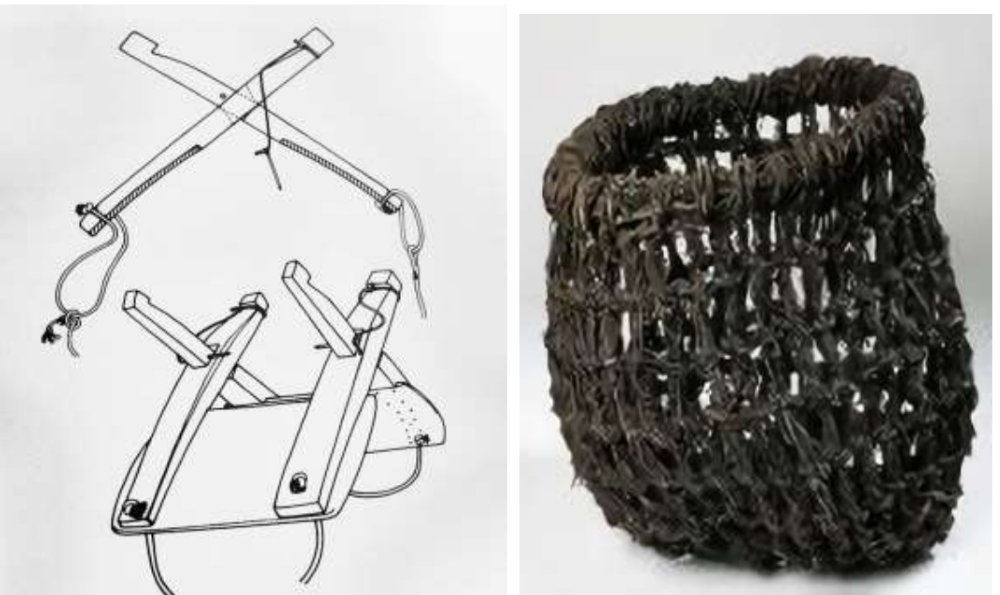
With roads being practically non-existent, much of the communication and carriage of goods and materials would have been by sea, with most of the toonships easily accessible by boat. Access overland would have been mainly by narrow, uneven tracks negotiable on foot or by horse during the summer months but very challenging during winter. Transportation of peats, seaweed, grain or any other commodity would have been by pack horse or oxen, each of which would have been kitted out for the purpose with a ‘flackie’ (a straw mat) laid on their backs to cushion the ‘clibber’ (a two part wooden saddle fitted with hooks) which was placed on the flackie and secured by a straw harness. Their cargo would then have been packed into ‘cubbies’ or ‘creels’ (baskets made of straw or heather) which were attached, one on either side of the clibber, by the basket handles being hung over the clibber hooks.

By the late 18th century the King’s Land and Kirk Land had mostly been bought by, gifted to or otherwise acquired by wealthy landowners, the Lairds who were to wield the power and decide the future of their tenants on Stronsay for nigh on 150 years. This old system of runrig farming, which had been superseded throughout most of Scotland by forming larger fields and utilising a system of rotational cropping, was to persist in Stronsay and Orkney for some time. Here these new lairds, most of whom lived in Kirkwall or further afield, seemed more interested in sending their tenants to gather and dry seaweed for the production of kelp to line the lairds’ pockets than in adopting new farming practices to improve their land and their tenants’ lot.
The first small signs of change was in the late 1700s when, while mainly still retaining the runrig pattern, a process by the name of ‘planking’ was undertaken where a number of adjacent rigs, designated collectively as a ‘shead’ or ‘sheed’ would be allocated to an individual tenant on a permanent basis, making it much more efficient to farm. Although this may seem a logical and easily implemented scheme it was often difficult to apply, with strong opposition from many tenants who had concerns both about the area of land allocated to them and the quality of that land. The responsibility for planking often fell to the Factor (the person who managed the estate on the laird’s behalf) to make and enforce these allocations and, where he was seen to be a fair and respected man, his judgement was usually eventually accepted with an air of inevitability by the tenants.

Around the same time as this planking took place some of the more forward- thinking lairds were trying to make improvements to their lands and farming practices, both to increase the value of their property and to make it more profitable.
The Stronsay section of the ‘Statistical Account of Scotland’, written by Rev John Anderson in 1795, gives a comprehensive and insightful snapshot of the island at that time, together with some of its history and folklore, and provides some detail of the early beginnings of agricultural improvements to come. His description of the island reads:
“The ridge of rising ground, which runs almost the length of the island from North to South, hath its surface covered with short heath, where it has not been cut up lately for turf or fuel; the soil is a dry, friable, blackish earth; the bottom clay, mixed with small stones, and in many places gravelly and shallow. The expense of cultivating such a subject might perhaps nearly equal its value when improved. It is the common pasture or out-freedom of all the farms and houses adjacent to it. The Milldam divides this from the common pasture of the farms on the East side of the island, which common is covered with a grass of mean quality; but as it has better deepness of soil than the other common, and a bottom of tough clay, it might probably recompence more liberally the labour and expence of the improver.”
He goes on to record that, even at that time, he felt the landscape had a raw beauty of its own:
“The common and sheep pasture above described are reckoned to be nearly two thirds of the whole island. The other third forms the skirts or borders of it; where Nature’s simple variety hath hitherto been but little encroached on by the regular uniformity of art. Corn fields of different shapes and sizes, which fields no man living ever saw in pasture, interspersed with a proportional extent of grass of different qualities, grass which bears no trace of having ever been in tillage; these exhibit a scene not unpleasant in the months of summer and harvest. The fields too, of natural grass, retain a degree of lively verdure, superior to those in many of the interior parts of Scotland. It is observable that the flatter any of those islands are found to be, the better, usually, is the quality of their grass and the more lively their verdure.”
With signs of some of the lairds pushing forward changes in practice and others at least being receptive to new ideas, a feeling of optimism seemed to be spreading throughout the tenant farmers on the island and again we turn to Rev Anderson’s Account for information on how this optimism was put into practice:
“With a view to guard against disappointment in reference to agricultural improvements, to communicate the success of experiments, and to remedy certain inconveniences to which the district is liable by its local circumstances the principal farmers in the island of Stronsay most cheerfully concurred to form themselves into a society, and they accordingly did form and constitute the society of farmers in Stronsay about eighteen months ago, to which almost all the farmers in the island have thought proper to accede. This Society agreed to such bye-laws as they judged necessary for regulating their future procedure. They resolved that small sums should be contributed annually by the members, who were ranked in four different classes, according to the extent they possessed.”
Samuel Laing, the proprietor of Rothiesholm at the time, was evidently a well liked, ambitious and forward-thinking laird and it is him who was credited with being the instigator and driving force behind the formation of this Agricultural Society. This was the same Samuel Laing who was responsible for establishing the herring fishing industry in Stronsay and, a few years later, with the formation of the Orkney Club, an organisation which is still in existence today.
This Society, presumably with the full consent of the Lairds, adopted a fairly comprehensive set of regulations, the most important of which appeared to be that they should be granted minimum leases of 19 years, with a rent review at the end of that period and, with the agreement of both parties, to extend the lease for a further two periods of 19 years. The Heritors were also to ensure that the houses were in good repair at the commencement of the lease, with a balance for improvement or deterioration to be accounted for at the end of the term. The principal tenant, in turn, was to ensure that the cottars within the area of his farm were allowed sufficient land to maintain themselves and their family. Of these, the minimum lease period was to be the ground breaker for further development, giving the tenant the confidence to undertake improvements and adopt new practices in the knowledge that, if he was successful, he would be the long term benefactor.
With an ever growing national awareness of the importance of agriculture and agricultural science in rural Scotland, it seems quite strange that the first ‘Agricultural Society’ in Scotland was formed in Stronsay in 1783, a full year before the ‘Highland Society of Scotland’ (the forerunner of the ‘Royal Highland and Agricultural Society of Scotland’) was established in Edinburgh in 1784!
Part 2 next month


Leave a Reply