
By Eamonn Keyes
September 8th. The Balfour Hospital, Kirkwall.

The Orkney International Science Festival is constantly looking at new ways to educate and entertain, and with this in mind held a Science of Health afternoon in the Balfour Hospital, giving the Orkney community and Festival visitors a chance to come and see the background of some of the diagnostic and treatment work that goes on daily to help patients. The afternoon was very well attended by a constant stream of visitors of all ages to the stands. There was also a chance to visit the new hospital and community Polytunnels and see how they have been progressing.
The Podiatry Department had an impressive stand, manned by Heather Louttit and Fiona Donaldson. Visitors even had a chance to have a Doppler test done on their feet. In Podiatry the Doppler test is a vascular assessment tool used to detect blood flow in feet. It assists podiatrists to diagnose and manage patients with peripheral arterial disease (PAD) or diabetic foot ulcer, showing whether a pulse is present and whether there is blood flow to a limb.


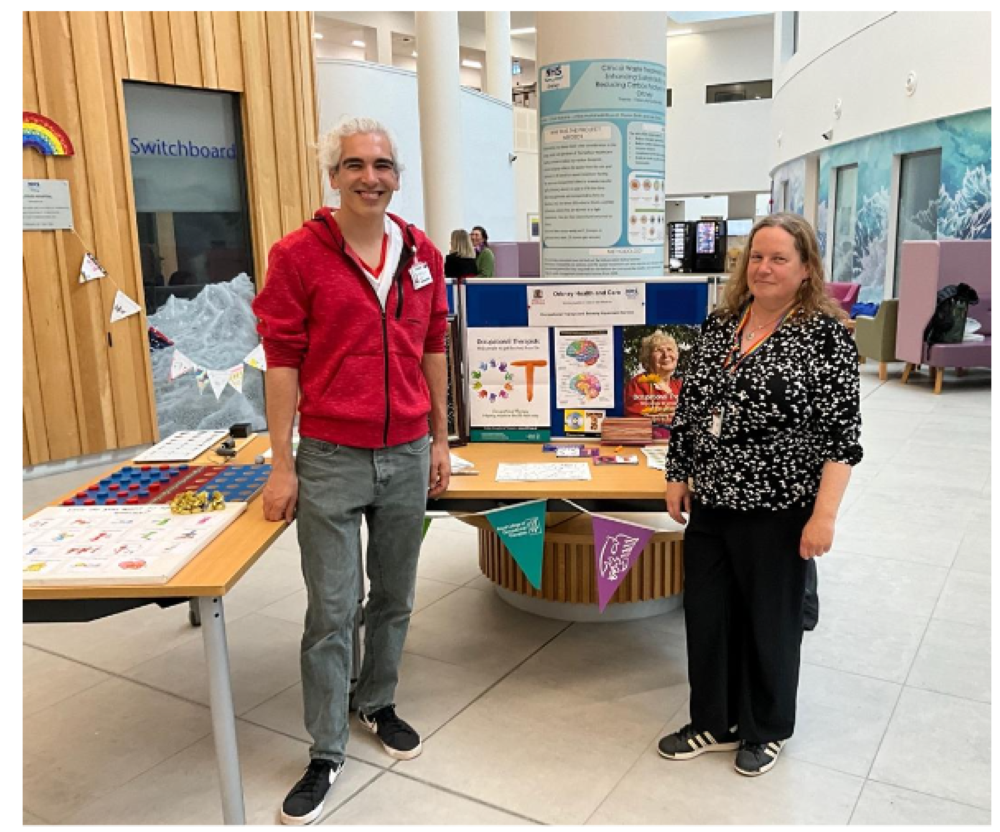
Occupational Therapy (OT) provided what seemed to be interesting games but which were actually tools used in the assessment of the ongoing rehabilitation of stroke and mental health patients. I was surprised to find out that in OT training they not only cover OT itself, but this also includes Mental Health training. Therapist Ruth Lea told me how the skills developed by Mental Health training can help greatly in helping patients being treated within the OT discipline. The games on display help therapists to time reactions to accomplish mental tasks which are timed and also to assess precision or lack of in physical skills.

In the former, a randomly mixed up selection of red and blue shapes have to be placed accurately within their corresponding holes in a board, and the time taken to do this is measured. This has two elements, both the mental act of distinguishing between the two and then the placing in the correct coloured area. The time taken will decrease with improvement. The latter test is basically a form of the ‘Operation’ game, where the patient has to place a pen in the middle of a series of holes which decrease in size, but without touching the sides. Touching them produces an electronic buzz. Again, this is timed, and improvement in post-stroke patients can be shown.

Most attention of the day seemed to be at the Laboratory stand, well manned by four Biomedical Scientists (BMS). There were free comics, badges, post-its and pens for children, an opportunity to see blood and bacteria through a high powered microscope, and throughout the event the staff were busy describing what their work involves and fielding answers to questions from visitors. There was an opportunity to do a few basic tests, see what units of blood for transfusion look like and many other activities.


Questioned about the Laboratory’s role within the hospital, Laboratory Manager Lorna Wilson said “our testing assists in the diagnostic process. Despite the fact that it is vital we are not as visible as others because we are not patient-facing”. This statement is perhaps somewhat understated, as without a 24 hour Laboratory service on site The Balfour would be downgraded to a community hospital, losing Maternity and A&E services as a result.
Festival sponsors and Balfour Facilities Managers company Robertson, who have a 25 year contract with The Balfour, were also on hand to show off some of their work in what is Scotland’s first Net Zero hospital, and provided free tea, coffee and biscuits in the foyer.

Julius Garrett, technical Facilities Manager with Robertson, described the many innovative and cost-reducing features that had been built into the new hospital.
Fossil fuels are not used in the normal operation in this Net zero hospital, with air-to- water heat pumps and the 1200 square metre Rooftop Photovoltaic (solar panels) Array providing all power. Air Conditioning uses the Mitsubishi City system, which can both heat and cool via the air conditioning splits. LED lighting is used throughout, and can be used in several ways, including being dimmed when not in use or switching off until there is motion detection. Underfloor heating, which is more efficient at lower temperatures, is used in many parts of the building. Ventilation uses electronic commutation in the generator, removing the physical brushes which wear out in other systems, and also removing a step in AC-DC conversion process, making it much more efficient. All the innovation within The Balfour has resulted in more efficient systems with savings in energy costs.
Overall, the day was very successful and was a great opportunity for Balfour Departments to connect with the public. It is unfortunate that more did not take this opportunity to do so, and hopefully this event may continue and expand to include even more departments showing what they do in years to come




Leave a Reply