
By Eamonn Keyes
September 8th. The Orkney Club, Kirkwall.
With its myriad events scattered over various venues The Orkney Science Festival requires a huge amount of preparation to run as it should, and both the organisers and the volunteer staff deserve massive praise for the effort they put in to ensure that this is almost always the case.
Behind the scenes, however, there is sometimes an atmosphere of panic as entropy intervenes on the night and things don’t go as they should, but the audience is usually unaware of this.

This event was to follow a concert in St. Magnus Cathedral by organist George McPhee joined by the Mayfield Singers and marking his diamond jubilee as organist at Paisley Abbey.
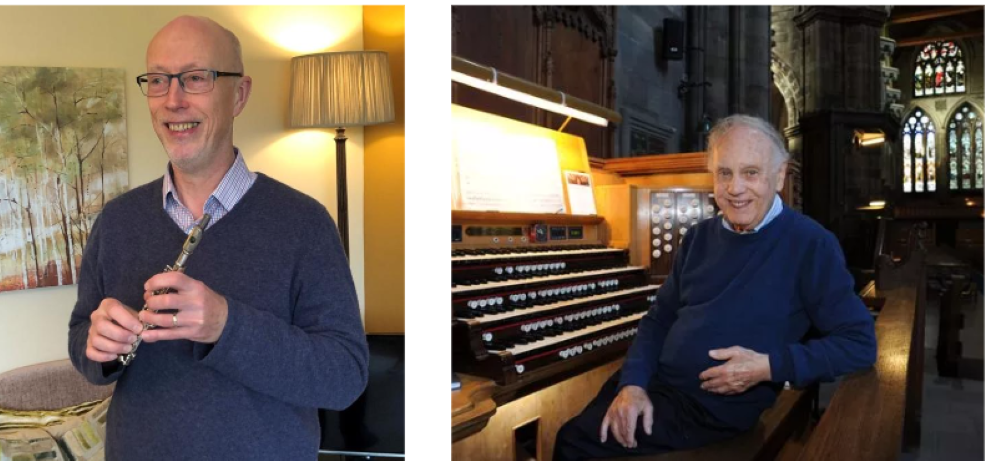
George was to join Scottish Opera flautist Ewan Robertson in conversation to reflect post-concert on what makes the pipe organ capable of producing such glorious music.
However, following an onset of illness George McPhee was unable to make the event, and so Ewan Robertson was left with the unenviable dilemma of what to do to ensure the event went ahead.
Ewan took the stage, calm and unflappable, and informed the audience of the loss, and had decided to maintain the concert mood by playing recorded works, all except one either written by or directed by George. The first piece played was Duruflé’s ‘Suite Pour Orgue Opus 5 Toccata’.
Ewan informed me that he wanted it to be loud to carry the power of the instrument, so I set the sound desk volume to 11, unprepared for what was to come.
This is an astonishing piece, sweeping through modulations and dynamics. It is hard to believe that anyone would be capable of the dexterity required and the complexity involved. For a few moments I had a mental picture of it being played by an enraged octopus being poked repeatedly with a stick.
After this musical blitzkrieg Ewan calmed the audience with George’s ‘Prelude on Bunessan’, featuring the music better known to most as ‘Morning Has Broken’ but beautifully arranged and performed, as were all the following pieces, by organist David Gerrard and the Choir of Paisley Abbey, where the recordings were made.
The choral pieces, the canticle ‘Benedictus es Domine’ and Robert Johnson’s organum ‘Gaude Maria Virgo”, then followed, both sounding splendid in the natural reverberation of the acoustic space of Paisley Abbey, and with the polyphony in the latter piece superbly performed.
Another Johnson composition, ‘Benedicam Domino’ was next on Ewan’s playlist, and as with the previous piece it was a joy to hear in the performance of its polyphony.
The next piece, James Mac Millan’s ‘Chosen’ came with a warning from Ewan to prepare us for it. This piece was written by composer James Mac Millan in 2003 for George McPhee’s 40th anniversary as Director of Music at Paisley Abbey in Scotland. However, I felt this was a very accessible piece, and it was possibly the one I enjoyed most despite never having encountered it before.
Ewan Robertson himself then had a chance to shine, as we listened to him play bass flute on ‘Ascension’ from ‘3 Donne Lyrics’ written by frequent OISF guest and virtuoso Eddie McGuire, who I shared a few drinks and an excellent conversation with during the previous year’s Festival. Eddie’s talent never fails to surprise me, and I love his compositions and performances, and this piece was beautiful.

‘Adam Lay Ybounden’ by Inverness composer Stuart MacRae was the penultimate piece of the night. Originally commissioned by the Royal School of Church Music Scottish Committee, I found this to be a soothing composition basically of acappella chorus with an occasionally dissonant but haunting organ. It was premiered in Paisley Abbey in 2003.
The evening ended with George McPhee’s ‘Trumpet March On Highland Cathedral”. This features a solo organ arrangement of the famous piece, and is grandiose and confident, a fitting end to an interesting yet unexpected deviation from the original talk. Ewan Robertson ensured that the music did the talking.



Leave a Reply