
By Eamonn Keyes
September 6th. The Orkney Club, Kirkwall.
The archives of the Royal Astronomical Society (RAS) contain many treasures pertaining to the early days and development of astronomy and geophysics over the centuries, and to that end both Dr. Sian Prosser and Dr. Sue Bowler brought us on a tour of some of these remarkable items.
The Royal Astronomical Society was founded in 1820 and encourages and promotes the study of astronomy, solar-system science, geophysics and closely related branches of science. The Society’s apartments in Burlington House are situated off London’s Piccadilly. It was originally the ‘Astronomical Society of London’ which was conceived on 12 January 1820 when John Herschel and Charles Babbage organised a dinner with twelve others. John Herschel was the son of William Herschel, the discoverer of Uranus, and was also an astronomer and scientist. Charles Babbage was a mathematician, philosopher, inventor and mechanical engineer, and in the 1830s Babbage originated the concept of a digital programmable computer.
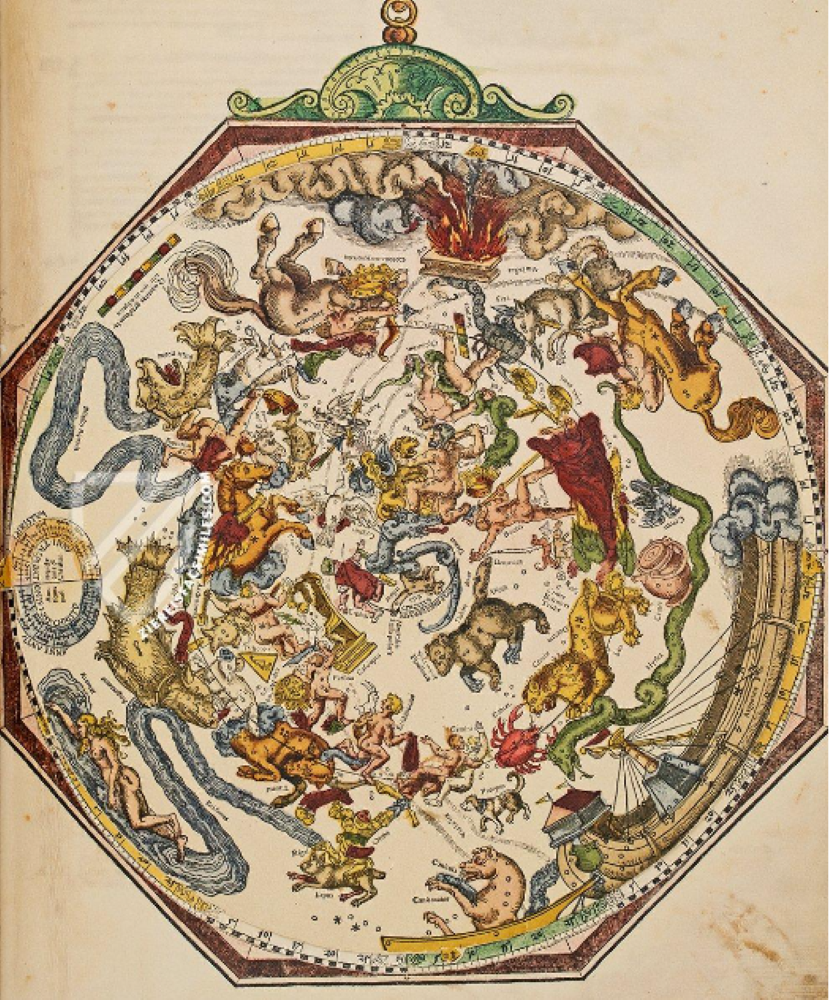
During the talk we were treated to many of the illustrations featured in these tomes, beautifully made, often with wood cuts and hand coloured.


The books and illustrations took us through the years of discovery in astronomy, from when the Earth was thought to be at the centre of the universe right up to and including the works of Galileo Galilei, Tycho Brahe and Johannes Kepler, the fathers of astronomy.
Sidereus Nuncius (usually called Starry Messenger ) was a short astronomical treatise published by Galileo Galilei on March 13, 1610. It was the first published scientific work based on observations made through a telescope, and it contains the results of Galileo’s early observations of the imperfect and mountainous Moon, of hundreds of stars not visible to the naked eye in the Milky Way and in certain constellations, and of the Medicean Stars, named in honour of his patron Cosimo II de’ Medici (but later renamed as the four Galilean moons) that appeared to be circling Jupiter.

The reactions to Sidereus Nuncius, ranging from appraisal and hostility to disbelief, soon spread throughout Italy and England. But many individuals and communities were sceptical. A common response to the Medicean Stars was simply to say that the telescope had a lens defect and was producing illusory points of light and images; those saying this completely denied the existence of the moons.
The book also contained his controversial drawings of what he had seen with his telescope when he turned to the Moon.

Galileo’s drawings of an imperfect Moon directly contradicted Ptolemy’s and Aristotle’s cosmological descriptions. Before the publication of Sidereus Nuncius, the Catholic Church accepted the Copernican heliocentric system as hypothetical. However, once Galileo began to speak of the Copernican system as fact rather than theory, it introduced “a more chaotic system, a less-than-godly lack of organization.” In fact, the Copernican system challenged Holy Scripture, “which referred to the sun ‘rising’ and the earth as ‘unmoving.’” The conflict ended in 1633 with Galileo being sentenced to a form of house arrest by the Catholic Church.

Dr. Sue Bowler then took the stage, and displayed a number of images based in geophysics, including a drawing from a photograph of the eruption of Krakatoa in 1883, made for the Krakatoa Committee of the Royal Society. The photograph had been taken on Sunday, 27 May 1883,at an earlier stage of the eruption before the island exploded exactly three months later on August 27th, with catastrophic effects resulting in 36,000 deaths and the destruction of 70% of the island of Krakatoa, with its surrounding archipelago collapsing into the caldera.
It was the loudest explosion in recorded history, ushering in earthquakes, tsunamis and unusual weather events that impacted all across the globe.

The images were many and always interesting, showing how far scientific thinking has come in each century up to the present. It was also interesting to see that the many keen scientific minds involved in these advances were not only specialists in one discipline, but were true renaissance men, versed in many scientific pursuits and making strides forward in many of them.
For example Edmond Halley, the discoverer of the most famous comet in astronomy, also made significant discoveries in the fields of geophysics, mathematics, meteorology and physics. And of course the RAS had an example of this other work, which was included in the talk.

Halley had noticed the deviation between true north and magnetic north, and to aid nautical navigation starting to plot all the points where the deviations stayed the same. He then joined these points up in 1700, and the result in shown in the photo above. What he didn’t know was that with this chart he was actually starting to show the lines of the Earth’s Magnetic Field, the first time this had been done. It also inspired later ideas such as those of isotherms by Alexander von Humboldt in his maps to show the depth of seas.
A thoroughly enjoyable and enlightening lecture with excellent use of imagery from the RAS archives.

Dr. Sian Prosser has been Archivist and Librarian at the RAS since 2014. The Archives and Library contain a vast collection which includes books, manuscripts, photos and instruments dating back to the 15th century.
Dr. Sue Bowler is the Editor of the Royal Astronomical Society’s magazine ‘Astronomy & Geophysics’. She is an experienced editor and writer with a 30 year history in science research communication, in astronomy, geophysics, geology and general physical sciences, and teaches at the University of Leeds






Leave a Reply