
By Eamonn Keyes
September 5th, The Orkney Club, Kirkwall.

Astronomy might seem an easy subject to communicate to an audience.
It isn’t.
There’s a delicate balance between speaking about the imagination-provoking, wow-making descriptions and possibly invoking the eventual turn-off factor of merely listing figures, distances and numbers that no human has ever experienced. Especially when we are talking about places we can’t really see, can’t ever go to, and whose dimensions and possible conditions we actually can’t properly conceive.
Just like exoplanets, which are planets outside our relatively cosy solar system.
When I first became magnetised to astronomy I was about 5 or 6.
We had nine planets, and that was your lot.
Astronomers surmised that there were probably others, but without any evidence and with religion and philosophy extolling the uniqueness of mankind it was a battleground of hazy concepts, ideas and probability that centred around the Drake Equation, which as astronomy progressed was expanding but was still just as hazy as the arguments.
The equation was formulated in 1961, just as I was finding astronomy, by Frank Drake, not for purposes of quantifying the number of possible radio-communicative planetary civilizations, but to stimulate scientific dialogue at the first meeting of the Search for Extra-Terrestrial Intelligence (SETI). It is more properly thought of as an approximation than as a serious attempt to determine a precise number. The estimated ranges for several of its factors are so variable that the equation cannot be used to draw any firm conclusions. The really dedicated reader can find out more about the Drake Equation here.
The search goes on for radio signals from intelligent life around the universe, but with the exception of the thought-provoking ‘Wow!’ signal in 1977, the universe is blanking us.
Read all about the ‘Wow!’ signal here. Sci-Fi fans especially.
Anyway, back to me. Whilst growing up I received the latest astronomy news via the Sky At Night, usually shown at way past bedtime o’clock, and hosted by the twitching phenomenon that was Sir Patrick Moore, dressed as if he had just been catapulted through a charity shop window and had emerged covered in the contents.
I had grown to manhood in a nine planet universe, but in 1992 my world was turned upside down. We discovered not only the first exoplanet, but the first two together. They were named Poltergeist and Phobetor were found orbiting a pulsar with the catchy name of PSR B1257+12, and in 1994, a 3rd planet was found in the system and named Draugr.
To date 5,500 exoplanets have now been found, with others being added constantly.

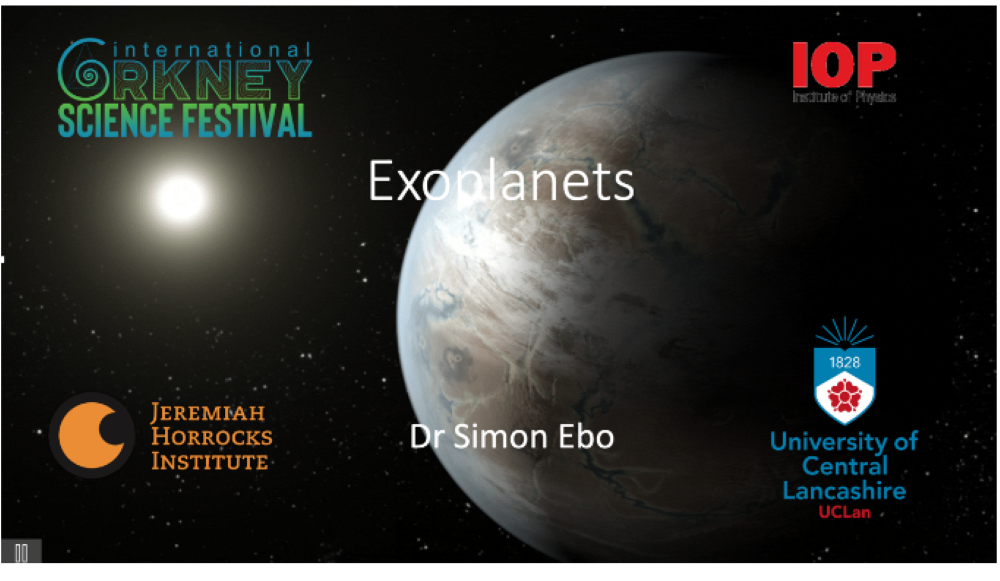
This search was Dr. Simon Ebo’s chosen topic for tonight’s second talk. Astronomers are usually a hybrid mix of cool and nerdiness, but generally all the cool ones are called Brian and play in bands. Simon is much more the former as he takes the stage, particular as he looks as if he could easily be a metal band lead guitarist, and it becomes evident that he has a quiet confidence with an audience. He defines what an exoplanet is and talks briefly about our solar system’s planets and the removal of Pluto from the astronomical pantheon.

Scientific talks, by their nature, fall into two categories.
The first is where the lecturer does his thing without interruption and there’s time some at the end for questions. My issue with this is that a term or concept that is unfamiliar to an audience will pass without clarification, possibly undermining the intrinsic value of the subject for them. The second is a dialogue, where questions arise spontaneously from an audience, are answered as they come up, but without necessarily interrupting the subject’s flow. I’m a fan of the latter, as to me a talk or lecture should be a conversation, and this is what Simon Ebo does, giving a free and easy exchange with the audience and thereby enhancing the mood of the talk and relaxing his audience. No everyone can do that.

Then on to the Drake Equation, and the fact that the range of possible values for contactable civilisations can range from a rough maximum of 15 million to a minimum value of just one, meaning we are alone in the universe. Once he talks about the possible number of exoplanets based on the number of stars in the universe the numbers first astonish then become literally incomprehensible.
Launched in 2009, the Kepler space telescope was NASA’s first planet-hunting mission, assigned to search a portion of the Milky Way for Earth-sized planets orbiting stars outside our solar system. During its nine year life Kepler showed our galaxy contains billions of hidden exoplanets, many of which could be promising places for life. They proved that our night sky is filled with more planets than even stars.

Analysis of Kepler’s discoveries concluded that 20 to 50 percent of the stars visible in the night sky are likely to have small, possibly rocky, planets similar in size to Earth, and located within the habitable zone of their parent stars. That means they’re located at distances from their parent stars where liquid water – a vital ingredient to life as we know it – might pool on the planet surface. The discoveries were detected by using the Transit Method, one of three methods used to detect exoplanets, and the method which has detected most to date.

The Transit Method reveals an exoplanet when it crosses in front of or transits its star. It’s detected by the light from the star dimming very slightly as the planet crosses its face, blocking out some light. This dimming can be seen on light curves – graphs showing the light received here on earth from the star over a period of time.

Several entire solar systems have also now been discovered, and comparisons with our Solar System show some contain planets-3 of them in the ‘Goldilocks’ zone-marked in green on the picture below of the Trappist-1 system, where it might be viable for life to begin and evolve.

From the exoplanets discovered by Kepler to date it appears that the most common planets are ones bigger than Earth, called Super Earths, with a mass up to 10 times that of Earth but smaller than Neptune, which has a mass 17 times greater than Earth’s. One of the greatest surprises was that most stars are binary systems featuring two stars or even multiple stars. Single stars such as our Sun only account for 15% of star systems.

The second way to discover exoplanets is by Radial Velocity. This relies on the fact that a star does not remain completely stationary when it is orbited by a planet. The star moves, ever so slightly, responding to the gravitational tug of its smaller companion. When viewed, these slight movements affect the star’s normal light spectrum, or colour signature. The spectrum of a star that is moving towards the observer appears slightly shifted toward bluer (shorter) wavelengths. If the star is moving away, then its spectrum will be shifted toward redder (longer) wavelengths.
By using highly sensitive spectrographs attached to ground-based telescopes, we can track a star’s spectrum searching for any spectral wobbles. The spectrum appears first slightly blue-shifted, and then slightly red-shifted. If the shifts are regular, repeating themselves at fixed intervals, it is almost certainly caused by a body orbiting the star, tugging it back and forth over the course of its orbit.
The third method, Direct Imaging, is very exciting, as we can now actually see the exoplanets themselves. Infrared light is used as it detects heat rather than visible wavelengths. Planets can be billions of times dimmer than their host stars, so they’re usually lost in the glare. But by blocking the star’s light using a coronagraph or starshade, astronomers can image fainter planets in orbit. This technique works best for young, nearby planetary systems, whose planets are especially bright. These worlds are typically super-Jupiters that are less than a hundred million years old – so young that they’re still glowing from heat leftover from their formation, which makes them detectable in infrared light. They also tend to be very far away from their host star because it’s easier to block the star’s light and see planets in more distant orbits.
By studying real images and spectra of exoplanets, astronomers can find out what the planets’ atmospheres are made of. This, in turn, can offer clues about the processes occurring on the imaged worlds, which can affect their habitability. Studying exoplanet atmospheres could even reveal signs of life since living things modify their environment in ways we might be able to detect, such as by producing oxygen or methane.

This was an extremely interesting talk by Dr. Simon Ebo, covering the progress to date and received by an appreciative audience. This is an ideal outreach subject, suitable even for a younger audience and certainly not pitched at too high a level for those with a more casual appreciation of astronomy, as well as providing room for questioning from those with a higher level of understanding.






Leave a Reply to berniebell1955Cancel reply