
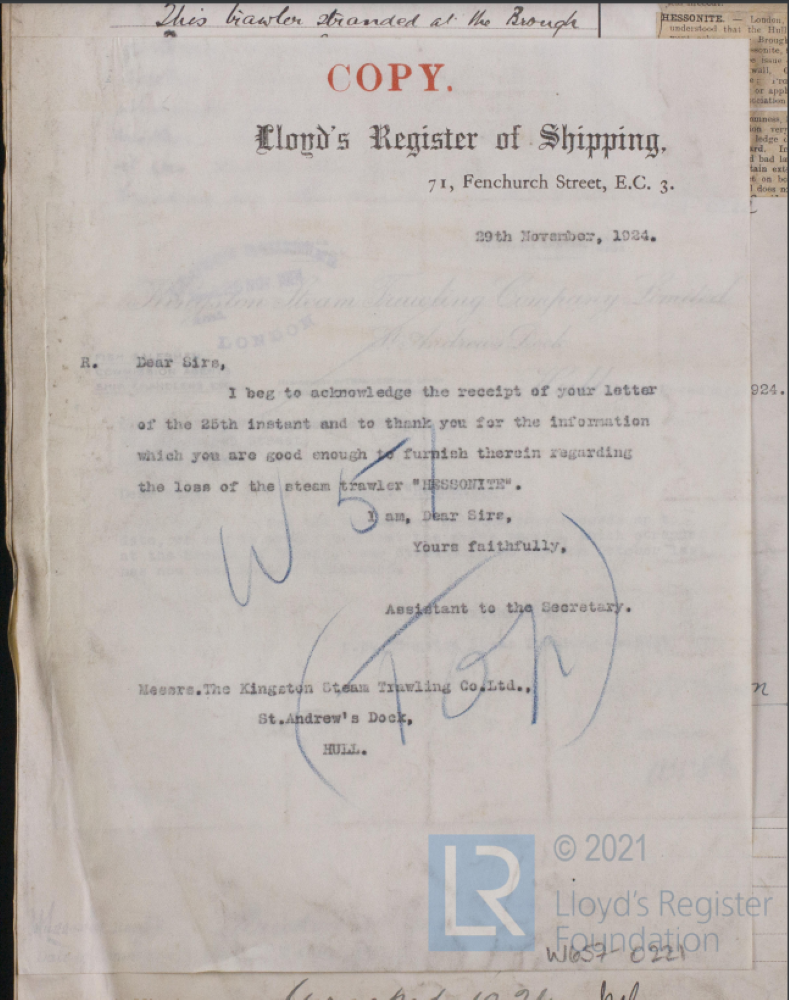
The Hessonite was a trawler which ran ashore on the North Side, Birsay on 4th October 1924. The crew of 10 were all saved by the actions of the local community, the Stromness Lifeboat, and the Rocket Brigade. The trawler lay on the rocks at Hellyalonga about a mile east of the Brough of Birsay for some time.

On 8th of October 1924, The Orkney Herald ran the following report:
The steam trawler Hessonite, H222, Capt. William Garner, on a passage from Faroe to Hull with a cargo of fish of the value of about £1500, stranded on the rocks of Hellyalonga, between Skipgeo and Costa Head, about 2.20am on Saturday morning during a dense fog. Fortunately there was little or no wind and the sea was smooth at the time.
The trawler’s whistle was kept blowing which attracted the attention of people residing in the neighbourhood and they at once sent a telegram for the Stromness lifeboat and Rocket Brigade, which message was received at Stromness shortly after 4 am.
No time was lost in getting the lifeboat crew and the Rocket Brigade together. The lifeboat was the first to leave for the stranded vessel, and the Rocket Brigade followed in a motor ‘bus and were the first to reach the vessel, with what communication was at once established, but the crew resolved to wait the arrival of the lifeboat which took them off and landed them at Stromness shortly after 10 am.
Although the crew on this occasion preferred the lifeboat, the Rocket Brigade rendered valuable services, and deserves the highest praise for their smartness in establishing communication with the vessel.
The Rocket Brigade desire to thank Mr Spence, Hyon, Birsay, for so kindly guiding the motor lorry, laden with the Rocket apparatus over the fields to the scene of the wreck. They also thank the ladies who so liberally provided them with tea and sandwiches.
For many years past it has been felt that the wagon provided by the Board of Trade for transporting the Rocket apparatus is out of date especially when a distance of 15 miles of more has to be covered in order to reach a wreck, and that a suitable motor lorry should be substituted for the reason that time is lost in transferring the Rocket apparatus from the wagon to any lorry that may be hired for the occasion. And time means so much in effecting a rescue from a shipwrecked vessel. The general feeling in Stromness is that the Town and County Councils should petition the Board of Trade and endeavour to get the latest and best conveyance possible in order to save shipwrecked men round our shores.
The Royal National Lifeboat Institution, kept up by volunteer subscriptions, are endeavouring to get the best lifeboats possible, but the Board of Trade continue their niggardly system of doing as little as possible to assist Rocket Brigades, not only in Orkney, but all along our coasts.
The wrecked trawler was visited on Sunday by a number of people from Stromness, who report that the vessel has been washed higher up on the rocks, which are large and flat as a table. So far as is known, she is undamaged and it is hoped to salve the vessel should the weather keep favourable. We understand the vessel is so close in to the cliff edge that she cannot be seen from above.
What was a Rocket Brigade?
The job of the Rocket Brigade was to attach a line from the beach to a distressed vessel in order to enable a ‘breeches buoy’ or other device to be hauled to the ship and return passengers and crew safely to the shore. They were located in many coastal communities. For example, the Newcastle Rocket Brigades were in operation from 1866 until 1974, often working alongside the lifeboat crews, and were a crucial part of trying to save the lives of those on board vessels that foundered along the coast.

The skipper of the trawler Hessonite, W. Garner, wrote a letter to the local press in Orkney expressing his thanks to all who had helped when the vessel stranded: to the people of Birsay and Stromness, and to the Rocket Brigade ‘who would have certainly have saved us if the lifeboat had been unable to reach us.‘ He also expressed his thanks to the lifeboat crew ‘who had great difficulty in finding us on account of the fog.’ (The Orkney Herald 22 October 1924).
The East Coast Salvage Company of Dundee were engaged to salvage the Hessonite. After going on board it was found that the vessel was undamaged. Wires were attached in readiness to refloat her when the weather was suitable. The cargo of fish was thrown overboard having been there for three weeks. (The Orkney Herald 29 October 1924.) Bad weather put paid to that plan with heavy seas breaking over the vessel and deck fittings breaking adrift. The vessel was abandoned by the Kingston Steam Trawling Company and declared a total loss.

The wreck of the trawler Hessonite was recorded on film and was presented by The Electric Theatre, Kirkwall at the Evie Drill Hall on November 4th along with other films for an admission of 1 shilling and 2 pence, or a sixpence for children.
The kindness of other community organisations in Orkney was further recorded by The Shipwrecked Fishermen and Mariners Society who received a letter from Mr J.W. Lown of the Kingston Steam Trawling Company, Hull. He wrote:
“When making up the accounts…we found that, with the exception of two days, the expense of boarding and victualling the crew during the period of their stay was born entirely by your association. We realise that if it had not been our decision to keep the men at Stromness they would have been sent home at an earlier date, and we shall therefore be pleased to settle your account for the expense of maintenance up to the time of their departure…We take this opportunity of thanking you for your kindness to the men on this occasion, and of recording our appreciation of the excellent work which has been and is being done by the Shipwrecked Mariners Association.”
Today we no longer have a Rocket Brigade but we do still have the Stromness RNLI Lifeboat and HM Coastguard Orkney and Shetland. And the Shipwrecked Mariners Society continues to help seafarers and their dependents.

Fiona Grahame




Leave a Reply