
In this series during Book Week Scotland we are looking at libraries, their past, present, and how they are adapting to the needs of the public.
Schools should all have provision for a library. Some teachers even make space in their classrooms for libraries and story corners. Unfortunately these come and go as the whims of curriculum fancies dictate but for some children being able to sit in a quiet space with a book which they read for their own pleasure may only be found in school.
Many teachers bring in their own books for the class library, ones perhaps they also enjoyed reading when they were younger. Public libraries may also provide a box for use in the classroom through The School Library Service.
James Coats jnr and School Libraries
The island of Gairsay, most famous as the place where Svein Asleifarsson – Orkney’s Last Sea Wolf, had his base, once had a enough families living on it that it had a school, sadly no more. Many schools depended on charitable benefactors to provide them with extras – like books and materials – which were not usually provided for by the public purse. In the summer of 1910 the school in Gairsay was delighted to recieve a bookcase and 200 books from Mr James Coats jnr, Ferguslie House, Paisley.
The teacher, Mr Jopp, described James Coats, who also donated school bags, as ‘one of the greatest educational builders of our own time’. The library consisted of books on science, the arts, and of particular note by Mr Jopp, poetry. James Coats was of the family firm, J and P Coats, thread manufacturers who became well known for being benefactors in a variety of causes.

J and P Coats also donated a library of books to the Stronsay School in 1908 which you can read about here:
Sellibister Public School in Sanday received a bookcase of books from James Coats jnr, ‘a special pointer for use in school, large wall maps of Scotland, Orkney, and Shetland, and a fully detailed map of Scotland.
Ten volumes of Harmsworth’s Encyclopaedia were gifted to The South Public School, Eday, from James Coats, along with a bookcase. It was felt that these reference books would not only benefit the school but the whole community. These were illustrated encyclopaedias, ‘Everybody’s book of reference.’
Flotta Public School received a bookcase from James Coats jnr, 160 books and 4 maps . The Orkney Herald of October 1906 reports that it “prove another incentive to advance still further in all that makes towards a good school.’
Although with larger populations than today, these schools were still small and donations of books would be a great boost to everyone in the community.
Schools would also hold their own fundraising events.
In 1898, Stromness Public School held two Christmas entertainments in the Drill Hall which included a lot of singing and recitations to raise money to establish a library in the school.
In 1892 the Harray Public School gave a performance of their previously successful kinderspiel concert with the proceeds going towards buying Cassell’s National Library of 208 volumes ‘bound in cloth.’
Henry Morley, Professor of English Literature at University College, London, became an important editor for Cassell. His focus was on popularizing literature, and he applied Cassell’s serial publication approach to a vast range of literary works. Morley edited the popular Cassell’s Library of English Literature, which consisted of summaries and edited literature with commentary, issued in seven penny parts then sold in clothbound form.
Morley “scored yet another success for Cassell with Cassell’s National Library, published from 1886 to 1890 in weekly parts selling at three- or sixpence each, depending on the quality of binding. Like most of Morley’s endeavors, the National Library cast its net widely, taking in ‘Standard Works in every Branch of literature, including travel, biography, history, religion, science, art, adventure, fiction, drama, belles lettres, and whatever else may be worth lasting remembrance.’” The titles were sold in the U.S. for 10 cents (paper) and 20 cents (cloth). Cassell’s National Library
Public lectures were popular events in Orkney and in 1888, a series of talks were held in the Dounby Public School with the proceeds going towards books for the school library.
A Library Service for Everyone
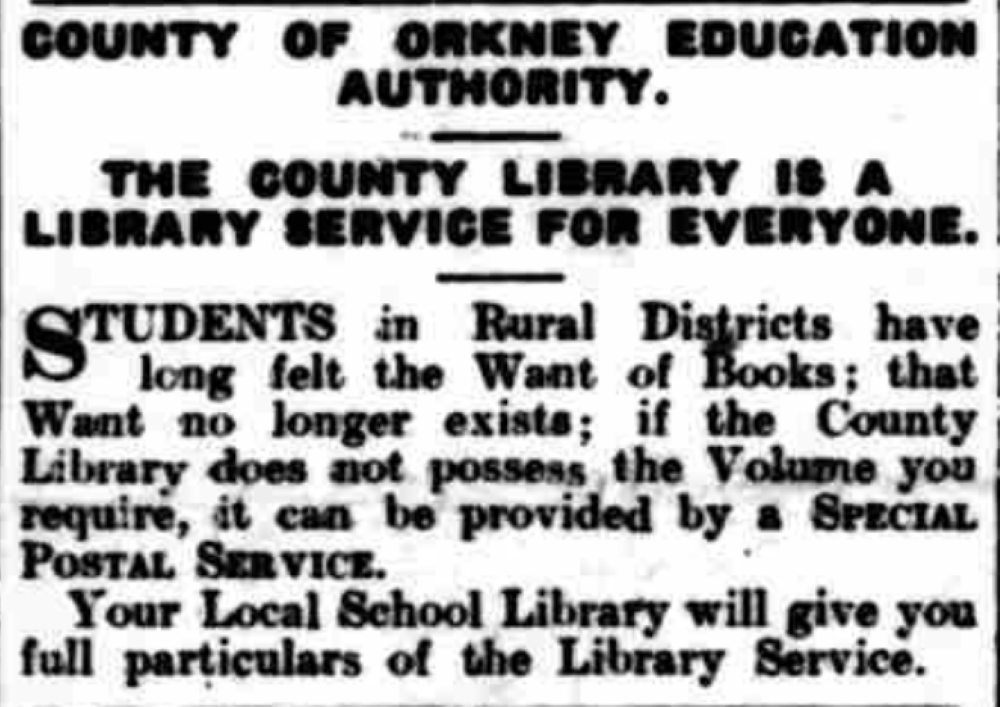
In the early 20th Century, The Orkney Library would provide, as this advert in The Orkney Herald of 31st October 1928 declares, books which any student in the islands might have trouble getting:

“The county library is a library service for everyone. Students in Rural Districts have long felt the Want of Books; that Want no longer exists; if the County Library does not possess the Volume you require, it can be provided by a Special Postal Service. Your Local School Library will give you full particulars of the Library Service.”
The type of books donated were very much a reflection of the times and those of the benefactor. In 1904, the Scottish Unionist politician Sir Henry Craik’s donation of books to the Burgh School Library, Kirkwall, included ‘A Series of Selections from English Prose Authors’ in 5 volumes which he himself had edited. He also gifted a copy of his own book ‘ A Life of Swift’, of which there were two volumes.
Today as more libraries are closed or put under threat of closure, and schools shift every increasingly into using digital formats, the purchase of books has become a price many schools are no longer willing to invest in. Even the space for the class library and story corner is squeezed out for the IT equipment. There should always be room for a bookcase in the busy classroom where a child can browse and select a book of their choice to read – purely for the pleasure of it.
Books must be treated with respect, we feel that in our bones, because words have power. Bring enough words together they can bend space and time. Going Postal, Terry Pratchett
Fiona Grahame


Leave a Reply