
By Ian Cooper.
From his excellent series, Records of a Bygone Age, published in The Stronsay Limpet, and shared here with their kind permission.
Contagious disease continued to be an all-too-common part of school and island life, with Scarlet Fever rearing its ugly head once more at the end of June 1918. The school was closed on 5th July to help prevent the spread of the fever and was to remain so for some time, only reopening on 2nd September.
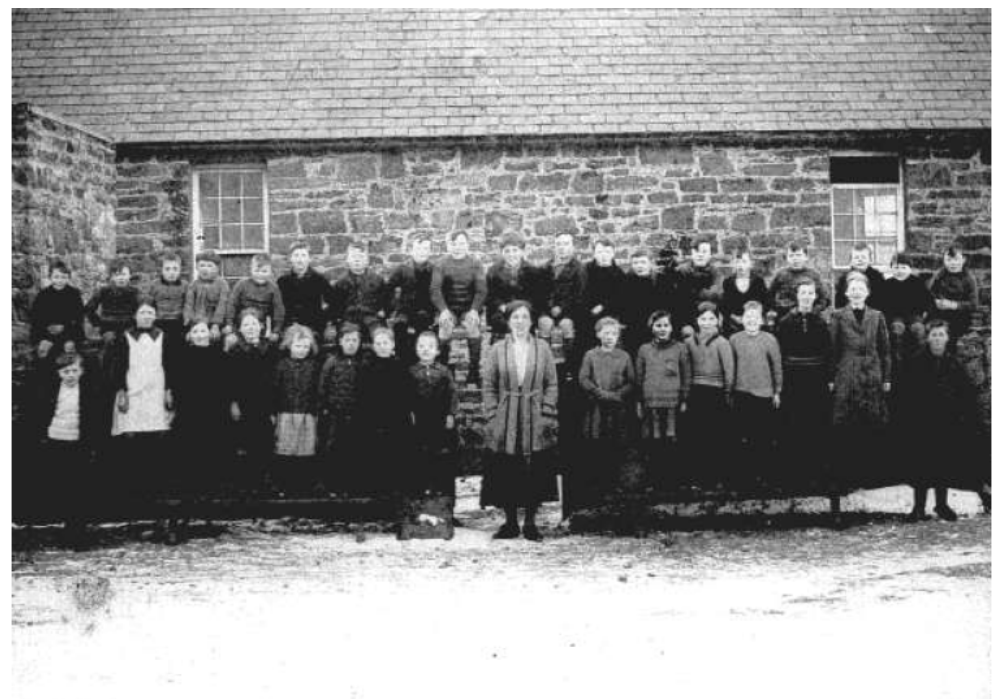
More illness was soon to follow as Spanish Flu, reputedly the cause of 40 million deaths worldwide, eventually reached Stronsay. All island schools were closed from 4th December until early in the New Year but even so seven islanders were to lose their lives in the epidemic before Christmas, including 9-year-old South School pupil Janet Cooper from Holland. Schools reopened on 6th January 1919 but, with a fresh outbreak of influenza in the New Year, the school was again closed from the 8th to 13th January and then, with the epidemic flaring up once more, was shut from 19th February to 17th March during which time the flu claimed another two victims. Even then when the school reopened the fear of the disease meant that only 3 pupils turned up that first day and it was to be the end of April before the epidemic was finally over. The school roll at that time was 33.
Scarlet Fever struck the island once again in February 1920 but, although one little boy in the island was to die from the disease the following month, the school seems to have remained open throughout.
A request for the use of the school for a wedding on the evening of 25th February was granted and the school was closed all that day to allow for preparation. This marriage was between William Cooper of Dale in Stromness and Isabella Maxwell from the Myres.
County Medical Officer Dr J R Adam inspected the school in September 1920, with his report stating that
“The present heating arrangements are insufficient. I would suggest that a large circular stove be placed in the centre of the room and the flue carried straight up through the roof ventilating aperture. The two classes could then be arranged facing the stove and on either side of it and the children would be in the correct light for writing instead of as at present with the light at their backs and in their faces. In the absence of a shelter the children should have access to the schoolroom in wet weather. School cleaning is satisfactory, but the pail closets should be emptied thrice instead of twice weekly.”
Some of those recommendations were acted upon fairly quickly and, at the opening of the new term in January 1921, a new stove had been installed as recommended by the medical officer. On its first day of use the school had to be dismissed early due to the fumes given off by the new stove and pipework but, after this initial problem, it seemed to work satisfactorily, at least for a time. No indication was given on whether the pail closets were, in fact, emptied more frequently following this inspection!

The school was dismissed at 10 o’ clock on 21st November 1922 to allow pupils to attend a large farm dispersal sale at Airy. This estate had quite an interesting history, having been in the ownership of the Fea family for several generations. On the death of the last of this family, spinster sisters Barbara and Helen Fea, in 1818 their Airy estate had been left to the Stronsay School, with the income from it intended to further the education of children from Stronsay and Eday. The farm had been managed by the School Board up until this time but, like many other estates of the time, was broken up with most of the crofts sold to the sitting tenants and the home farm of Airy sold to William Watt, a butcher from Stromness.
A young boy, 8-year-old James David Cooper, was enrolled at the school on 8th December. His family, after farming at New Holland in Holm for a number of years, had bought the farm of Cleat and returned to their native island to live, with their two older sons William and my father Sam being enrolled at the Central School.
An outbreak of whooping cough once more, this time in December 1922 and January 1923 affected many of the school pupils although this time the school remained open over the course of it.
We take a leap now to 1924 when, at a special meeting of the School Management Committee on 13th March, a parent was summoned to appear before the Committee for failing to send his son to school. In what appeared to be a stalemate, the parent would give the committee no definite promise that he would send his son to school in future. No further record of this appears so we’re left to wonder how or when this was resolved.
Around the same time Miss Fotheringhame noted in the log that good use was being made of the rural library and that ‘the encouragement given to home reading from the rural library is noted with satisfaction.’ This library may possibly have been one of the many gifted to schools by philanthropist James Coats, millionaire owner of the J & P Coats thread and weaving company of Paisley.

In addition to her teaching role Miss Fotheringhame had been caring for her elderly parents for some time, with her father James dying in 1921. Her mother Rebecca then passed away on 18th September 1924 and the school was closed on that date, reopening on 22nd September.
In a note in the log in October 1925 Miss Fotheringhame complained that ‘We have had a bad time this week with a smoking fire. The stove was shifted but all to no purpose.’ This badly smoking fire when the wind was in the east or south-east was to be a recurring theme through the entire life of the school, with no remedy ever to be found.
December that year saw an older boy re-admitted to the school. This was a young lad whose foot had been crushed in an accident with a reaper and who was unable to walk to the Central School.
The usual nature rambles continued in 1927, with a walk being noted in March which started from the school down to Housebay, then along the shore to the Crook Sand, on to Torness and the Test Hut and then returning to the school. This must have been a walk of around six miles, quite a trek for young children who had already walked to school and would have to walk home again at the end of the day. The roll at this time had fallen to 25.
The school was dismissed early on 17th November 1927 ‘to allow children to come back to see Commander Kilgour’s cinematograph.’ Commander Kilgour was Inspector of Coastguard Life Saving Apparatus for the Northern District and was happy to give exhibitions with his cinematograph (an early type of movie projector) as he did his rounds of the districts. This was his second display in Stronsay, the first being held in the school during a full gale back in January. This January meeting would undoubtedly have been the first time that the children, and probably most of the adults in attendance, would have seen moving pictures and was reported in the Orkney Herald of 2nd February as follows:

A HMI report in March 1928 again gave quite a favourable report of the school and the teacher:
‘The highest class varies in age, ability and attainment. The least satisfactory parts of the work were oral answering and written composition. A further effort should be made to secure a rational arrangement of matter and better connection of clauses. Arithmetic is quite well on and reasonably accurate. Handwriting and spelling are weak in a number of cases. The next class, a smaller one, made a better appearance and promises well. The younger classes are making good progress. The teaching is painstaking and faithful, and the tone of the school is pleasing. Serious physical disability has caused the more or less continued absence of two of the pupils on the roll; the attendance of a few of the others should be better than it is.’
The roll at that time had fallen once more, this time down to only 20, consisting of 16 boys and only 4 girls.
In what was a very worrying time for the island, the school was closed on 7th May 1929 due to a highly contagious disease affecting some in the community. It only opened its doors again on 27th May but even then, some parents were afraid to send their children to school because of the virus. It later transpired that the disease was in fact Poliomyelitis and had taken the lives of 3 people on the island while leaving a number of others with disabilities of varying degrees of severity.
Rambles and other activities continued play an important part in the school curriculum, with the older pupils visiting the Vat of Kirbuster for a nature study in May 1930. The afternoon of 25th June 1931 was spent in a field near the Central School where the SWRI provided a picnic for the children of all five schools, then in September a visit was paid to the Coastguard Watch Hut on Burgh Hill. Another school ramble to Lamb Head took place on 30th June 1933, where ‘the Juniors and Seniors spent the afternoon exploring the rocks and ruins at Lamb Head. They found many nests and curious stones and rock formations.’ The following year they were taken to the rocks below Kirbuster and along to the Brough at Burgh Head to see the birds and wild flowers.
Professor John Tait, a nephew of Alexander and George Tait of Midgarth, home on holiday from his post as lecturer at McGill University in Montreal, visited the school on 14th June 1934 to speak to the pupils about his time in Canada, also showing them three Texas rattlesnakes. These rattlesnakes were apparently preserved in a glass jar and when the jar was rocked they appeared to come alive. The rattlesnakes were left with some of Professor Tait’s relatives, the Pottinger family at Whitehall, and were a curiosity for quite some time.
The school closed early on 23rd January 1934 to allow pupils to attend the island ploughing match in a field near the school and then, on 6th May the following year, all schools were shut for a celebration to mark the Silver Jubilee of King George V and Queen Mary. This took the form of an island picnic and sports day at a field at Samson’s Lane, followed by tea for all in the Central School.
That same month all the pupils were taken to see the Coastguard Watch Hut on Burgh Hill, then on to the Brough at Burgh Head and along the cliffs to the Ram, a big sheep-like boulder that had been tossed up over an 18-metre-high cliff in a storm.
Then, in June 1936, another school outing took the pupils to Odiness Point to see the wreck of the steam drifter Rose III. This drifter had struck the rocks on Odiness Point in thick fog and, although the crew got off safely, the ship was a total wreck and the crew also lost some of their nets and personal belongings.
Also in 1936, in an attempt to cure the ‘bad vent’ causing smoke to blow back down the chimney, the fire and chimney were moved to the east wall of the school but apparently with little success as it was noted that ‘the smoke still comes out when the wind is in the east’.
In what was possibly a fairly innovative move at a time when parents were less than welcome in the school, Miss Fotheringhame organised a ‘Parent’s Day’, held on 20th October 1936, when the School Log tells us that ‘All the mothers came to see the school at work. The children had prepared a short programme of songs, recitations and physical exercises, the attendance prizes were presented and the school dismissed early.’
With smoke in the building still proving to be a problem it was noted in the log on 27th January 1937 that ‘We were forced to keep school in the kitchen today. The fire blew straight out.’ This appeared to be a continuing theme, with a record for 5th March stating that ‘Most of this week has been spent in the kitchen. The cold southeast wind makes the school too cold with open doors.’ Although the school roll had fallen to 15 by this time, this must have been quite a squeeze in the Schoolhouse kitchen! By 5th April the stove had been put back in its old corner and we are told ‘we can now shut the doors when the wind is in the east.’
Part 4 next month.
Leave a Reply