
Based on the global average temperature for the most recent 10-year period (2014- 2023), the Earth is now about 1.2°C warmer than it was in the pre-industrial era (1850- 1900). 2023 was the warmest year on record, with the global average near-surface temperature 1.45°C above the pre-industrial baseline. The period 2011-2020 was the warmest decade on record for both land and ocean. Climate Action Fast Facts, United Nations
Every nation will be, and is, significantly affected by climate change. The COP29 climate change conference has come to an end with the rich nations (and biggest polluters of the planet) pledging to contribute at least $300 billion annually to tackle the effects of the extreme weather events and rising sea levels. The amount pledged has been labelled insulting by many developing nations and island states.

Coastal and island communities are already facing the consequences of our continuing use of fossil fuels and failure to develop alternatives. Big money is dictating the future of the planet with short term financial gains dominating climate action plans, limiting the response needed to avert the climate disaster before us.
On an average day in 2023, nearly one third of the ocean was gripped by a marine heatwave. Over 90 per cent of the ocean experienced heatwave conditions at some point during 2023. Glaciers around the world thinned by an average of one meter per year and sea level rose at a rate of 4.5mm per year between 2011 and 2020. Greenland and Antarctica lost 38 per cent more ice during the period 2011-2020 than during 2001- 2010. Climate Action Fast Facts, United Nations

The Facts are frightening but world leaders of the rich nations procrastinate over policies, such is their devotion to fossil fuels.
Given the financial deal that the wealthy nations carved out at COP29, falling well short of the $1trillion that the developing nations and island states said was required, it is not surprising that the Alliance of Small Island States (AOIS) walked out of the talks, as the rich nations celebrated.
A representative from a group of small island nations said: “After this COP29 ends, we cannot just sail off into the sunset. We are literally sinking.”
The rising sea levels will be disastrous for all islands and coastal communities in rich and less developed nations.
Sea Level Rise
A new study published in Nature Climate Change estimates that a 1-meter sea level rise by 2100 would affect over 14 million people and $1 trillion worth of property along the U.S. Southeast Atlantic coast, from Norfolk, Virginia, to Miami, Florida.
Manoochehr Shirzaei , Virginia Tech’s Department of Geosciences, explained:
“The risk of flooding, compounded by sinking land and beach loss, could displace millions and damage critical infrastructure unless robust adaptation strategies are implemented.”
The key findings from the study are:
- Shallow groundwater hazards: By 2100, 70 percent of the coastal population will be exposed to shallow or emerging groundwater, a far more significant exposure than daily flooding. The research projects that this groundwater hazard will affect approximately $1 trillion in property value, creating new challenges for infrastructure such as roads, buildings, septic systems, and utilities.
- Storm-driven flooding: Coastal storms and hurricanes will amplify the risk of flooding over land. With 1 meter of sea level rise, overland flooding will affect up to 50 percent of residents in the region, impacting $770 billion in property value.
- Beach erosion and loss: The Southeast Atlantic region, known for its barrier islands and coastal ecosystems, could lose up to 80 percent of its sandy beaches with just 1 meter of sea level rise.
- Land subsidence: In addition to sea level rise, many areas along the Southeast Atlantic coast are experiencing sinking land, called subsidence, which exacerbates the effects of rising seas.
- Socioeconomic exposure: A significant portion of the population and property in the Southeast Atlantic will be exposed to multiple coastal hazards, which will disproportionately affect lower-income communities. As much as half the population in flood-prone areas will be ex
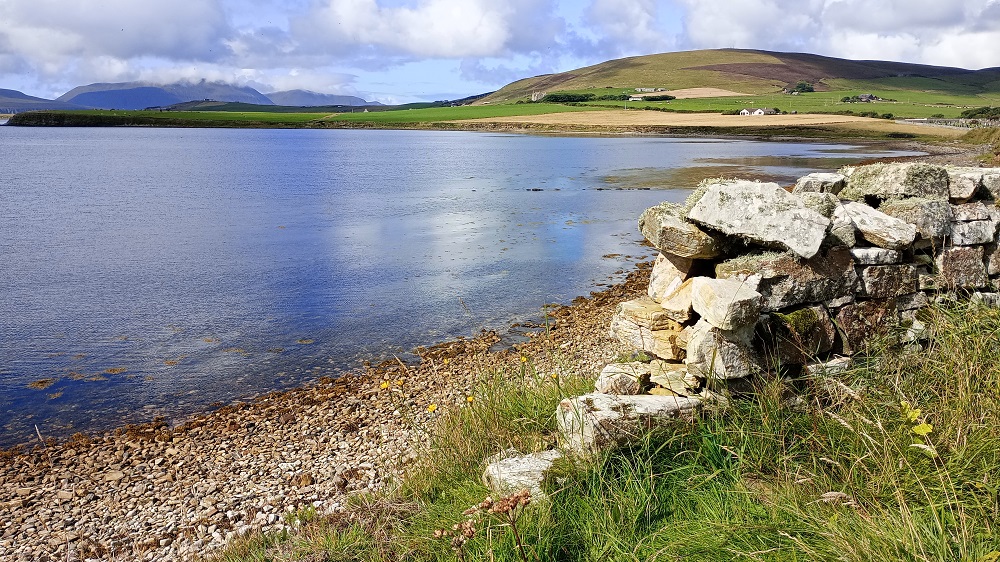
In Orkney, we have already seen the effects as our coast is eaten away. Where there was once a path where you could walk the coastline it is gone, or going fast.

Weather Extremes are Deadly
The extremes of weather kill millions of people each year. Dr. Andrea Pozzer, from the Max Planck Institute for Chemistry in Mainz and who is adjunct associate professor at The Cyprus Institute in Nicosia, Cyprus commented:
“In 2000, around 1.6 million people died each year due to extreme temperatures, both cold and heat.
“By the end of the century, in the most probable scenario, this figure climbs to 10.8 million, roughly a seven-fold increase. For air pollution, annual deaths in 2000 were about 4.1 million. By the century’s close, this number rises to 19.5 million, a five-fold increase.”
The findings in the study, ‘Atmospheric health burden across the century and the accelerating impact of temperature compared to pollution’, are published in Nature Communications.
The study shows significant regional differences in future mortality rates. South and East Asia are expected to face the strongest increases, driven by aging of the population, with air pollution still playing a major role.
In contrast, in high-income regions—such as Western Europe, North America, Australasia, and Asia Pacific—deaths related to extreme temperatures are expected to surpass those caused by air pollution. In some countries within these regions, such as the United States, England, France, Japan and New Zealand, this shift is already occurring.
The disparity is likely to grow, with extreme temperatures becoming a more significant health risk than air pollution also in countries of Central and Eastern Europe (e.g., Poland and Romania) and parts of South America (e.g., Argentina and Chile).
By the end of the century, temperature-related health risks are expected to outweigh those linked to air pollution for a fifth of the world’s population, underscoring the urgent need for comprehensive actions to mitigate this growing public health risk.
Jean Sciare, director of the Climate and Atmosphere Research Center (CARE-C) of The Cyprus Institute added:
“Climate change is not just an environmental issue; it is a direct threat to public health.
“These findings highlight the critical importance of implementing decisive mitigation measures now to prevent future loss of life.”
The science is providing the evidence to what the continued use of fossil fuels is doing to the planet. The buzz phrase of achieving ‘Net Zero’ is used by governments in their climate change action plans.
Net Zero
On 22nd November 2024 the Climate Change (Emissions Reduction Targets) (Scotland) Bill, was enacted. It rolled back on previous commitments in legislation when it was clear Scotland would not meet the target of a 75 per cent reduction in emissions by 2030. The UK is committed to reaching the magical Net Zero by 2050.
The UK Government has issued hundreds of new licenses to extract oil and gas from the North Sea. In his presentation to the Offshore Energies UK’s annual conference in Aberdeen on 17 September 2024, NSTA (North Sea Transition Authority) Chief Executive Stuart Payne said:
“The North Sea has the natural resources – up to 5bn barrels of oil and gas, a 60GW target for offshore wind, up to 78GT of carbon storage potential. It has the infrastructure – with key onshore terminals, offshore clusters and more than 100 pipelines with real repurposing potential. “
Offshore wind will be developed, but the big money is still with fossil fuels and the renewed exploration and extraction of sites in the North Sea. Internal NSTA analysis show that the average time between licensing and first production is now close to five years, which means that licences awarded now could be producing before the end of the decade.
Geological Net Zero means balancing flows of carbon into and out of the solid Earth, with one tonne of CO2 committed to geological storage for every tonne still generated by any continued fossil fuel use. Given the cost and challenges of permanent geological CO2 storage, achieving Geological Net Zero will require a substantial reduction in fossil fuel use.
In a new study, Geological Net Zero and the need for disaggregated accounting for carbon sinks, published in Nature and led by the University of Oxford’s Department of Physics an international group of authors who developed the science behind net zero demonstrate that relying on ‘natural carbon sinks’ like forests and oceans to offset ongoing CO2 emissions from fossil fuel use will not actually stop global warming.
Professor Myles Allen, of the University of Oxford’s Department of Physics, who led the study, explained:
“We are already counting on forests and oceans to mop up our past emissions, most of which came from burning stuff we dug out of the ground. We can’t expect them to compensate for future emissions as well.
“By mid-century, any carbon that still comes out of the ground will have to go back down, to permanent storage. That’s Geological Net Zero.”
Professor Kirsten Zickfeld of Simon Fraser University in British Columbia, Canada, co-author and leader of one of the other 2009 net zero papers, added:
“It is a common assumption that removing carbon from the atmosphere to offset burning of fossil fuels is as effective as not burning fossil fuels in the first place. It is not.
“Offsetting continued fossil fuel use with carbon removal will not be effective if the removal is already being counted on as part of the natural carbon cycle and if the carbon is not permanently stored. Unless we can increase transparency in national Greenhouse gas reporting and target setting, offsets will become part of the problem instead of part of the solution.”
We have the science. We know the facts. The developing nations and island states understand the realities of what is happening. Despite all of this governments across the world will continue to open up new coal mines, extract oil and gas in new fields, and ignore both the scientific evidence and the reality of climate change in their communities.
Fiona Grahame




Leave a Reply