
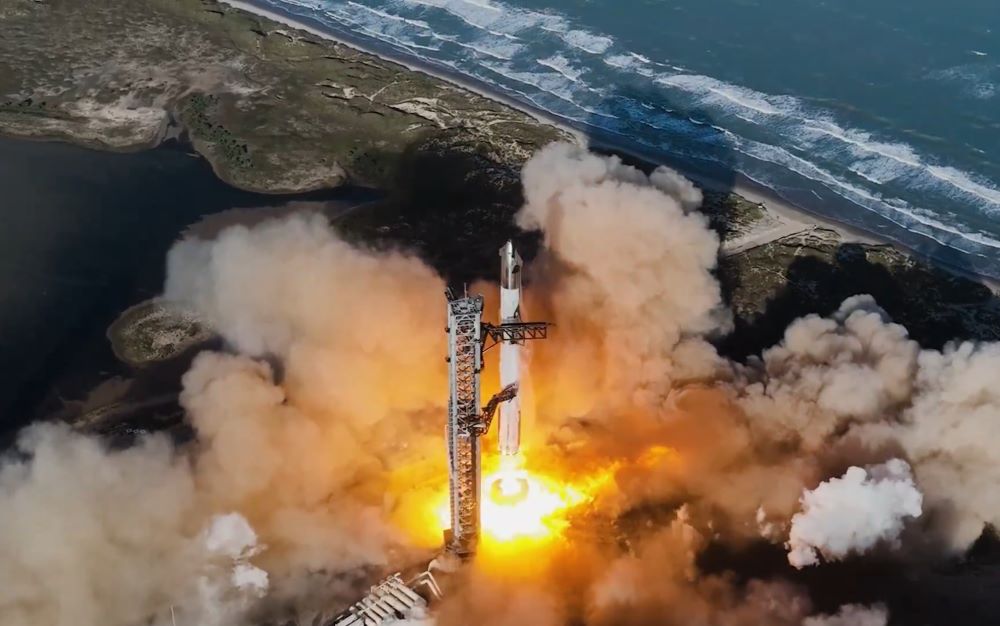
One of the biggest topics in November was the sixth flight of the SpaceX Superheavy/Starship combination, on 19th November. Elon Musk had promised ‘thrills’, and some commentators wondered how that would be possible when the Federal Aviation Authority was insisting on an exact repeat of the Ship 5 flight plan. After the event, some expressed disappointment that there had been no major new development in defiance of that edict. But the mere fact that so much of it was familiar, while being done differently, was spectacular proof of how well things are going.


The rollout on October 19th (Fig. 1), the Superheavy ignition (Fig. 2), liftoff (Fig. 3), climbout (Fig. 4), and acceleration to ‘Max Q’, the moment of maximum dynamic pressure after passing Mach 1 (Fig. 5), all passed without incident, watched by President-Elect Trump with Elon Musk from near the launch site at Boca Chica in Texas. The ‘hot fire’ of the second stage engines and the separation of the two stages went equally well (Fig. 6), and the Superheavy turned around and completed the ‘braking burn’ that initiated its descent.

The first departure from the previous mission came with a temporary glitch in communication with the booster, as a result of which its automatic safety system opted for a descent into the ocean instead of an attempted capture by the ‘Mechazilla’ arms of the launch tower, which had been achieved successfully on Flight 5. But the booster made a perfect descent (Fig. 7) and touched down perfectly on the water (Fig. 8). The Starship continued to accelerate away, photographed from the International Space Station by astronaut Don Pettit (Fig. 9), and once in orbit, it conducted a successful vacuum restart of one of its Raptor engines. After its cruise around the planet (Fig. 10), it went through re-entry with a new arrangement of heat absorbing tiles, some of them of a new type, and better protection for the fin hinges which burned through before, only one of them damaged this time.


One reason for the launch at mid-afternoon, rather than sunrise as before, was to film the final descent and splashdown in more detail – assuming that the vehicle was intact, because it was put through a tougher flight regime, including pulling up from a nosedive, and partly exceeding the design limits. Nevertheless it survived the stresses, passing directly over the ‘buoycam’ (Fig. 11) before making a perfect vertical touchdown (Fig. 12), falling over only when the engines went off and this time burning on the surface rather than exploding. Commentators watching said there was no reason not to go for soft landing on a pad or on a ship, but Elon Musk has said that he wants to achieve capture by a tower, as with the Superheavy, for faster turnaround to the next mission (see below).


Kate Tice, a senior quality engineer at SpaceX, confirmed during Flight Test 6 that FT-7 will feature a longer version of Starship, with a 25% greater fuel capacity, as well as redesign and repositioning of the forward fins to eliminate the burnthrough problem with the hinges. That will be the last ocean splashdown of the Starship before going for tower capture. (Mike Wall, ‘What’s Next for SpaceX’s Starship After Its Successful 6th Test Flight?’, Space.com, online, 21st November 2024.)


Traditionally crewed spacecraft carry soft toys as ‘zero-g indicators’, to show the crew and watchers by TV that propulsion has stopped. Sean the Sheep was one of those on the Artemis 1 mission orbiting the Moon in November 2022. On FT-6 the indicator was a banana in the cargo bay (Fig. 13), also depicted in a life-size decal on the ship’s side (Fig. 14), and also in the mission patch (Fig. 15). During the mission it was being worn on T-shirts by SpaceX personnel, who explained that ‘It’s bananas!’ was what they were being told about the upcoming schedule. (When Grace Franklin of the Daily Record launched her own press agency, she called it YAM because everyone told her ‘You Are Mad’.) What’s bananas is that after its prior objections to the programme, the Federal Aviation Authority has issued clearance for 25 flights next year.


Those will doubtless include tests of the modified Starship for the first human landing on the Moon since 1972, in the Artemis III mission, still scheduled for 2026. Details are starting to emerge about Starship’s role, in which it will rendezvous with the Orion capsule (Fig. 16) and take its crew down to the lunar surface (Fig. 17), to which they will descend by elevator, wearing spacesuits built by Axiom Space (Fig. 18). Given the disparity in size between Starship and Orion, critics are asking, ‘Why not just use Starship throughout?’, as SpaceX and Axiom intend to do for their own missions. The only answer I can think of is that it provides an extra tier of safety, whereby either spacecraft can bring the crew back if the other is stuck in lunar orbit. But it’s a very expensive way of doing that, when each Artemis launch by the Space Launch System costs $ 4.1 billion.

NASA has now confirmed that Starship will continue to be the lunar lander, with a contract to deliver a pressurised rover to the Moon on Artemis VI, while cargo deliveries will be made by Blue Origin’s unnamed freight lander (Fig. 19). The Starship variant for the lunar missions has been named HLS (Human Landing System), and in illustrations of it refuelling in Earth orbit, it’s now being depicted in black where all previous artwork has shown it in white (Fig. 20).

The refuelling element of the system has been attracting criticism, because it will take several cargo launches to do it, but that overlooks how cheap Starship launches will be if production ramps up to the intended level (see below).


Blue Origin is also having quite a good run at the moment. Space tourism launches of the Blue Shepard vehicle resumed on November 22nd (Fig. 21), carrying among its passengers Emily Calendrelli, an MIT-trained aerospace engineer known as ‘Space Girl’ for her broadcasts on social media, and now the 100th woman in space (Fig. 22). The United Launch Alliance is preparing for the third flight of its new Vulcan booster with Blue Origin engines (Fig. 23), the third acceptance test of five after the first two successes, and Blue Origin’s own New Glenn booster is stacked for launch after the disappointment when NASA decided not to launch its ESCAPADE Mars probes on it until February at the earliest (Fig. 24).


What is truly ‘bananas’ is the plans SpaceX has for 2026. Elon Musk plans to launch four Starships to Mars that year, and if successful, they will be carrying supplies for a crewed mission in 2028. It’s not known how many people that would involve, but Starship is intended to carry people to Mars 100 at a time. Because the surface gravity is only one-third of Earth’s, Starships will be able to land and takeoff from Martian settlements without boosters (Fig. 25).

But if four ships can carry enough for 100 people for two years, then only 50 ships in total would be needed for a first wave of 1000 people in 2030, even if they were wholly supplied from Earth. Ambitious as that is, during FT-6 Kate Tice and her webcast co-host, SpaceX manufacturing engineering manager Jessica Anderson, talked casually about 125 launches in 2026, and said the company eventually aims to build one Ship every eight hours. This work will be done at Starfactory, the manufacturing facility that SpaceX is constructing at Starbase. There’s no indication how long that production run would last, but a quick calculation reveals that they’re talking about building over 1000 Starship per year.
During presentations around the flight, SpaceX executives revealed that the launch of Starlink satellites is the mainstay of the company business. Launches paid for by the US government and other commercial enterprises make their contribution, but the bulk of the money comes from the fees for Starlink use. Starlink’s main aim is to provide communications access via satellite to anywhere on Earth, including broadband, and although it currently costs about £500 per month, plus accessories, Starlink has over 4 million subscribers in more than 100 countries and the number is growing constantly. Starlink now has at least 6500 satellites on-orbit, as of early November, and is eventually planned to reach 40,000. Although there are huge social benefits in bringing quality communications and broadband to the large areas of the world which don’t even have telephone links, as soon as the launches of ‘Starship trains’ began (Fig. 26) there were complaints from astronomers. The mass-produced Starlink satellites are released from Falcon 9s up to 60 at a time (Fig. 27), and on the edge of naked-eye visibility. Attempts to reduce their brightness have not been successful so far. For professional and serious amateur observers that is not quite as bad as it sounds, because these days time exposures are compiled by stacking electronic images; but with 40,000 Starlinks up there, it may be hard to take any image of the sky which isn’t marked by satellite trails. Several similarly large constellations of satellites are planned by other suppliers, along with even larger and brighter satellites, some possibly as bright as Venus (Figs. 28 & 29). There are no regulatory bodies with control over this situation, which may destroy the view of the night sky worldwide – similar to the attitude of many authorities at ground level. (See ‘The Dark Sky’ Parts 1 & 2, ON, September 11th and 18th, 2022.)


Elon Musk has repeatedly said that he would like to phase out both Falcon 9 and Falcon Heavy, launching everything by Starship/Superheavy. That won’t necessarily please customers for other launches, though. In ‘Rockets, for November 5th‘ (ON, 5th November 2023), I wrote:
“Elon Musk’s Starship offers a massive drop in launch costs per kilogram. Due to its size, it could in theory launch all the satellites wanted in any given year, even launching entire huge constellations like Starlink in a single flight, and some recent articles have predicted that Starship could put all the other launch providers out of business. But Starship is not quite the game-changer it seems. Orbital plane changes are very expensive to make, using up a great deal of fuel, and they will be very costly for Starship because it’s so big. However many satellites it carries on each launch, they will all be released at the same inclination to the Equator, though onboard propulsion could move them higher or lower. Even for the most popular destinations like geosynchronous or Sun-synchronous orbit, it may take time for a Starship launch manifest to fill up, and some customers will prefer to pay for an earlier launch on a smaller rocket.
“Many scientific satellites are in near-unique orbits. IUE, the International Ultraviolet Explorer, was launched in 1978 into a ‘tundra’ orbit, with a 24-hour period but inclined to the equator, with a triangular ground track over the Atlantic which brought it over the participating nations in turn, eliminating the need for onboard tape recorders, often the first components to fail in satellites of that time. As a result IUE remained operational till 1996, when it had to be turned off for lack of funds. By contrast, GOCE, the gravity-mapping satellite, was in an orbit so low that it required continuous low-level thrust, and came down off the Falkland Islands as soon as its fuel was exhausted. If anyone wished to put a future satellite into an exotic orbit like that, they might have to wait a lifetime for a Starship manifest to fill up for it. So there will still be a market for dedicated satellite launches, and specialised boosters waiting to provide them, even if Starship dominates the mass market.”
And indeed Jeff Bezos has spotted that likely market and plans to move into it. Blue Origin has announced plans for Blue Ring, ‘a spacecraft platform focused on providing in-space logistics and delivery… The platform provides end-to-end services that span hosting, transportation, refuelling, data relay, and logistics, including an “in-space” cloud computing capability. Blue Ring can host payloads of more than 3,000 kg and provides unprecedented delta-V capabilities and mission flexibility [Fig. 30].

“Blue Ring addresses two of the most difficult challenges in spaceflight today: growing space infrastructure and increasing mobility on-orbit,” said Paul Ebertz, Senior Vice President of Blue Origin’s In-Space Systems. “We’re offering our customers the ability to easily access and manoeuvre through a variety of orbits cost-effectively while having access to critical data to ensure a successful mission,” Ebertz added. (‘Blue Origin Unveils Multi-Mission, Multi-Orbit Space Mobility Platform’, Blue Origin online, 16th October 2023.)
But a thousand fully reusable Starships, coming off the production line at 8-hour intervals, and with a turnaround of only hours before reuse, according to Musk’s stated aims? Each version 3 Starship will be capable of launching over 300 tons to Low Earth Orbit, according to Jessica Anderson, and even if they relaunch only every 3 days, that equates to 30,000 tons per year, probably an equivalent figure to Geosynchronous Orbit if they’re uncrewed like Cargo Dragon. With 1000 ships, that provides 30,000,000 tons per year in total.
I picked a three-day turnaround time for easier comparison with ‘Project Starseed’, which the late John Braithwaite and I published in the Journal of the British Interplanetary Society, in September 1983. Prof. Gerard K. O’Neill had proposed a 25-year programme to meet the energy needs of the USA and then the world with Space Solar Power Satellites (SSPS), built from lunar resources by a large workforce living in a rotating space habitat whose building had taken most of the time. John and I proposed a much faster programme which would reverse the steps, housing the builders in smaller habitats built of Space Shuttle External Tanks. It had been estimated by others that 500 such ‘powersats’, each massing 60,000 tons, could meet the entire estimated energy needs of 21st century civilisation, and we reckoned that with a baseline programme of nuclear waste disposal in space, launching a Heavy Lift Shuttle-derived booster every three days, the target could be met in 10 years. It did require the development of several new technologies, and in particular a dedicated lunar surface mining industry, because launching the materials from Earth would be far too expensive, at Space Shuttle prices.

Others thought it might be possible, and preferable, to do all the manufacturing on Earth in segments before launch direct to geosynchronous orbit. Boeing and Rockwell International both had detailed proposals, the former for very large sea-launched Heavy Lift boosters and the latter for an equally large winged shuttle called Star-Raker (Fig. 31). In both cases the start-up costs seemed prohibitive, though the Star-raker concept had a new lease of life in the mid-1980s with its conventional jet engines replaced by scramjets. What nobody thought was that cheap mass-produced launchers would become available, yet it seems we might have them very shortly.
The 60,000 ton mass of a 5-10 Gigawatt powersat, comparable to the mass of a large aircraft carrier, was calculated from the limited efficiencies of solar cells at that time. But those have more than doubled since, and the biological solar cells discussed last week (‘Lasers in Space’, ON, 24th November 2024) offer still greater improvements. Without knowing then where this was going, I made a point of quoting Prof. Erik Gauger of Heriot-Watt University when he said that “it could even offer a route to sending power to satellites or back to Earth using infrared laser beams”.
500 powersats of 60,000 tons would have a total mass of 30 million tons, which just happens to be the annual cargo capacity of 1000 Starships launching every three days and carrying 300 tons each, as above. If that’s a coincidence, it’s a remarkable one – but if it’s not a coincidence but a minimum target for SpaceX to aim at, then (as I’ve said before in other contexts) you read it here first.
Bioengineered solar cells might drastically reduce the mass to be launched and allow the constellation to be completed still faster: a global network of 30,000 ton powersats could be completed in six months, lower masses even sooner. Doing it so fast, with prefabricated units to be assembled in geosynchronous orbit, has one great advantage, which is that it might be a done deal before effective opposition can be generated. Cheap, clean power for the world would have enormous social and environmental advantages, as J. Peter Vajk pointed out in his book Doomsday Has Been Cancelled (Peace Press, 1978, Fig. 32), but it generated strong opposition from the nuclear lobby last time, and it won’t sit well with Donald Trump’s friends in the oil industry, to say nothing of China’s huge investment in coal. If it is what Musk intends, having the capability to do it in place and doing it quickly may be the way to avoid years of battles in court.

One drawback which can’t be entirely eliminated is that on 1970s estimates, each powersat would be as bright as the Full Moon, and there would be a string of them from horizon to horizon, visible from everywhere on Earth except possibly the north and south poles. More efficient solar cells could make the powersats smaller, but not eliminate the problem, which would eliminate dark skies worldwide. The benefits would outweigh that, and the dark sky may have gone anyway thanks to Starlink and its rivals.
It would certainly have to happen on Mars, if the settlement there grows as Musk plans. But interestingly enough, Mars is so much smaller that the altitude for ‘areosynchronous’ orbit would be below the orbit of Deimos, the outer moon, which cannot be seen from higher latitudes on Mars. ‘Come to Mars to see the stars again’ could be an effective slogan for Martian emigration and tourism, in the not too distant future.




Leave a Reply