
The slaughter of civilians in Gaza continues both directly through Israeli Defence Force action, and indirectly through starvation, disease and trauma. However, there has been some positive news.
The most recent UNRWA report states that on 10 December, a joint UN convoy delivered urgently needed food to communities in southern and central Gaza. A total of 105 trucks successfully completed their journeys along the Philadelphi corridor and adjacent routes, and the convoy was able to provide food for nearly 200,000 people.
OCHA reported that on 3 December, the World Health Organization (WHO) completed a three-day mission during which it delivered to Kamal Adwan Hospital 10,000 litres of fuel, 200 food parcels from the World Food Programme (WFP), blood units and medical supplies, and evacuated 23 patients to Al Shifa Hospital in Gaza City. WHO also delivered 24,000 litres of fuel and medical supplies to Al Shifa hospital for further distribution.
Small but positive reports. Unfortunately most reports are of the continuing genocide being perpetrated upon the people of Gaza.
On 4 December, an Israeli airstrike hit a makeshift tent encampment sheltering 21 families in the Al Mawasi area in Khan Younis. The strike, together with secondary explosions, which appear to have been caused by gas cylinders according to the UN Human Rights Office (OHCHR), destroyed all 21 tents and killed at least 23 Palestinians, including at least four children and two women – one of them pregnant – while seriously injuring others.
Nowhere is safe in Gaza as even the most makeshift shelters are destroyed by IDF attacks. Those that escape the burning tents are traumatised, haunted by the fear of further attacks.
“SOS Children’s Villages International condemns the recent attack adjacent to a temporary tent encampment in Khan Younis, Gaza, accommodating 46 children under our care. The Dec. 4 attack, right next to our encampment, claimed the lives of more than 20 individuals, including children, according to medics. Fortunately, none of the children or staff of SOS Children’s Villages were physically harmed.” SOS Children’s Villages International
These attacks by the IDF take place in official Humanitarian Zones.
SOS Children’s Villages in Palestine, established in 1968, provides alternative care to more than 190 children and young people without parental care in two villages: in Rafah (now emergency relocated) and Bethlehem. The organization also runs family strengthening and other preventive programmes that support more than 400 families in the West Bank and Gaza. Since the start of the war in Gaza, SOS Children’s Villages in Palestine has provided direct humanitarian support to the most affected families and separated children.
In another attack on 8 December, at about 15:20, at least 11 Palestinians, including children and women, were killed, with several bodies recovered in pieces, when a house was hit in Al Bureij refugee camp in Deir al Balah.
The General Assembly of the United Nations on 11 December overwhelmingly adopted two resolutions, demanding a ceasefire in Gaza and calling on Israel to drop its ban on the UN agency for Palestine refugees, UNRWA, following an emergency special session triggered by another use of a veto in the Security Council by the USA. The resolution on 20 November in the UN Security Council in New York demanded an immediate, unconditional and permanent ceasefire as well as the release of all hostages and full humanitarian access for civilians.
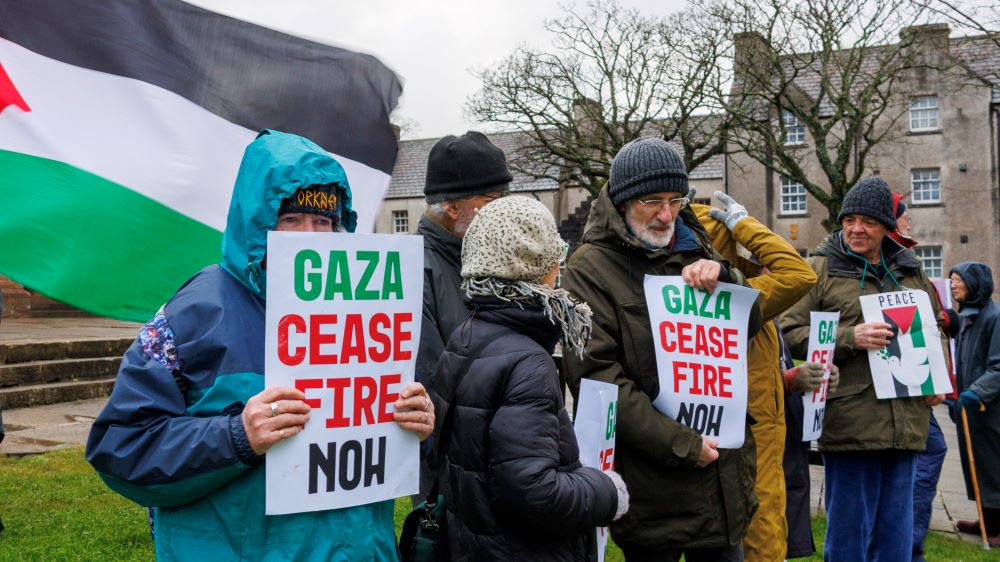
In Orkney, islanders will continue in their vigil calling for an immediate ceasefire. They have been meeting every Saturday between 1 and 2pm on the Kirk Green, St Magnus Cathedral, Broad Street, Kirkwall.

Refaat Alareer
This week we also remember Refaat Alareer Palestinian writer, poet, professor, and activist from Gaza who was killed by an Israeli airstrike at approximately 18:00 on 6 December 2023 in northern Gaza. His brother Salah with son Mohammed, and his sister Asmaa with three of her children (Alaa, Yahia, and Mohammed) were also among those killed in the same airstrike.
The title of this article is taken from his poem ‘Drenched’.
On the shores of the Mediterranean,
I saw humanity drenched in salt,
Face down,
Dead,
Eyes gouged,
Hands up to the sky, praying,
Or trembling in fear.
I could not tell.
The sea, harsher than the heart of an Arab,
Dances,
Soaked with blood.
Only the pebbles wept.
Only the pebbles.
All the perfumes of Arabia will not grace the rot
Israel breeds.
Refaat Alareer’s final poem, “If I must die”, was widely circulated after his killing and was translated into more than 40 languages. My final moments with Refaat Alareer
As people here rush around buying Christmas gifts for family and friends or attend church services in their communities, we remember Refaat Alareer, and the thousands of families in Gaza who have been obliterated in this appalling slaughter.
Fiona Grahame
Leave a Reply