
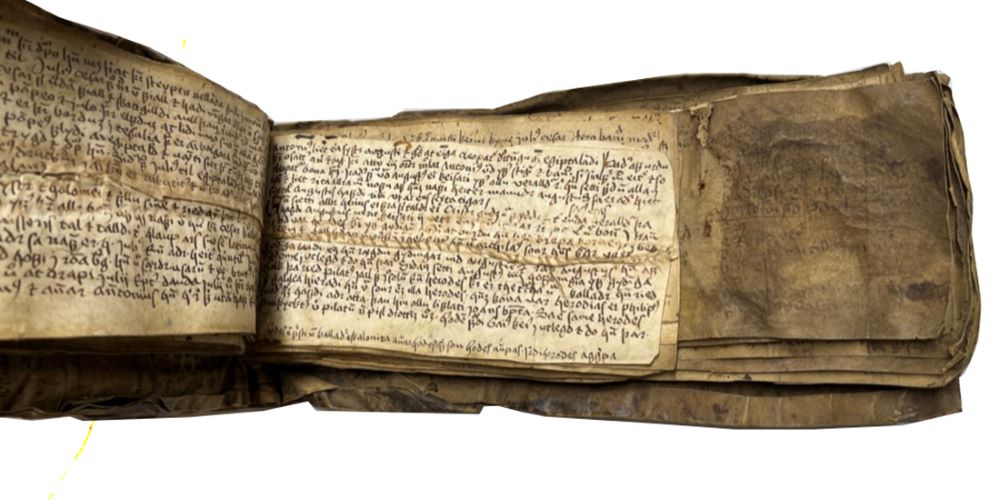
Iceland has a very high rate of literacy – estimated today at 99%. This small but independent country has always prided itself on its love of writing, reading, and importantly story telling. It is thanks to those Medieval Icelandic scribes that we have the Norse Sagas, retelling the tales of the Norse Earls and their adventures.

Comparing Iceland’s literacy rate with that of the countries which make up the UK is food for thought:
- England: 1 in 6 (18% / 6.6 million people) adults aged 16 to 65 in England have very poor literacy skills.
- Scotland: 1 in 4 (26.7% / 931,000 people) adults in Scotland experience challenges due to their lack of literacy skills.
- Wales: 1 in 8 (12% / 216,000 people) adults in Wales lack basic literacy skills.
- Northern Ireland: 1 in 5 (17.4% / 256,000 people) adults in Northern Ireland have very poor literacy skills.
Tom Lorenz, a PhD research fellow at the Department of Language and Literature at NTNU (Norwegian University of Science and Technology) is hunting down hidden and forgotten pieces of Iceland’s literary history.
He explained:
“Previously, the theory was that Iceland was so dark and barren that the Icelanders had to fill their lives with storytelling and poetry to compensate for this. But Icelanders were certainly part of Europe and had a lot of contact with Britain, Germany, Denmark and Norway, among others.
“The Icelanders were part of a common European culture, and Iceland has been a great knowledge society for a long time.”
Icelandic skalds were skilled and sought after, and Norwegian kings engaged skalds to ensure that their story and their feats would be told and passed on. Skalds were poets who composed one of the two kinds of Old Norse poetry in alliterative verse, the other being Eddic poetry. Skaldic poems were traditionally composed to honour kings.
In the Middle Ages, the Icelanders wrote down these oral traditions both in Latin and in Old Norse. Snorri Sturluson was the last and most important in a long line of saga writers who wrote down the kings’ sagas in the 13th century.
This is how the kings’ sagas were preserved.
“In addition to sagas, eddaic poems, and skaldic verse, scientific literature and political treaties were also written in Iceland during the Middle Ages,” added Tom Lorenz.
Icelanders were also very particular about the material they wrote on, only the best parchment (calf skin/vellum) was used. The parchment was valuable and was often reused. Previous writing could also be scraped off it and the parchment could be written on again. The scraping and polishing to create new written works is called a palimpsest. In Iceland, parchment was also reused for printing books after Gutenberg invented the printing press in the 15th century.
Tom Lorenz explained:
“Palimpsests were common in the Middle Ages across Europe, and were particularly widespread in Iceland. Although literarily rich, Iceland was a poor country. The supply of expensive parchment was limited, while the demand was high because the Icelanders had much they wanted to communicate.
“The fact that there are printed palimpsest books in Iceland and not just handwritten palimpsest parchments is unique in a European context, and this has not been studied before!”
In Iceland, as elsewhere in Europe, texts and books were written in Latin during the Middle Ages, especially liturgical texts used in ecclesiastical contexts. Latin was the predominant written language of Catholic Europe.
With the Reformation many northern European countries converted to Protestantism, including Iceland between 1537 and 1550. The Reformation brought an end to ecclesiastical manuscripts and books being written in Latin. The language of the common man was now to be used.
Latin script was scraped off existing parchments so they could be used for new texts written in Icelandic, and these became palimpsests. The texts and words that have been scraped away can also be retrieved using modern techniques, such as infrared rays, but quite a lot of the old text can often be read with the naked eye.
And it is in the hidden remnants of old Icelandic parchments written in Latin that Tom Lorenz is searching for hidden and forgotten pieces of history. He examines the preserved fragments from these ancient books and also studies the different forms of parchment recycling and reuse.
From the 17th century onwards, Old Norse texts became important in the building of identity, national pride and power in the Nordic countries.
In Denmark, the Icelander and archivist Árni Magnússon (1663-1730) was tasked with collecting medieval documents from both Iceland and the rest of the Nordic countries. At this time, Iceland was under Danish rule in the absolute monarchy of Denmark-Norway.
Árni Magnússon was particularly interested in texts about Icelandic history. He scoured the market, almost draining Iceland of medieval literature, and built a large collection of handwritten books, the Arnamagnæan Collection. The collection is now part of UNESCO’s Memory of the World Programme.
Árni Magnússon was most interested in books written in Old Norse, not in Latin. He used parchments from the Latin books as covers for the Old Norse books. In the early 20th century, the book covers were removed and stored separately, and few people have shown much interest in them – until now.
These ancient book covers are among the parchments that Tom Lorenz is studying in his search for hidden and forgotten fragments of history.
Between 1971 and 1997, half of Árni Magnússon’s book collection was returned from Denmark to Iceland, and half of the original collection of 3000 manuscripts is now back in its country of origin. Some medieval manuscripts are still located in archives and museums in Norway, Denmark, and also Sweden. So, Lorenz’s search has taken him on a journey through the nooks and crannies of many archives.
“I have identified several previously unidentified Latin fragments related to Iceland. These new discoveries contribute to greater knowledge about which theological and liturgical texts were in circulation in medieval Iceland. The texts show that medieval Icelanders followed and participated in European intellectual culture,” said Lorenz.
The text fragments he has found include hymns, prayers, sermons, hagiographies and church music.
Click on this link to access, Recycling and Recontextualisation in Medieval and Early Modern Icelandic Palimpsests, published in Gripla.


Leave a Reply to Discovering The Norse Settlers of The Faroes & Iceland – The Orkney NewsCancel reply