
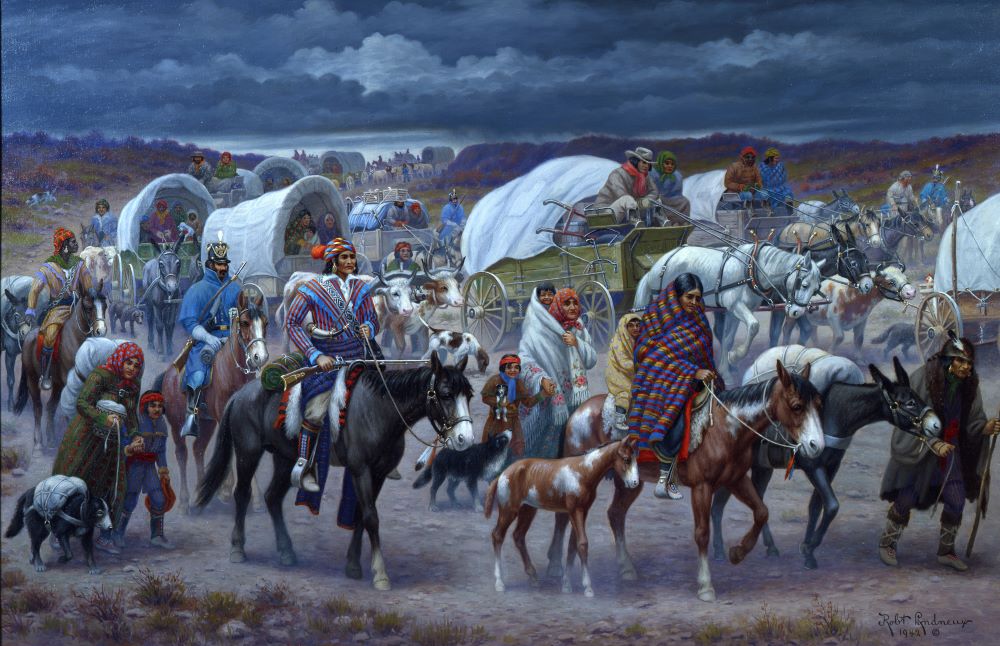
On 29th December 1835 the Treaty of New Echota was signed between the US government and representatives of a minority Cherokee political faction to cede all lands of the Cherokee east of the Mississippi River to the United States.
Andrew Jackson, a Democrat and supporter of Indian removal, was elected president in 1828
The negotiation of the Treaty of New Echota was largely encouraged by Jackson, and it was signed by a minority Cherokee political faction, the Treaty Party, led by Cherokee leader Elias Boudinot. However, the treaty was opposed by most of the Cherokee people, as it was not approved by the Cherokee National Council, and it was not signed by Principal Chief John Ross. The Cherokee National Council submitted a petition, signed by thousands of Cherokee citizens, urging Congress to void the agreement in February 1836.
Despite this opposition, the Senate ratified the treaty in March 1836, and the Treaty of New Echota thus became the legal basis for the Trail of Tears. Only a fraction of the Cherokees left voluntarily. The U.S. government, with assistance from state militias, forced most of the remaining Cherokees west in 1838.

The Cherokees were temporarily remanded in camps in eastern Tennessee. In November, the Cherokee were broken into groups of around 1,000 each and began the journey west. They endured heavy rains, snow, and freezing temperatures.
By the end of the decade in 1840, tens of thousands of Cherokee and other Indian nations had been removed from their land east of the Mississippi River. The Creek, Choctaw, Seminole, and Chicksaw were also relocated under the Indian Removal Act of 1830. One Choctaw leader portrayed the removal as “A Trail of Tears and Deaths”, a devastating event that removed most of the Indian population of the southeastern United States from their traditional homelands.





Leave a Reply