
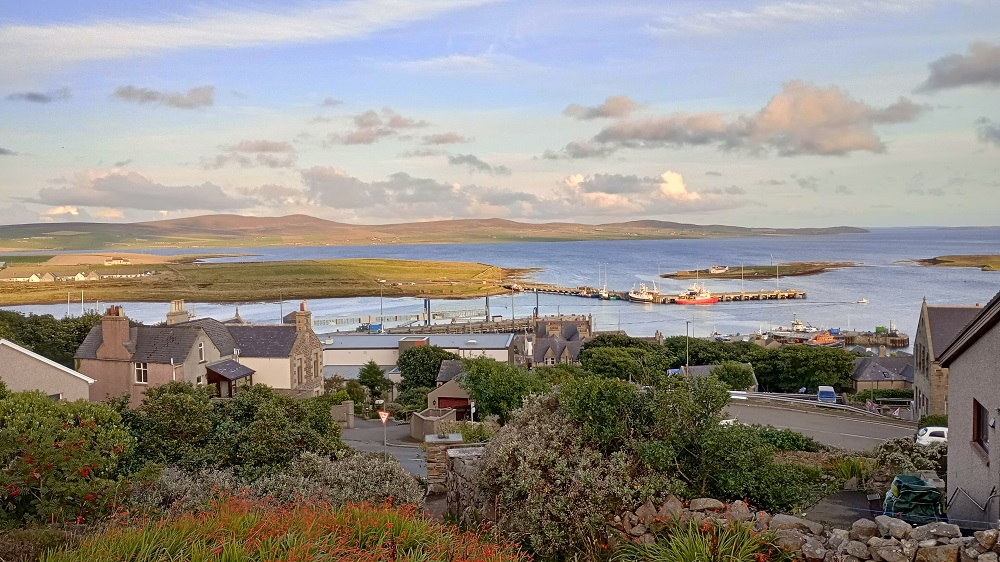
On 30 June 2023, the population of the islands of Orkney was 22,000, a decrease of 0.1% from the previous year. Over the same period, the population of Scotland increased by 0.8%. The information, published by the National Records of Scotland, shows that Orkney has the lowest population out of all of Scotland’s Local Authority areas.
Between 2001 and 2023, Orkney’s population increased by 14.5% and by 2028 is projected to be 22,311. Due to the ageing demographic of the islands it will only maintain its population with immigration.
| Age group | 2001 | 2023 | % change | Scotland % change |
|---|---|---|---|---|
| All people | 19,220 | 22,000 | 14.5 | 8.4 |
| 0 to 15 | 3,815 | 3,461 | -9.3 | -7.8 |
| 16 to 64 | 12,182 | 12,953 | 6.3 | 5.9 |
| 65 and over | 3,223 | 5,586 | 73.3 | 38.3 |
The birth rate is decreasing. In 2023, there were 162 births in Orkney a slight decrease of 0.6% from 2022. Of these 162 births, 74 (45.7%) were female and 88 (54.3%) were male. The most common age group of mothers was 30 to 34 as more women delay starting families.
There were 277 deaths in 2023. The leading cause of death for males was Ischaemic heart diseases (11.5% of all male deaths), followed by Cerebrovascular disease (6.5%). The leading cause of death for females in 2023 was Ischaemic heart diseases (14.5% of all female deaths), followed by Dementia and Alzheimer’s Disease (10.1%).
People in Orkney have a higher life expectancy than Scotland for both females and males: females 82.7 years and males 78.7 years.
The number of people who came into Orkney to live in the period 2021-22 was 790, a 15.1% decrease from 930 in the period 2020-21. In comparison the number of resident islanders who left was 670, which is a 10.7% decrease from 750 in 2020-21.
| Area | 2018 | 2028 | Natural change | Net migration | Total change | Natural % change | Net migration % change | Total % change |
|---|---|---|---|---|---|---|---|---|
| Orkney Islands | 22,190 | 22,311 | -770 | 1,037 | 121 | -3.5 | 4.7 | 0.5 |
| Scotland | 5,438,100 | 5,537,116 | -90,876 | 189,892 | 99,016 | -1.7 | 3.5 | 1.8 |
There were 90 marriages registered in Orkney in 2023. Four civil partnerships were registered, all of which were mixed-sex.
The number of households increased by 1.4% to 10,811. Looking over a longer period, in comparison to 2001, the number of households has increased by 29.7%. It is projected that by 2028 the number of households will increase by 4.8% to 11,010.
| Type | 2018 | 2028 | % change | Scotland % change |
|---|---|---|---|---|
| All households | 10,506 | 11,010 | 4.8 | 4.9 |
| One adult | 3,808 | 4,195 | 10.2 | 8.1 |
| Two adults | 3,641 | 3,872 | 6.3 | 7.2 |
| One adult, one or more children | 471 | 496 | 5.3 | 2.2 |
| Two or more adults, one or more children | 1,747 | 1,638 | -6.2 | -0.9 |
| Three or more adults | 839 | 809 | -3.6 | -3.4 |
Household type by 2028 is projected to remain the most common of “One adult” (38.1%) and the household type “One adult, one or more children” is projected to remain the least common (4.5%).
In 2023, the number of dwellings was 11,719, a 0.9% increase on the previous year. Taken over a longer period compared with 2001, the number of dwellings has increased by 26.9%. Council Tax band B was most common (25.0%), followed by Council Tax band C (21.3%).
| Tax band | % of all dwellings | Scotland % of all dwellings |
|---|---|---|
| All dwellings | 100.0 | 100.0 |
| A – C | 66.7 | 58.7 |
| D – E | 29.8 | 27.5 |
| F – H | 3.5 | 13.8 |
Population projections help with planning future service provision and challenges which Orkney may face in the years ahead.

Fiona Grahame
Leave a Reply