
By Edwin Heath
Where in the world is one prompted to reach for the sun-tan oil in the middle of the night? Answer – either Pole. But for the easiest to reach, try the Norwegian Arctic in June or July.
Such childish curiosity was sufficient, back in the summer of 1980, to set me off on a quest for the proverbial “midnight sun”. It all seemed so easy, in theory. Learning that a few seats remained on a charter flight to Bergen, I seized my chance.
And, on first seeing the rocky islands of the Norwegian coast, as the plane swooped down toward Bergen, I knew I would not be disappointed.

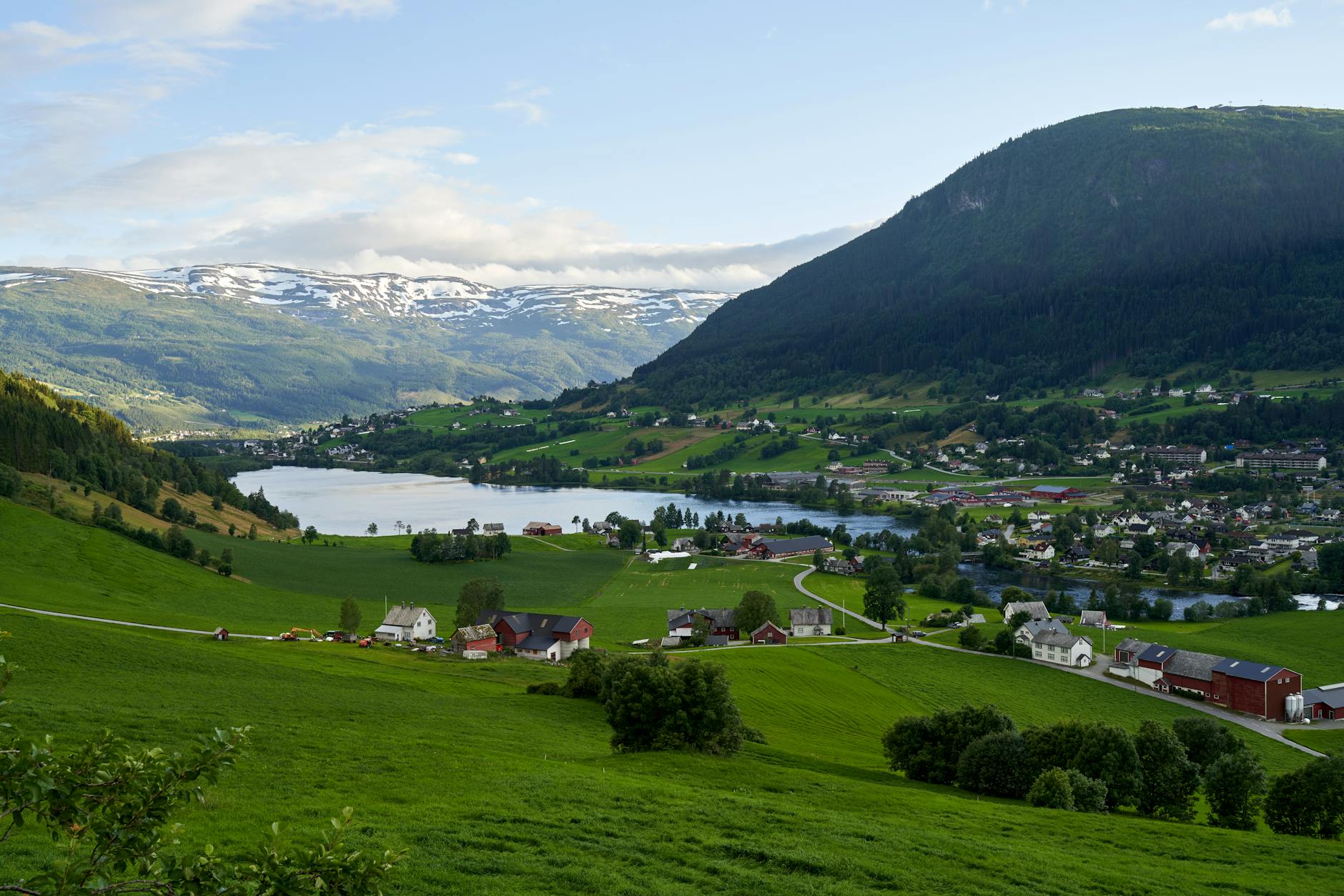
The Bergen area is ideal for exploring Norway’s beautiful fjords, with the Hardanger fjord to the south, and the Nordfjord and the Sognefjord to the north. It’s as good as Switzerland, and much nearer to Orkney.
Take a bus or train from Bergen, and in half an hour a panorama of lake, glacier, high plateaux and endless snow-capped mountains unfolds.
The most restless wanderer could be happy here for months. I was tempted to linger myself, except for that more distant goal: the famous Arctic Circle.
With limited spending money, I’d have to do it the hard way. With my rucksack and tent, and hitch-hiker’s thumb at the ready, I started at once on the journey north. Before long, I’d got my first lift in a Norwegian car.
A courteous young man took me well on the way to Voss, a popular lakeside resort. The road zig-zagged down through lovely snow-covered mountains – a hint of the breathtaking scenery to come.

I stayed the first night at Voss Youth Hostel, right by the lake, with wooded hills all around. Youth Hostel? It was more like a hotel, with comfy armchairs, TV, a sauna – even a disco, for those who like that sort of thing.
Next day, hitting the northward trail again, I took a bus to Balestrand, on the other side of the Sognefjord. The road climbed up to a wild paradise called the Vikafjell, where the sight of so much snow, crystal-clear streams and empty space made me want to jump off the bus and go wandering, there and then.
Still, the descent to Vik in Sogn is no less dramatic. The road winds down from a superb height, with an eagle’s view of the town below. And, beyond that, across the fjord, an almost Himalayan succession of mountain ranges, receding far into the distance.
The bus stopped at Vik for 20 minutes, giving one time to admire the vistas across the fjord, here several miles wide. Apart from its width, the Sogne is the longest and deepest fjord in the whole of Norway.
Then back on the bus, and on to Vangsnes, where the ferry crosses over to Balestrand. Here the main fjord branches away on several sides, and there’s even a glacier to contemplate in the distance.
But enough of such pleasant dallying. The Arctic Circle was still 700 miles away! Next day, after 14 hours of continuous travel, and fantastic luck with lifts, I found myself a hundred miles north of Trondheim, on the E6. This is the main route north, sometimes called the “Arctic Highway”. It was 2 am; and, with nowhere to stay, I pitched my tent by a river. At least, this far north, no summer camper ever needs a torch.
Then on up the E6 to Mo-I-Rana, the last big town before the Arctic Circle. The Youth Hostel was full, so I camped in a nearby forest, alive with mosquitoes. Strangely, the further north you go, the hotter it seems to get, and the harder the insects attack you. Maybe I was lucky, but for over a week I hardly saw a cloud.
But now my luck ran out on the road. Next day, after twelve hours in the baking sun, I’d got only 50 kilometers further. Yet on the map, I was almost there.
Rather than give up, I decided to walk to the Arctic Circle, if necessary. Again I camped out in the wilds. After another early start, encouraged by an onslaught of mosquitoes, I strode along the empty road, enjoying the morning heat, and the silent forests and hills.
Occasionally I displayed my sign saying Arctic Circle to passing motorists: who laughed or yawned, but always carried on. Imagine my surprise, then, when a car actually stopped!
At last I’d made it! The road climbed up to a huge bleak plateau, relieved on either side by snowy peaks. In this desolate landscape, a wooden building bedecked with flags came into view. This was it: the beginning of the Arctic!
The driver stopped and asked me if I wanted to send some postcards. This I did gladly, since from here alone would they receive the special Arctic Circle postmark – a collector’s item indeed.
Now only one thing remained: a sight of the midnight sun. The question was, where could you see it? The guide books said Bodø, capital of Nordland, was as good a place as any.
My hitchhiker’s luck returning, I arrived there by early afternoon. But, with nine hours to wait for the mystical event, and nothing much else to do, I submitted again to the wanderer’s impulse, and hurried aboard a departing post-boat. It was continuing north, to a group of islands called the Lofotens.

I had heard of this archipelago, and its spectacular charm. But the first glimpse was still a surprise; and there was more to come. The sea approach to Skye or Harris, or even the cliffs of Hoy, has nothing on the approach to the Lofotens.
Rugged, snow-capped mountains, stark and awesome, rising dramatically out of the sea, with little towns and fishing villages huddled at their feet. No chocolate-box scenery, this. It attracts by being outlandish, sinister, like something out of Tolkein’s Lord of the Rings.
Everywhere, the vertiginous descent from summit to shore. Only on the south coast of Crete have I seen such a startling coastline.
As the boat manoeuvred into the tiny harbour of Stamsund, I eagerly disembarked. My boat ticket was to Svolvær, further north; but on each trip, you are permitted to break your journey once.
The Youth Hostel was predictably full, so I camped on a foothill above two glacial lakes. With a climbable mountain at my back, what better place to see the midnight sun? Solar midnight, incidentally, is 1 am Norwegian summer time.
At 12.30, the sky was still blazing. But then, disappointingly, the object of interest disappeared behind some distant mountains. That’s the snag about seeing the midnight sun: there’s nearly always something in the way! Oh well, you can’t win ‘em all. An hour later it reappeared, rising gently along a slow arc from north to east across the sky. But what a sky! The Arctic air of unreality! Pale blue, merging to a pink translucence on the horizon, with high wisps of cirrus and alto cumulus, spreading fan-like over the ragged mountains and dark-blue sea.

The rest of my holiday passed like a dream. Svolvær, partly built on islands by bridges and causeways, protected from the open sea by innumerable skerries, and backed by fjords, plunging mountains and jagged peaks. I camped three days there, roaming the mountains, making iced coffee from the snow on their summits, where I sunbathed, free at last of the bloodthirsty mosquitoes and attacking horseflies, and those countless small black flies, which seemed to swarm into every aperture, so that in breathing you swallow half a dozen in a good day’s hiking.
Then, one evening, after 12 hours of clambering, and a glorious conquest of three mountain peaks, I hurriedly de-camped, and rushed to catch another northbound boat. An overnight vessel, full of camera-shod, unsleeping travellers, all waiting for that elusive midnight sun.
But first, another phenomenal event. In the middle of the brilliant night, the steamer passes through the renowned “Trollfjorden”: a steep-sided, high fjord of sheer rock, which ends abruptly after a mile, where a few houses cluster beneath a stupendous semi-circle of snow crested, precipitous mountains.
It’s as if the Corinth Canal had been cut straight into the middle of the Alps. The boat turns judderingly around at the end of this narrow fjord, while excited passengers clamber all over the foredeck, trying to take photographs, and the ship’s officer has to beg them to retreat from forbidden areas.
And still the excitement goes on. The islands become starker, more lurid, more astounding. The mountains tower overwhelmingly over the narrowing sound, diminishing the ship to the proportions of a toy in a Cornflake packet.
Then, at last, an open stretch of sea … and there it is, the midnight sun: dipping, hovering, and now – yes! – rising. A day ended, a day begun, in the undying rays of an unsetting sun.
Then further north still, to Risøyhamn, just below the 69th parallel. How far, one wonders, from here to the North Pole? Bergen seemed another world away. And yet I had to get back, in a matter of days.
The solution was simple, though not exactly cheap. All the way back on another post-boat, appropriately named the Midnatsol, or Midnight Sun. Three days of leisure, nursing mosquito bites and relishing the magnificence of Norway’s coast; now slipping effortlessly by …
Unforgettable? I’ll say!




Leave a Reply