
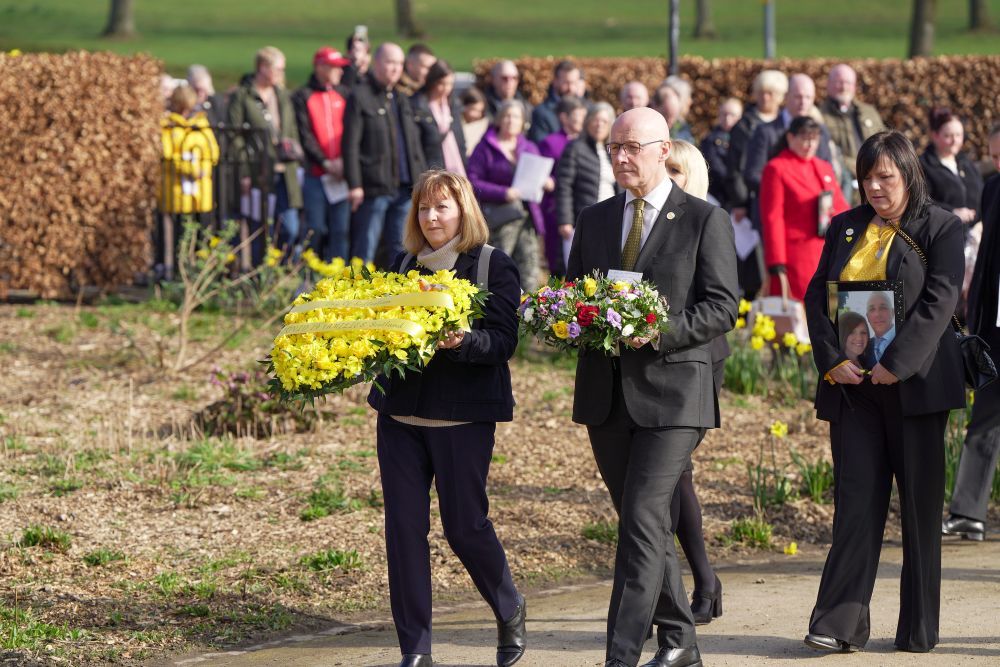
Sunday 9th March was Covid remembrance day – an official commemoration for all those who died during the pandemic. It was also an opportunity to remember all those who kept us going doing those dreadful times.

Covid is still present in our communities. There have been 19,563 Covid related deaths in Scotland, as at 25 February 2025, of these, Covid was the main cause of death in 15,313.

Cases of novel coronavirus (nCoV) were first detected in China in December 2019, with the virus spreading rapidly to other countries across the world. This led WHO to declare a Public Health Emergency of International Concern (PHEIC) on 30 January 2020 and to characterize the outbreak as a pandemic on 11 March 2020….Since the COVID-19 pandemic started, over 2 million people in the European Region have died from the disease. World Health Organisation
On 13 March 2020 the first confirmed death of a COVID-19 patient in Scotland was announced by Catherine Calderwood, Chief Medical Officer for Scotland.
Scotland’s first lockdown started on 24 March 2020.
The virus spread quickly and with fatal results especially for the elderly and those with underlying health conditions, but long covid has now affected thousands of people in Scotland.
These estimates show 79,000 (1.5% of people living in private households) in Scotland had self-reported long COVID in the four weeks to 6 March 2021. This increased to 204,000 (3.9%) in the four weeks to 3 September 2022, before decreasing to 172,000 (3.3%) in the four weeks to 5 March 2023. Investigating the prevalence of long COVID in Scotland
Many of those with long Covid have been unable to work as they once did, suffering periods of exhaustion and other conditions – “44,000 (25.6%) reported their ability to undertake their day-to-day activities had been “limited a lot”.
Although most of the population stuck to the lockdown rules, social distancing, wearing face masks, and working from home – those who did not included the UK Prime Minister at the time, Boris Johnson, who infamously partied on, Partygate, whilst those with family who were dying couldn’t even visit their relatives in their last days.
Scandal and profiteering has haunted the UK’s response to the Covid pandemic. Elderly hospital patients were discharged to Care Homes, taking with them the Covid virus, resulting in serious illness and sadly death to many.
Covid deaths included many health and social care workers who were having to cope with a virulent virus without adequate personal protective equipment. Others made vast profits from selling dodgy PPE under UK Government procurement contracts.
The High Court has ruled that the government has acted unlawfully by failing to disclose details of Covid-related contracts until forced to do so by litigation.
The judge said:
“The Secretary of State acted unlawfully by failing to comply with the Transparency Policy” and that “there is now no dispute that, in a substantial number of cases, the Secretary of State breached his legal obligation to publish Contract Award Notices within 30 days of the award of contracts.”
He went on to say:
“The obligations imposed by reg. 50 (in the Public Contracts Regulations 2015) and by the Transparency Policy and Principles serve a vital public function and that function was no less important during a pandemic. The Secretary of State spent vast quantities of public money on pandemic-related procurements during 2020. The public were entitled to see who this money was going to, what it was being spent on and how the relevant contracts were awarded. This was important not only so that competitors of those awarded contracts could understand whether the obligations owed to them under the PCR 2015 had been breached, but also so that oversight bodies such as the NAO, as well as Parliament and the public, could scrutinise and ask questions about this expenditure.”
In a report from The House of Commons Accounts Committee it stated:
The Department for Health & Social Care (DHSC) lost 75% of the £12 billion it spent on personal protective equipment (PPE) in the first year of the pandemic to inflated prices and kit that did not meet requirements – including fully £4 billion of PPE that will not be used in the NHS and needs to be disposed of. There is no clear disposal strategy for this excess but the Department says it plans to burn significant volumes of it to generate power – though there are concerns about the cost-effectiveness and environmental impact of this “strategy”.
The Public Accounts Committee says that as a result of DHSC’s “haphazard purchasing strategy” 24% of the PPE contracts awarded are now in dispute – including contracts for products that were not fit for purpose and one contract for 3.5 billion gloves where there are allegations of modern slavery against the manufacturer.
The Committee says this only exacerbates DHSC’s “track record of failing to comply with the requirements of Managing Public Money even before the further exceptional challenges of the pandemic response”. It also raises concerns about “inappropriate unauthorised payoffs made to staff by health bodies”, with the planned large-scale NHS restructuring “increasing the risk of this happening again.”
One of those said to have been profiteering in the PPE scandal is Michelle Mone, now Baronness Mone, sitting in the unelected house of Lords. The ongoing UK Covid Inquiry, however, has ruled that evidence related to PPE Medpro, the firm linked to Baroness Michelle Mone and her husband Doug Barrowman, will be heard in a closed, private session.
Profiteering whilst thousands were dying – and still the public does not know the extent of this abhorent money making scam.
Scotland has been holding a separate Covid Inquiry. The Inquiry has now moved on to investigating the impact of the pandemic in Scotland on worship and life events, and then equalities and human rights. It is anticipated that these hearings will conclude in June 2025. It is the largest ever public inquiry to be held in Scotland.
The UK Covid-19 Inquiry has been also covering how Covid affected personal lives in ‘Every Story Matters’ – the online form will close for submissions on Friday 23 May 2025. Every Story Matters has already received over 56,000 contributions – these have been gathered online on everystorymatters.co.uk, in person at public events, as well as through interviews and focus groups on different topics.
To date the Inquiry has released two records, the first detailing the public’s experiences of Healthcare, which was released in September 2024, with the second dealing with Vaccines and therapeutics published in January of this year. Each record will be presented to the Chair and will help shape her recommendations for the future.

Research scientists worked at speed to find a vaccination for Covid-19, a virus which changed and evolved. Once vaccines had been developed the successful uptake by the majority of the population meant that restrictions could be gradually lifted. Today a Covid vaccine is still being offered to the elderly and those with underlying health conditions due to the virus still being about within our communities.
Post Covid was supposed to be the ‘new normal’, but in reality it has returned to what we had before, with poor ventilation in public buildings and events spaces. Working from home which had proved to be so successful for many is increasingly rare – unless of course you are a member of Orkney Islands Council or the Scottish Parliament, where you can join in debates and votes from your own home instead of going in person to do so.
We all know someone we lost either due to Covid, or whom we couldn’t visit when they were ill during the lockdown. The mental health fall out from those restrictions continue.
Fiona Grahame


Leave a Reply to Suppressing the Evidence of War Crimes : 125 Journalists Killed in 2025 – The Orkney NewsCancel reply