
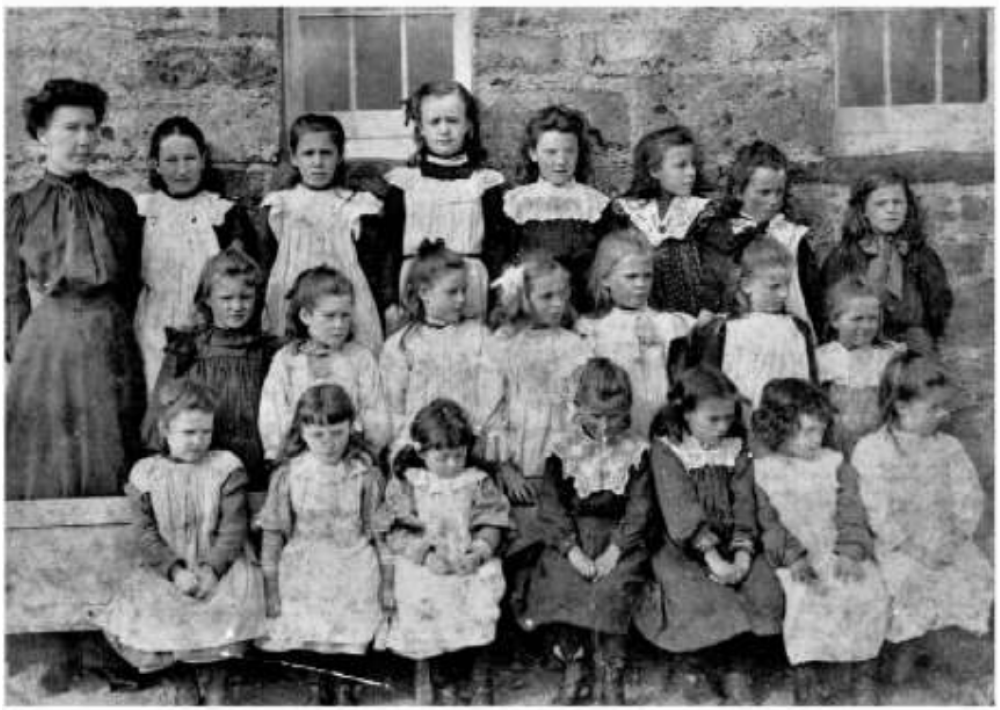
By Ian Cooper, from his excellent Records of a Bygone Age published in The Stronsay Limpet and republished here with kind permission.
Last month’s article ended in December 1900 with the resignation of Miss Catherine Raeburn, who had been teaching at the South School for about two years. Although her time in Stronsay had been relatively short she had obviously had a positive impact on the school pupils and the local church as can be seen in this newspaper report from January 1901.

Bearing in mind that Miss Raeburn’s annual salary was £55, a presentation of six guineas (£6.30) would have represented a very generous donation.
Miss Raeburn was replaced by Miss Jane M Shurie, who started teaching at the school in January 1901 at an increased salary of £60. Her stay too was comparatively short, moving on in July 1902 to teach at Skelwick in Westray. Her replacement as teacher moved in the opposite direction, with Miss Margaret Calder coming from the Rackwick school in Westray to the South School in August 1902 at the same salary as her predecessor. In June 1904, 14 year-old Jane Sinclair from Housebay was appointed as monitor to assist Miss Calder, no doubt an appointment much appreciated by Miss Calder.
It seems that Miss Calder never really settled into this post as she submitted her resignation from the South School in March 1905, apparently the third time she had done so, but this time it seemed to be final! Some clue to her dissatisfaction with the post may be found in a HMI (His Majesty’s Inspectorate for Education) report from the previous year where it was noted that, despite evidence of considerable effort by the teacher, the progress of the school hadn’t been altogether satisfactory. The inspector highlighted the poor working conditions and lack of adequate seating, particularly for the infants, as being factors. The report also drew attention to the fact that there was an excessive number of pupils for one teacher at the school, noting that there were 54 pupils present on the day of the inspection, 27 of whom were infants.
With Miss Calder’s departure the vacant post was then offered to Mrs Tolmie, longtime teacher at the North School, at an increased salary of £70 and, when this offer was declined, the position was offered to Miss Russel of Forres at a salary of £80. When this appointment also fell through the post was offered to Stronsay lass Annie Jane Logie, a former Pupil Teacher at the Central School who was currently teaching in Pharay, at a salary of £60 and she was happy to accept. Then, in February 1908, in what must have been a welcome appointment, 13-year-old Georgina Logie was appointed to assist her teacher sister Annie Jane at the South School.

Cottage; Nellie Spence (Waterside, Sillerha’ and Airy) Front: unknown; Jessie Cooper, Blinkbonny; Annie Cooper, Blinkbonny; unknown; Daisy Shearer of Cott (later Mrs Tulloch); Grace Smith of Scoulters (later Mrs Chalmers Housebay); unknown.
The Clerk had visited the South School on 19th April 1910 and found only 6 pupils present due to an outbreak of measles, with all children from any household where infection was present being excluded. After consultation with the local Medical Officer, it was agreed that the school should be closed from that date until the 9th May.
In December 1910 the South School was again closed for a time and thoroughly disinfected. The cause isn’t recorded but may well have been scarlet fever once more. This was soon to be followed by closure once again, this time in March 1911 due to an outbreak of mumps, when the school was shut for two weeks to allow the epidemic to pass.
Miss Logie resigned from the South School in October 1911 and it was agreed to advertise the vacant post at a salary of £80, with free part-furnished house and garden. Miss Elizabeth Fotheringhame, formerly from Hescombe, who had trained as a teacher in Edinburgh and was currently teaching in Wishaw, was appointed to the post the following month, a post she was to hold for 38 years.
Much of the following information comes from the South School logbook held in the Orkney Library Archives covering the period from 1913 until its closure in 1959.
Some of the events noted in the first year of the log were the installation of a new stove in February to better heat the building and, it was hoped, not see so much smoke billowing back into the room. The following month William Clyne replaced Alex Chalmers as Attendance Officer, whose role was to examine the attendance registers on a regular basis and visit the homes of those pupils who had been absent for no good reason. Although the school roll at that time stood at 52 it was noted that a number of pupils were being kept home to plant potatoes, which may well have instigated a visit from the newly appointed Attendance Officer.
Although maintenance didn’t seem to be a high priority with the School Board a new floor had been installed in the school during the summer break, with the classroom ceiling also being heightened and new roofs being fitted on the outhouses.
In February 1914 it was noted that the children of one family – 3 girls and a boy – had been excluded from school due to a ‘contagious skin disease’, possibly ringworm. They were taken off the roll and readmitted 6 weeks later.
By April 1914 the roll had fallen to 41 and 2 months later had again fallen, this time to 30, with a number of children leaving the island and others moving on to the Central School.
Following a HMI inspection in June 1914 the subsequent report, although noting some badly needed improvements, was generally quite encouraging, stating that:
“Thoroughly good work is being done in this school. The premises have been improved by the heightening and by the reflooring of the classroom and re-roofing of the offices. The Board should supply some more modern desks or replace the old furniture. The doors and walls of the offices, which are disfigured by scribbling of an objectionable kind, must be repainted and distempered. The school is insufficiently heated.”
An important aspect of Miss Fotheringhame’s teaching seemed to have been her desire to make her pupils aware of nature and the world around them, and to this end there seemed to be regular ‘nature rambles’. One of those was recorded on 26th June 1914 when, with all pupils present, the afternoon was spent at the seashore in the study of flowers, seaweed and shells. This was followed on 10th July by a ramble to the Muckle Water when she took her pupils to see the swans and to collect flowers.
The outbreak of war in August 1914 meant that many of our young men went off to join the army or navy, resulting in a reduced work force on the island. To help counter this, notice was received on 14th September that the school was to be shut for 3 weeks to allow the children to assist in the harvest. The next entry, dated 19th October, informs us that the school has been shut for a month, an additional week having been granted by the Board to allow people to finish their harvest.
It had been opened that day but only 7 children had turned up and it was thought that an outbreak of whooping cough seemed to be keeping many pupils home. This epidemic was to last until late December, when it was recorded that all school work was in a very backward state.
Holidays over the Christmas period were much shorter in those days, with the school being shut from 25th December 1914 until 1st January 1915 inclusive. Numbers in attendance remained low in the beginning of that term, still due to the lingering whooping cough epidemic. Weather too played its part, with only 3 pupils turning up on 11th January and none at all on the 13th, both due to heavy and persistent rain.
Absenteeism continued to be a problem throughout the early months of 1915 and, despite the best efforts of the Attendance Officer, led to the School Board sending a letter to parents on 28th May stating that they “insist on perfect attendance until the holidays or more stringent measures will be resorted to.” This appears to have had the desired effect as there is no record of any ‘stringent measures’ being resorted to.
Stronsay’s United Free Church had been granted free use of the North, South and Rothiesholm side schools to hold weekly Sunday Schools but in 1915 the Board agreed that the Janitor of each school should be paid 10/- per year for the extra work involved with this.
As we move into 1916, heavy rain on the 12th and 13th January again resulted in no pupils turning up for lessons. Then, in April, 4 pupils left to attend the Central School and 6 young pupils started school, giving a roll at that time of 37.
Dr RP Heddle, the County Medical Officer, visited the school occasionally, a duty later taken over by Stronsay’s own doctor, Robert Rosie. On 3rd May 1916, on what was recorded as his first visit to the school, Dr Rosie sent six children from Housebay home as Scarlet Fever was in their homes, with the rest of the children from Housebay being excluded the following day. Due to this epidemic the school was subsequently shut on 8th May, reopening on the 21st but no pupils put in an appearance that day, nor on the 22nd, 23rd or 24th. 11 turned up on the 25th but attendance remined very poor due to fear of the fever. Schools were again shut on 5th June, this time for a fortnight, and this was later extended for another week, the school being thoroughly disinfected during that time. When it reopened on 26th June the epidemic appeared to be over and attendances back to near normal.
A day’s holiday was given on 1st September 1916 to allow pupils to attend a sale of work in the Central School in aid of the war effort, with the school then shutting on 21st September to allow pupils to once again help with the harvest, only reopening on 30th October by which time harvest had all been completed. By this time Miss Fotheringhame recorded that all class work was in a very backward state.
Christmas holidays were again kept to the bare minimum, lasting from 25th December to 1st January inclusive.
There was little of note in the log for 1917, although a rather poignant entry on 12th October recorded that ‘The want of boots has kept one boy home all week.’
An unexpected early fall of snow and sleet after the children were at school on 26th November saw a rescue operation swing into action, where it was recorded that “Carts came for most of the children and all had gone by 3 o’ clock.”
The school reopened after the Christmas break on 2nd January 1918 but very soon afterwards heavy snow was to cause disruption for some considerable time. A day by day account was recorded in the log as:
7th January: Heavy drifting snow. No child could come out.
8th January: Worse today than yesterday
9th January: Snow lying deep on the ground and still falling
10th January: Fine frosty day but snow too deep for walking
11th January: This week is a complete blank with no child present. Today the snow is worse than ever.
14th January: Snow much too deep for the children but otherwise the day is good
15th January: Very bad snowstorm
16th January: Snow still continues
17th January: The day is good but the roads impassable
18th January: Another week gone and no child has come or could have come out.
21st January: Thaw has set in which has not improved matters.
22nd January: Weather looks threatening. Roads are very bad
23rd January: The thaw continues. Roads like a burn in places.
24th January: Ten children turned out today, most of them with wet feet. They dried their stockings at the fire and went home at 10 o’ clock.
25th January: Nineteen came today. They were dismissed at 2 o’ clock. The roads are still bad in many places.
By the beginning of the following week, as the thaw continued, all the roads were passable once more and things were returning to normal.
The worst of this snowstorm was recorded in the Orkney Herald of 16th January 1918 as follows:
Weather of the worst kind has been experienced in Orkney for a week and a half. The first phase of the snowstorm, which began on Sunday 6th inst., continued with varying intensity until the afternoon of Tuesday the 8th. Long before the storm subsided, all roads were hopelessly blocked by wreaths of snow, and Kirkwall was completely cut out from communication with the outlying districts. On Wednesday a slight thaw set in, but little impression was made on the mounds of snow which lay piled up to a great height across the roads. This thaw was of very short duration and from Wednesday to Saturday the whole county was bound in the iron grip of a most intense frost. On Saturday however the barometer began to fall and, in the evening, the second phase of the snow storm commenced. At first there was little or no wind, and consequently no drift; but early on Sunday morning the wind, which had been easterly, suddenly changed to the north northwest, and almost immediately attained the force of a gale. From then onward to daylight a most severe blizzard was experienced. The snow accumulated to great heights, and many people could be observed on Sunday forenoon digging a passage of outlet from their houses. When the storm ceased on Sunday, a period of comparative calm prevailed, which lasted until Monday afternoon. Then a change in the weather again took place. The wind shifted to the southeast, the sky became black with the gathering clouds, and the third phase of the storm – equal, if not exceeding in violence, those which preceded it – broke out. The snow came down in blinding sheets, carried along by the gale and none ventured out of doors except those on urgent business.
Later that year, in what was obviously a fairly delicate situation, the Board wrote to 73 year old Mary Maxwell of Sunnyside to tactfully suggest that, owing to her advancing years and failing strength, she should consider resigning her post as cleaner at the South School. The letter seemed to have the desired effect as Mrs Maxwell submitted her resignation soon after.
The pen of the Clerk to the Board was again in action in September 1918, with a letter sent to the head teachers of all the schools stating that ‘The Board desire to point out to the Headteachers in all the schools the necessity of strict economy in the use of coals owing to the great scarcity and high price of that useful commodity.
With the war still going on, a school holiday was declared on 13th June to allow pupils to attend a sale in aid of the Red Cross in the Central School.
Rambles were still an important and welcome part of the curriculum, with pupils spending the afternoon of 24th May at Lamb Head and the Dane’s Pier. This was followed by a ramble to the Muckle Water on 7th June, an afternoon gathering wild flowers on 21st June and an outing to the sands below the Telegraph Test Hut at Holland on 28th June.
John Shearer took over from William Clyne as the School Board Officer in May 1918 with another change in September when John Fotheringhame took over from Mr Shearer.
1918 also saw the abolition of the School Boards, which had served the educational needs of Scotland for almost 50 years, to be replaced by School Management Committees serving a very similar purpose but under the control of the County Council’s Education Committee.
Part 3 next month.
Leave a Reply