
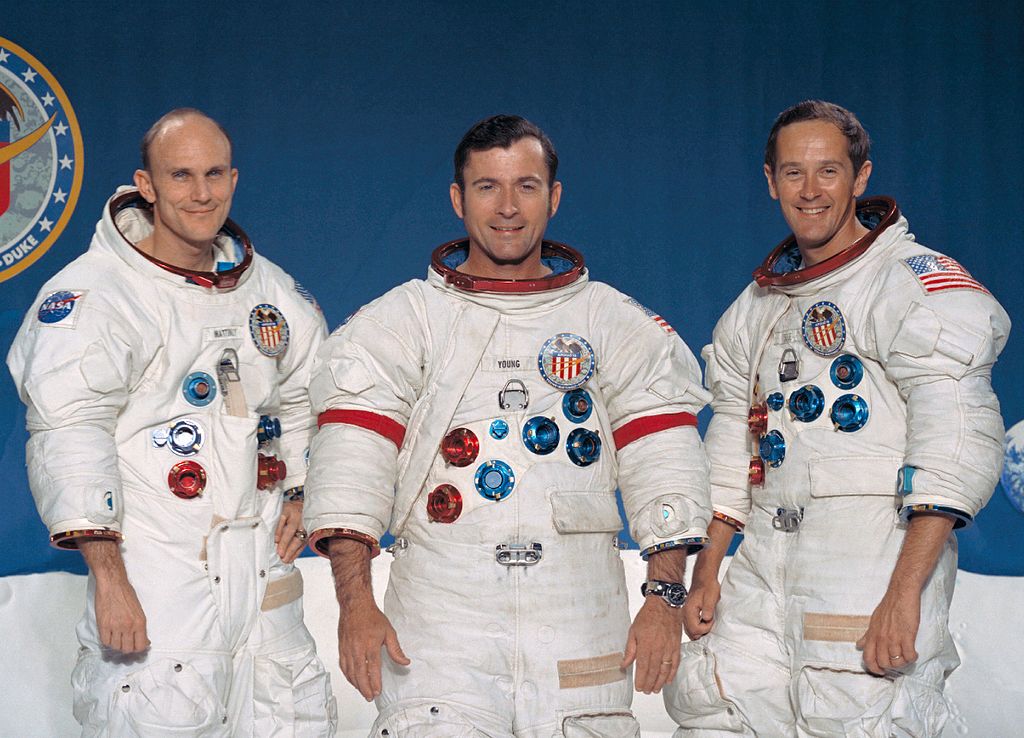
On 20 April 1972 Apollo 16’s John Young & Charles Duke landed on the moon with Boeing Lunar Rover #2.

Apollo 16 (April 16–27, 1972) was the tenth crewed mission in the United States Apollo space program, administered by NASA, and the fifth and penultimate to land on the Moon.
Mission Facts
Launch: April 16, 1972; 12:54:00:567 p.m. EST
Launch Pad: 39A
Orbit Duration: 11 days, 1 hour, 51 minutes
Orbit Altitude: 107.5 miles
Orbit Inclination: 32.54 degrees
Orbits: 64 revolutions
Orbit Surface Time: 71:02:13
Orbit Distance: 1,391,550
Landing: April 27, 1972
Landing Location: Pacific Ocean
Payload: Casper (CM-113), Orion (LM-11)

Commander: John Young. He is the first person to fly in space six times from earth, and seven times counting his lunar liftoff.
Lunar Module Pilot: Charles M. Duke Jr. this was his first and only flight to space for Apollo 16.
Command Module Pilot: Thomas K. Mattingly II originally selected as Command Module Pilot for the Apollo 13 flight he was removed from flight status 72 hours prior to the scheduled launch due to exposure to the German measles.
Apollo 16 entered lunar orbit on April 19, 1972.
Young and Duke touched down at the Descartes site in the lunar highlands. They conducted three surface excursions totaling more than 20 hours, using a Lunar Roving Vehicle for transportation. They deployed an experiment package, collected 209 pounds of rock and soil samples, and set up the first telescope on the Moon. In the meantime, Mattingly conducted observations and photography of the lunar surface from orbit. – Apollo 16 on the Moon at Descartes (NASA)



Leave a Reply