
Germany unconditionally surrendered on Tuesday 8 May 1945. It became known as Victory in Europe day. It was not the end of World War 2. Many servicemen continued in active service not only in Europe but in other conflict zones.
There were still many restrictions for civilians which would continue for some time. Rationing was to go on for years, and photography was restricted. In Orkney official photographers were permitted to take pictures of VE Day events in the islands. Reporting was also still under strict censorship.
VE Day in Orkney was a day of heavy rain and dreadful weather but this did not prevent events going ahead to celebrate the end of the war in Europe.
On news of the ending of the war in Europe the Lord Lieutenant of Orkney and Zetland, Alfred Baikie, sent a telegram to the Lord Chamberlain, Buckingham Palace:
On behalf of the people of Orkney and Zetland, please convey to His Majesty their sincere congratulations on the penultimate victory.
There were two days of public holidays.
There were dances in the Kirkwall Town Hall and the Drill Hall. More dances and events were held as the days passed. The Home Guard also organised an All Scottish Dance in the Drill Hall Kirkwall on 17 May.
In Stromness the dances in the Town Hall and military camps were packed. Dances took place across all the islands.
The Gordon Highlanders Military Band paraded through the streets of Kirkwall and held a concert at the Market Green. A collection was taken for the Welcome Home Fund.
Church services took place all across Orkney and bells rang out.
A service took place in the Paterson Church Kirkwall on the evening of May 8 as the St Magnus Cathedral organ required to be repaired. Three Church of Scotland congregations and the Congregational Church came together for the thanksgiving service. A thousand people attended.
In Stromness, churches were open throughout the day with people coming out to attend despite the atrocious weather.
In Longhope flags flew and at 3pm the vessels in the bay began hoisting their bunting and blowing their whistles.
Returning home were POWs. Private William Harvey of the 2nd Seaforths was captured at St Valery in 1940. He was liberated by Russian forces from Stalag 344.
Private Thomas Tulloch of Eday had been in a German POW camp since Dunkirk, in 1940, his family were informed that he would be coming home soon.
Second Officer J. R.C. Bremner had been in a German prison camp for four and half years. He was now on his way back to Stromness.
But there were people still waiting to hear news of their sons and husbands. Private Johnston of the Parachute Regiment had been captured around D Day in June 1944. His family were still waiting to find out when he would return.
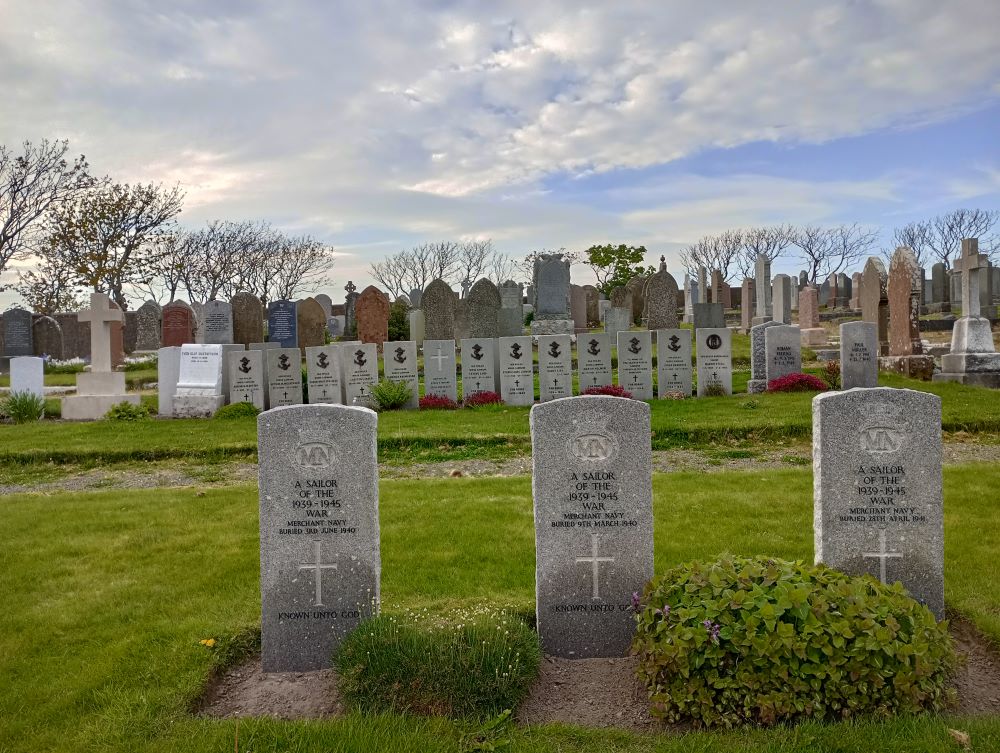
Not everyone came home. Even in the last weeks and months of the war, when it seemed like it would soon be over, servicemen were killed. There were still delays in news reaching home. In May, as others were celebrating the end of the war in Europe, the family of Andrew Garson age 24, a Royal Marine Commando, received the sad news that he had died of his wounds on April 22.
The Blackout was over. It was hoped that now repairs would be done by the council to street lights. The situation in Stromness was particularly bad.
Thoughts turned to the future, where people would have a better standard of living: a massive house building programme, the creation of the National Health Service providing free medical care, the nationalisation of key industries, and a lasting Peace.
The Stromness correspondent for The Orkney Herald remarked:
And so another war comes to a finish. So long as we live we don’t want to see any more victory days (except the forthcoming VJ Day – Victory Over Japan ).

Fiona Grahame

Donate to The Orkney News
£2.00

Leave a Reply