
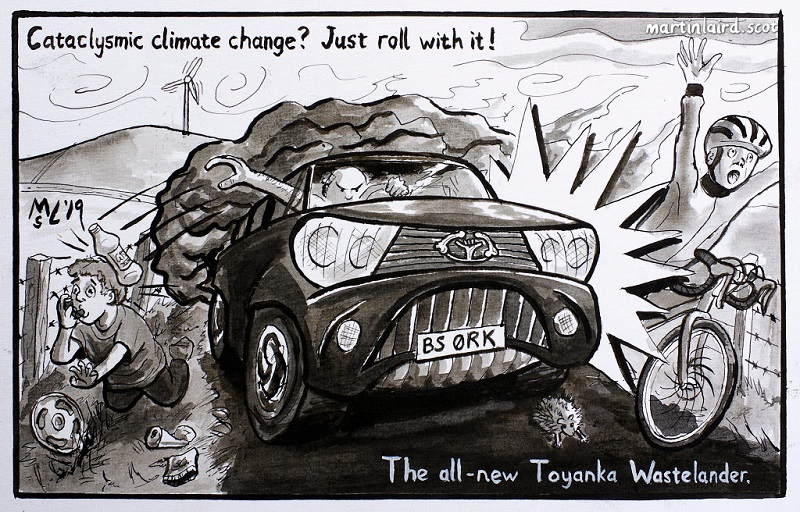
Is it all down to planting more trees ? What are the biggest contributors to Greenhouse Gas Emissions in Scotland ? And what is working well to reduce them.
“The SNP’s record on the environment is one of grand promises and woeful delivery,” commented Sarah Boyack, Labour’s spokesperson for Net Zero.
The comments come after the publication of the report, Scottish Greenhouse Gas Statistics 2023, which reported net emissions from seven greenhouse gases were estimated to be 39.6 million tonnes carbon dioxide equivalent (MtCO2e).
Sarah Boyack MSP continued:
“It’s clear more must be done to drive down emissions in Scotland and do so in a way that delivers lower bills for struggling Scots and creates good quality green jobs.
“The SNP’s failure to plant trees and restore peatland at the rate needed means our land is not operating as a carbon sink.
“The UK Labour government is stepping up where the SNP has failed and is driving forward investment in clean energy and green jobs through GB Energy – but we need change in Scotland too.
“A Scottish Labour government will use devolved powers to cut emissions – supporting green transport, helping agriculture reduce emissions, boosting treeplanting and peatland restoration, and retrofitting Scottish homes.”

The report states that :
There was a very large reduction in emissions in the electricity generation sector of 0.8 MtCO2e in 2023, with a large reduction in gas-fired electricity generation being principally responsible for this drop. More modest reductions were seen in Fuel Supply (-0.4 MtCO2e); and Buildings & Product Uses, Domestic Transport, Industry and waste; which all reduced emissions by 0.1 MtCO2e when compared to 2022.
Agriculture emissions were essentially unchanged between 2022 and 2023, falling very slightly by 0.1 per cent.
However, the above reductions were offset partially by increased emissions in international aviation and shipping (+0.3 MtCO2e) effectively returning to their pre-COVID levels; and ‘Land Use, Land Use Change And Forestry’ (LULUCF) increasing by 0.6 MtCO2e in the latest year.
Scottish Greenhouse Gas Emissions, 1990 to 2023.


Power stations alone account for 33% of the decline in Scotland emissions between the base year and 2023. – DA GHG Inventory 1990-2023 Report
Reducing emissions was successful as follows:
- Reduction in Electricity Supply emissions (i.e. power stations) (-13.8 MtCO2e; 93.4 per cent reduction)
- Industrial emissions fell 7.5 MtCO2e (59.5 per cent reduction)
- ‘Land Use, Land Use Change And Forestry’ (LULUCF) reducing its net emissions over the period, reducing by 5.5 MtCO2e since 1990.
- Reduction in Waste Management emissions (such as Landfill) (-4.6 MtCO2e; a 73.1 per cent reduction)
- Reduction in Fuel supply emissions (-3.7 MtCO2e; a 55.9 per cent reduction). Reduction in Buildings and product use emissions (-3.4 MtCO2e; a 31.0 per cent reduction)
- Domestic transport fell by 2.4 MtCO2e (a 17.3 per cent reduction)
- Agricultural emissions fell by 1.1 MtCO2e (an 13.0 per cent reduction)
Increased emissions took place, however, in International aviation and shipping where emissions increased by 0.4 MtCO2e. (MtCO2e refers to million tonnes of carbon dioxide equivalent. )
Friends of the Earth Scotland commented that the report was a “grim reminder of Ministers decision to scrap annual targets to cut pollution.”
Alex Lee, Friends of the Earth Scotland’s senior climate campaigner, said:
“Scotland is facing extreme wildfires and suffering from the driest spring in 60 years and yet Ministers are still considering building a new gas burning power station at Peterhead and can’t bring themselves to say that we shouldn’t be drilling for more oil in the North Sea.
“John Swinney’s year as First Minister has been one of no progress to reduce climate pollution or deliver on a fair transition. His team have been allowed to pay lip service to climate action whilst key policies that could improve lives have vanished or been scrapped.
“For too long Scottish Government Ministers have kept people trapped in cold homes, underserved by public transport and offered no certainty of a clear transition plan for oil workers. Climate solutions are the same solutions to the cost-of-living crisis – cheaper energy, affordable transport and secure jobs building the green infrastructure we need.”
What is the picture like across the whole of the UK ?
Greenhouse Gas Emissions for the UK 1990 – 2023
- In 2023, England’s GHG emissions are estimated to be 284.8 million tonnes CO2e (MtCO2e), which represents a 74.0% share of total net UK GHG emissions. England has seen a decrease of 55% in GHG emissions between the Base Year and 2023. Emissions between 2022 and 2023 have decreased by 5%.
- In 2023, Scotland’s GHG emissions are estimated to be 37.8 MtCO2e which represents a 9.8% share of total net UK GHG emissions in 20232. Scotland has seen a decrease of 51% in GHG emissions between the Base Year and 2023. Emissions between 2022 and 2023 have decreased by 2%.
- In 2023, Wales’s GHG emissions are estimated to be 33.7 MtCO2e which represents an 8.8% share of total net UK GHG emissions in 20233. Wales has seen a decrease of 38% in GHG emissions between the Base Year and 2023. Emissions between 2022 and 2023 have decreased by 6%.
- In 2023, Northern Ireland’s GHG emissions are estimated to be 18.2 MtCO2e, which represents a 4.7% share of total net UK GHG emissions in 2023. Northern Ireland has seen a decrease of 31% in GHG emissions between the Base Year and 2023. Emissions between 2022 and 2023 have decreased by 7%
Domestic Transport is the Largest Source of Emissions in Scotland

Domestic Transport – Includes all emissions from domestic vehicles, including domestic air and marine travel.
Scottish Greenhouse Gas Emissions by Territorial Emissions Statistics Sector, 2023.

In 2023, Domestic transport (excluding International Aviation and Shipping) (11.4 MtCO2e) was the largest source of net emissions, followed by Buildings and product use (7.7 MtCO2e), Agriculture (7.5 MtCO2e), Industry (5.1 MtCO2e) and Fuel supply (2.9 MtCO2e).
Scottish Greenhouse Gas Emissions by Gas and by Territorial Emissions Statistics Sector 2023. Values in MtCO2e
| TES sector | Carbon Dioxide | Methane | Nitrous Oxide | Fluorinated gases | Total |
| Agriculture | 1.2 | 4.5 | 1.9 | 7.5 | |
| Buildings and product uses | 7.1 | 0.1 | 0.1 | 0.4 | 7.7 |
| Domestic transport | 11.1 | 0.0 | 0.1 | 0.1 | 11.4 |
| Electricity supply | 0.9 | 0.0 | 0.0 | 1.0 | |
| Fuel supply | 2.6 | 0.3 | 0.0 | 2.9 | |
| Industry | 5.0 | 0.0 | 0.0 | 0.1 | 5.1 |
| International aviation and shipping | 1.7 | 0.0 | 0.0 | 1.8 | |
| LULUCF | -3.9 | 3.7 | 0.7 | 0.5 | |
| Waste | 0.0 | 1.6 | 0.1 | 1.7 | |
| Net emissions | 25.7 | 10.3 | 2.9 | 0.6 | 39.6 |
Domestic Transport has consistently been a large part of Scotland’s emissions. This sector showed dramatic reduction in emissions associated with the COVID-19 lockdown in 2020 (-2.4 MtCO2e) but rebounded in 2021 by 0.9 MtCO2e, and increased again in 2022 by 0.3 MtCO2e. In the latest year, domestic transport emissions fell slightly by 0.1 MtCO2e.
Domestic Road Transport

Domestic transport has been the largest source of emissions in Scotland since 2013. Within domestic transport, road transport contributes to 22% of the 2023 inventory. – DA GHG Inventory 1990-2023 Report
The Scottish Government has launched the The Zero Emission Heavy Duty Vehicles Skills Challenge Fund to develop the skills in the workforce in the switch to zero emission heavy duty vehicles (HDVs).
Cabinet Secretary for Transport Fiona Hyslop said:
“The transition to net zero will lead to a change in the type of jobs within the transport sector, so it’s essential we help workers access the skills they need to adapt to and support that change.
“The Zero Emission Heavy Duty Vehicles Skills Challenge Fund is being launched to support organisations in addressing the key challenges for the sector – covering issues such as access to training, increasing diversity and encouraging private investment in skills.
“The delivery of this fund is a Programme For Government commitment and I encourage companies to take this opportunity to develop skills for the transition and tackle long-standing workforce challenges making the sector more attractive to new entrants.”
Domestic Road Transport Statistics for the Whole of the UK
The UK Department of Transport Vehicle licensing statistics: 2024 report that:
Comparing 2024 with 2023, in the UK there were:
- 2,605,000 vehicles registered for the first time, an increase of 3%
- 410,000 zero emission vehicles registered for the first time, an increase of 20%
At the end of 2024, compared to 2023, in the UK, there were:
- 41.7 million licensed vehicles, an increase of 1%
- 1,394,000 licensed zero emission vehicles on the road, an increase of 37%
At the end of 2024 zero emission vehicles accounted for 3.4% of all road using vehicles, an increase of 0.9 percentage points from the end of 2023.
And whilst there is an increase in the number of licensed zero emission vehicles being licensed what is actually on our roads shows that change is still a long way off.
Licensed road using vehicles and licensed zero emission vehicles by body type, with one year and total stock comparison, UK, 2024, (VEH1103a)
| Body type | 2024: Licensed road using vehicles (thousands) | 2024: Licensed zero emission vehicles (thousands) | 2024: Proportion (%) of all licensed road using vehicles that are zero emission |
|---|---|---|---|
| Total | 40,848 | 1,394 | 3.4 |
| Cars | 33,967 | 1,287 | 3.8 |
| Light goods vehicles | 4,790 | 86 | 1.8 |
| Heavy goods vehicles | 518 | 1 | 0.2 |
| Motorcycles | 1,355 | 14 | 1.0 |
| Buses and coaches | 143 | 5 | 3.6 |
| Other vehicles | 75 | 1 | 0.7 |

Fiona Grahame

Donate to The Orkney News
£2.00




Leave a Reply