
“In 2022/23, the exclusion rate for looked after pupils was almost six times the rate for all pupils.” – Exclusion Labelled as Support.
The Scottish Government has issued guidance on when exclusion can be used and other behaviour support strategies for schools, hot on the heels of a damning report by Who Cares Scotland for the Children & Young People’s Commissioner which makes three key recommendations.

This in turn follows a report about Education in Scotland’s schools by Commissioner Nicola Killean in March of this year.
Too many Care Experienced children and young people are not getting the support they need to thrive in education, according to the new report.
The guidance from the Scottish Government, working in collaboration with the Scottish Advisory Group on Relationships and Behaviour in Schools (SAGRABIS), and jointly chaired with COSLA, states that exclusion should only be used as a last resort, where proportionate and there is no appropriate alternative.
The report for Charity Who Cares? Scotland found:
Young people told us that many of them had experienced exclusions or alternatives to exclusions, and that these measures often made them “feel like failures.”
In Commissioner Nicola Killean’s wide-ranging report into education in March, she warned that the whole system needs overhauled to work for all children. She made a series of recommendations to the Scottish Government and education authorities.
Ms Killean commissioned Who Cares? Scotland to look specifically at Care Experienced children – those who are or have been in care such as children’s homes, foster care, or who are looked after by relatives or at home with social work involvement – in education as there has been a gap in evidence for this group whose rights are more at risk.
Commissioner Nicola Killean said:

“The report by Who Cares? Scotland reinforces findings from my recent report that too many children are being let down by the current education system.”
“Every child has a right to an education that develops their personality, talents, and abilities to their full potential. But we know this isn’t happening for lots of children who have care experience.
“It is important that we actively seek to include the views of children whose rights are most at risk as their voices can often be lost.
“This report shows that despite some examples of good practice, Care Experienced children and young people’s right to education is often not being met.
“They are more often excluded from school than other children and are often given part-time timetables that they do not want. In some cases, a child can be on a timetable for as little as 30 minutes or one hour a week, even if they want to be in school for longer.”
Evidence for this report was drawn from Who Cares? Scotland’s database of issues raised by children and young people seeking advocacy. The evidence – from various sources – included testimony from 200 young members of Who Cares? Scotland at participation events, and through small bespoke group sessions, and 1:1s with members.
The report reveals education is one of the top three issues for young people requesting advocacy from Who Cares? Scotland. Within education, the most common subject raised is ‘support in school’. The report covers topics raised by young people including feelings of stigma and prejudice, mental health and emotional support, formal and informal exclusions, impact of care transitions, academic support, and additional support for learning.
Many other young people request advocacy support to prevent being moved schools. While we know that Care Experienced people often have several care placement moves across their lives, Scottish Government data records the number of care placement moves in one year only. For academic year 2022-23, 13% of children in care had two placement moves, and 4% had three or more. – Exclusion Labelled as Support
Despite the Scottish Government’s pledge to keep The Promise – a commitment made after the Independent Care Review that Scotland would be the best place for Care Experienced children to grow up loved, safe, and respected – the new report by Who Cares? Scotland shows:
- Care Experienced children and young people are over-represented in rates of exclusions and are often subject to part-time timetables limiting their access to education
- support services for Care Experienced young people in education are not consistently available or meeting their needs, and
- the right to independent advocacy can help keep The Promise.
“School isn’t about all the textbooks or sitting at a desk. I’d say the most important thing about school is finding out who you are and making friends. Academia is more about learning life lessons…who to trust.” Individual participant, Exclusion Labelled as Support.
Louise Hunter, Chief Executive Officer at Who Cares? Scotland, said:
“Every child and young person in Scotland deserves to have an education that allows them to learn, flourish and dream big. But our report highlights that the most basic right to education for too many Care Experienced pupils is not being met.
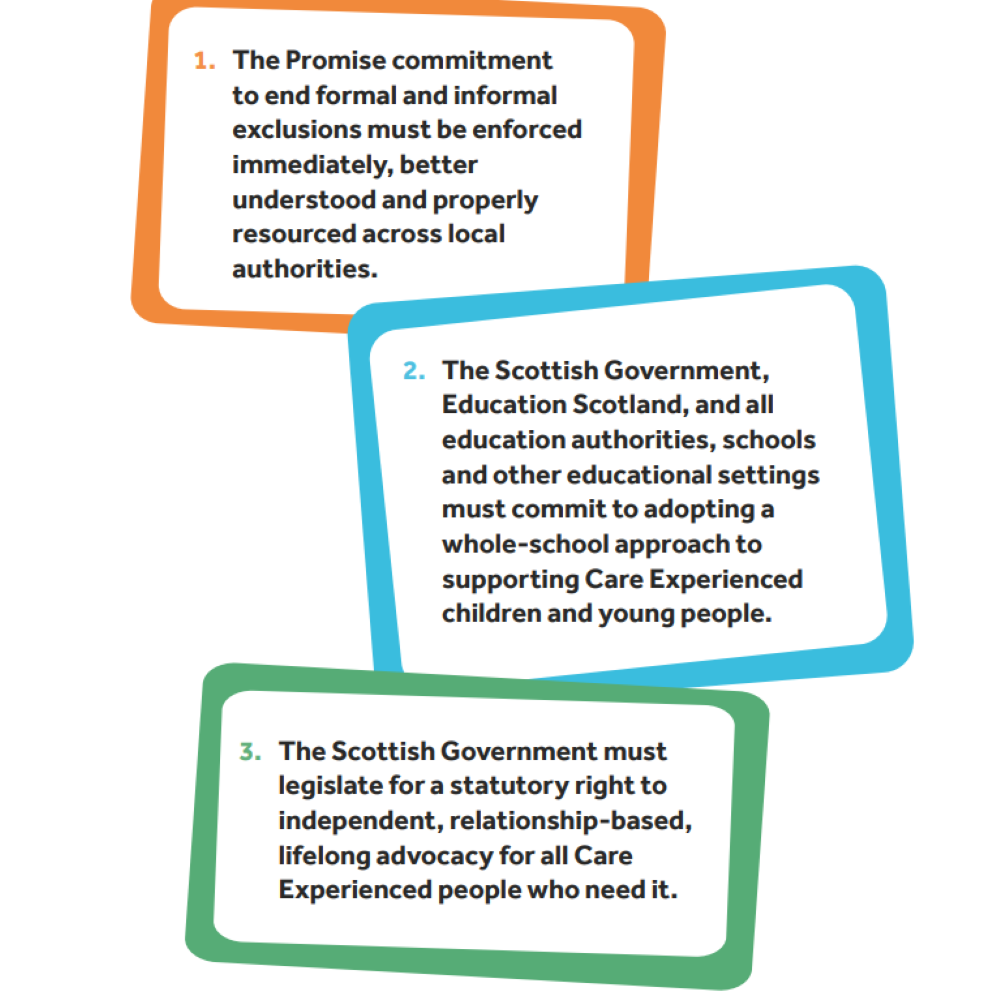
“Scotland must uphold this right and within our report there are three recommendations on how to make this happen. First, there must be action on advocacy. The Government must legislate for a statutory right to independent, relationship-based, lifelong advocacy for all Care Experienced people who need it.
“Next, the commitment within The Promise to end the formal and informal exclusion of Care Experienced pupils must be enforced. Lastly, a whole-school approach to supporting Care Experienced children and young people must be adopted. Only then will we be able to ensure all pupils in Scotland are taught in communities that care.”
Ms Killean is urging the Scottish Government to immediately scrutinise the use of informal exclusions and part-time tables to ensure that the rights of Care Experienced children and young people are respected, protected and fulfilled.
Education Secretary in the Scottish Government Jenny Gilruth, commenting on her published guidance said:
“The majority of children and young people behave well in school, but where someone needs support with their behaviour, it is important that schools can respond in ways that are appropriate, supportive and respond to the needs of each individual child. Evidence clearly shows young people need structure and boundaries to support their development and having predictable consequences helps them to feel safe.
“Responding to behaviour in our schools requires all members of the school community – staff, children and young people and parents and carers – to work together to identify the values that underpin school life, how this translates into expectations of behaviour, and to support appropriate responses. We want to create a strong partnership between home and school to help create a consistent, supportive environment where children feel safe, respected, and are better able to learn and thrive.
“This guidance takes account of the concerns about behaviour I have heard from teachers, support staff and teaching unions, and will be an important tool in ensuring that they are properly supported in our schools.”
You can download a copy of ‘Exclusion Labelled as Support’ here:
Fiona Grahame

Donate to The Orkney News
£2.00


Leave a Reply