
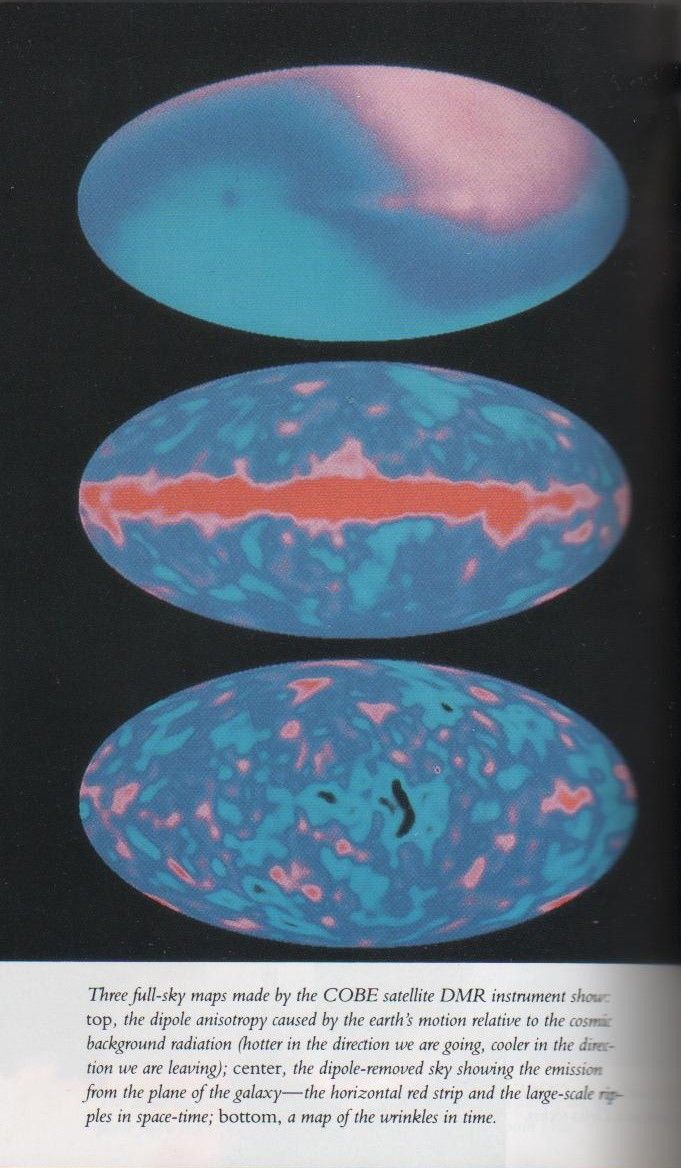

To start where I normally finish on this topic: when the motion of the Local Group of galaxies (of which our Milky Way is a member) was first discovered, it was as an imbalance in the Cosmic Microwave Background (technically, its Anisotropy), which is the leftover radiation from the Big Bang (Fig. 1).

At first it seemed as if the Local Group was in orbit around the Virgo cluster of galaxies, 53 million light-years away (Fig. 2), then that they were orbiting the Coma cluster of galaxies at 320 million light-years (Figs. 3-5).


But it turned out that the Local Group and all the rest in Fig. 5 were sweeping round the Coma Cluster as part of a much larger grouping called Laniakea (Fig. 6), responding in turn to an unknown Great Attractor (Fig. 7), which in turn has been resolved into a supercluster in Boötes and several smaller ones, 820 mly distant and 1000 mly across (Fig. 8), in an overall structure with a still less pronounceable name from the Kumulipo, a Hawaiian creation chant evoking the origin of structure.


The protrusion into it of the Sloan Great Wall at bottom left and the fainter figures in the background bring us towards the scale of the Cosmic Web, the strings of dark matter from the earliest history of the Universe, between which lie the interconnected voids (Fig. 9) and along which the visible galaxies are aligned (Fig. 10).


The ‘local’ features above are on a much larger scale than the ones discussed last week, where the ‘Local Bubble’ generated by supernova shockwaves was only 1000 light-years across, between two arms of the Milky Way spiral. The Local Group of galaxies is about 10 million light-years across, 10,000 times larger, the ‘local universe’ of Fig. 5 is roughly 4 times larger again, the ‘local void’ of Fig. 7 is roughly 6 times larger still, and the ‘bubble’ surrounding the Boötes supercluster in Fig. 8 is a billion light-years across, a million times larger than last week’s ‘Local Bubble’.

The Local Group contains just three spiral galaxies (Fig. 11). The three spirals are M31, the Great Nebula in Andromeda, M33 in Triangulum and the Milky Way, which is intermediate in size between the others (Fig. 12).

(The M-numbers are from the catalogue of nebulae and galaxies compiled by Charles Messier in 1774-81, so they wouldn’t distract him when searching for comets, but the catalogue turned out to be far more important.) There are also a large number of smaller dwarf galaxies, including the Milky, Way’s two major satellites, the Large and Small Magellanic Clouds, perhaps the best known because they’re visible to the naked eye, in the southern hemisphere (Fig.13).


It seems likely that they were once parts of a dwarf spiral which had a destructive passage through the outer arms of the Milky Way, and they’re linked by a bridge of dust, gas and newly formed stars which are evidence of that (Fig. 14). This is happening now with the Sagittarius dwarf galaxy, which has passed through the outer arms four times in the last 8 billion years, generating star streams each time (2 shown in Fig. 15), and with the next encounter due in 10 million years.

Tracing similar streams, the Gaia space telescope has shown that even larger collisions and mergers over the last 11 billion years have shaped the Milky Way as it is today (Figs. 16-18), the most recent just 6 billion years ago, possibly giving birth to our Sun in the subsequent 2 billion years of star formation, and meaning that there could be forms of life in the Galaxy contemporary with ourselves.


For many years, since the 1960s at least, it’s been assumed that the rate of star formation in the Galaxy has been a steady 1-2 stars per year – it’s one of the assumptions of the Drake Equation, seeking to predict how many civilisations there might be in the Galaxy (Fig. 19 ‘r*‘) – and Gaia has demonstrated that’s far from the case.

My friend Dr. Gerry Nordley has suggested that even if advanced civilisations last for a million years, on average, they might still be so widely separated in space that over 15 million years, none of them ever get in touch (Fig. 20). But if they all start off from stars of roughly the same age – even over a 2 billion year spread – it improves the odds at least a little.

The other two spirals show similar evidence of collisions. It was thought at one time that M31 had undergone a merger with a full-sized spiral like ours, and contained two supermassive black holes as a result, but it turned out that one of the apparent ones was actually a ring of red giant stars around the other. But M31 and M33 are suggestively close in the sky (Figs. 21 & 22), and sure enough there turns out to be a bridge of gas and new stars between them (Fig. 23).


And rather oddly, almost all the dwarf companions of M31 are on the same side of it, the side nearest us – noticeable in Fig. 11, once you look. (Keith Cooper, ‘Our galactic neighbour Andromeda has a bunch of satellite galaxies — and they’re weirdly pointing at us’, Space.com, April 22nd 2025).
It’s also strange that the Local Group is virtually flat, with the three spirals on a diagonal plane through Fig. 11 and the satellites orbiting them staying close to it – almost inviting collisions, and looking as if there have already been some. It’s as if there are unknown attractors out there, and they might be dark matter concentrations between the galaxies.
But right on cue, just before I started writing this, another possibility came up. I can’t say ‘came to light’ because there’s none involved. It is known that there’s normal, ‘baryonic’ matter in intergalactic space, though hitherto nobody’s been sure how much.

But in studying the still not explained phenomenon of ‘FRBs’, Fast Radio Bursts from distant galaxies (Fig. 24), investigators have found evidence of diffuse matter along the signal paths, and as previously surmised, there’s a lot of it. Liam Connor and his colleagues at the Harvard & Smithsonian Center for Astrophysics (CfA) have studied 69 FRBs at known distances from 11.7 million to 9.1 billion light-years, using multiple radiotelescopes around the world, and the results indicate that of the invisible normal matter in the Universe, 76% of it is in the space between galaxies, 15% is locked up in the vast diffuse haloes around galaxies, and the remainder consists of stars and cold galactic gas. (Richard Lea, ‘Scientists find universe’s missing matter while watching fast radio bursts shine through “cosmic fog”‘, Space.com, online, 16th June 2025.)
And before I had time to submit what I thought was the final version, the same Richard Lea announced through Space.com that the XMM-Newton and Subaru x-ray space telescopes of the European and Japanese Space Agencies, respectively, had found a filament of baryonic matter, 23 million light-years long, with 10 times the mass of the Milky Way, linking four of the galactic clusters in the Shapley Supercluster, which can be found on the upper right of Fig. 5 and at bottom centre of Fig. 8. Although the filament’s at a temperature of 10 million degrees C, it’s been virtually invisible till now, masked by x-rays from supermassive black holes within it. (Richard Lea, ”’The models were right!’ Astronomers locate universe’s ‘missing’ matter in the largest cosmic structures’, Space.com, 19th June 2025.)
It’s apparent confirmation that the intergalactic matter occurs in high-velocity clouds of hydrogen, rather than being evenly spread as it is in the galactic halos. Travelling at hundreds of kilometres per second, smaller ones fall into the Milky Way and help to fuel star formation in the spiral arms.


But one notable exception is the Smith Cloud, discovered in 1963, thought to have been ejected from the rim of the Milky Way about 70 million years ago and now falling back (Fig. 25), to return to us in about 30 million years (Fig. 26). It’s been studied by the Green Bank radiotelescope and the Hubble Space Telescope along sight-lines to nearby dwarf galaxies (Fig. 27).

It’s similar in composition to the Great Nebula in Orion, which is a star-forming region and may help to explain its ejection, but it may have a dark matter halo, as many dwarf galaxies have. 9,800 by 3,300 light-years in diameter, it’s much larger in the sky than the Full Moon (Fig. 28). Although this one has come from the Milky Way, the primal clouds in intergalactic space will be much older, and if they don’t have some bearing on the anomalies in the Local Group I shall be surprised.

Back in primary school, I remember being asked in how many directions the Earth was moving. The answer was supposed to be two (on its axis and around the Sun), but I made myself really popular by naming six, one of which was ‘towards the Great Nebula in Andromeda’. There was some doubt back then as to whether that was due to the rotation of the Milky Way, but actually it had been known since 1912 that M31 was on an actual spatial path towards us. At that time the distance to M31 was thought to be 750,000 light-years, and over my life it has gone up to 2.5 mly, so the confusion at the time is understandable. In 2012, analyses using Hubble Telescope data indicated that we really were on a collision course, at about 100 kilometres per second, heading towards a merger in 3.9 billion years, within the remaining lifetime of the Sun (Figs. 29-32).


Although the stars are so far apart that collisions between them are unlikely, even in a merger of two galaxies, it used to be thought that collisions of dust and gas would generate so much radiation that no life could survive in them. The calculation came from observations of Cygnus A, one of the first three ‘radio galaxies’ to be detected, in 1931, and thought to be a collision of two spirals. Asked in a press interview about the likelihood of such an event, Sir Bernard Lovell said there were no galaxies close enough to pose any threat, but the reporter noticed that he couldn’t help looking out of the window at the overcast sky over Jodrell Bank. Like many active galaxies, Cygnus A has turned out to be radiating from high-velocity jets emitted in opposite directions from a supermassive black hole, and while we wouldn’t like that to happen to the Milky Way either, it now seems that a galactic merger would have little effect on the Solar System except to change its orbit around the Galactic Centre, in the redistribution of masses. The possible merger of the two supermassive black holes would be a drastic event, detectable as a gravitational wave over much of the observable Universe, but not likely to harm the Solar System at such a distance, which is more likely to increase than decrease. What would happen, and we can see happening elsewhere, would be a very intense burst of star formation which would use up or expel all the dust and gas of both galaxies, resulting in the formation of a very large elliptical galaxy, unattractively called ‘Milkomeda’ (Fig. 33), in which nothing much would happen thereafter. We can see this happening in many clusters of galaxies, and it has even happened between two pairs of satellites of M31, forming the dwarf ellipticals M32 and M110 (Fig. 34).


Actually that’s not quite true. Some of the new stars would be massive enough to go supernova, synthesising new elements and ejecting them into the interstellar medium, while slightly less massive ones would form planetary nebulae and do the same, less violently. Under the collective gravitational fields of the elliptical galaxy, these new clouds would migrate towards the centre and new stars would form there. Their numbers would be relatively few, but we can see it happening in ellipticals today (Fig. 35). But if civilisations arise there, they will literally have ‘a poor look-oot’, with nothing to see except a dense field of stars in all directions. They might never know there was an outside Universe at all.

At the end of Stephen Baxter’s novel Galaxias (Gollancz, 2021), he foresaw a Milky Way-wide conflict between our descendants, 200 million years hence, and the water-world group-mind of the title, who had suppressed our kind of life for so long. Reviewing it here (ON, 30th August, 2022), I wondered if there would be a sequel at the onset of the Milkomeda crisis. Going one better in The Thousand Earths (Gollancz, 2022, review ON, July 9th 2023), Stephen sends his central character on a voyage at near lightspeed to the Perseus Cluster, returning when the collision and its aftermath are over and a new civilisation is building new stars and new worlds. Barring developments on that timescale, it seems a shame for our beloved Milky Way to cease to exist as such when the lifetime of the Sun isn’t even over – though it is reminiscent of the very old joke where a lecturer says that the Sun’s stable lifetime will end in 5 billion years. Someone in the audience leaps up and shouts, “How long?”, and when the lecturer repeats the figure, says, “Oh, thank God. I thought you said five million.”
Nevertheless, like the Eos Cloud (ON, 8th June 2025), and the Smith Cloud above, the halo of M31 would be much larger than the Plough or the Full Moon if we could see it (Figs. 36 & 37), and at a million light-years away it’s already interacting with the Milky Way’s, so it might seem the writing is on the wall for us.


The 2012 announcement said that the collision was ‘virtually certain’, the only question being whether it would be head-on or more oblique. In 2019, however, ESA announced that new results from the Gaia space telescope indicated that the collision was a lot less likely. Taking the gravitational pulls of the Large Magellanic Cloud and M33 into account made the approach path much more complicated, with a 50% chance of a complete miss, and no collision in any circumstances for 10 billion years, after both galaxies had looped round each other (Fig. 38; Anon, ‘Gaia clocks new speeds for Milky Way-Andromeda collision’, ESA Science & Exploration/Space Science/Gaia, online, 7th February 2019).

On 2nd June 2025, further results from Gaia, Hubble and the James Webb Space Telescope concluded that while the chance of a collision within 10 billion years was still 50% at present, an initial pass at 100,000 light-years would definitely lead to one, at 500,000 light-years friction between the dark matter halos would lead to a much closer encounter, with an equal probability of a merger or a flypast; but at 1 million light-years a clear miss was assured. (Fig. 39; Till Sawala et al, ‘No Certainty of a Milky Way-Andromeda Collision’, Nature Astronomy, 2nd June 2025, Evan Gough, ‘Did the Hubble Just Cancel the Milky Way-Andromeda Collision?’, Universe Today, 2nd June 2025.)

The researchers also considered the possible role of the Small Magellanic Cloud, which has only one-fifth the mass of the Large one and doesn’t affect the situation within the 10 billion-year timescale; and of the M32 satellite of M31, which Milkomeda was expected to hit during the ongoing merger (Fig. 40).

Presumably it’s still liable to do so on the more complicated paths of Fig. 38, and as it’s even less massive than the SMC, M32 is indeed unlikely to affect the eventual outcome of the encounter in 10 billion years’ time. But if it collides with the Milky Way during the flyby, or even before it, some very interesting things could happen in the next 5 billion years, which maybe haven’t been considered.
M32 is on this side of M31, and from figures available online, it appears to be about 32,000 light-years from it, further than our Sun is from the centre of the Milky Way (about 27,000 l.y.), so presumably that’s its distance from the rim of M31. That’s about one-third of the 100,000 l.y. Milky Way pass discussed above, and at that distance, tidal forces would seriously disrupt both M31 and the Milky Way, as in Fig. 30, before a final merger about 5 billion years later. As M32 is already mostly stripped of gas and dust, the main effect of colliding with it earlier would be to add more stars to the Milky Way, as the Sagittarius dwarf is doing at the moment (Fig. 15). But its central supermassive black hole, estimated to be of 1.5-5 million solar masses, would certainly cause disruption if it ended up in the nucleus of our Galaxy, circling our black hole and eventually merging with it. Its dark matter halo would probably break free and fly on, which has happened in other galactic collisions (Fig. 41).

M32 shows some recent star formation, presumably by the mechanism discussed above, and if there’s a significant amount of dust and gas in its central region, it raises the interesting possibility that a central collision might inflate the disc of the Milky Way into a ring, as has happened in some central collisions elsewhere (Fig. 42).

The discovery of ring galaxies in the 1970s (Kenneth F. Weaver, James P. Blair, ‘The Incredible Universe’, National Geographic Magazine, May 1974) caused something of a stir because they appeared to match Freeman Dyson’s vision of a Kardashev-3 civilisation, one which controls the matter and energy resources of a galaxy. ‘Starlight instead of shining wastefully all over the galaxy would be carefully dammed and regulated. Stars instead of moving at random would be grouped and organised. In fact, to search for evidence of technological activity in the galaxy might be like searching for evidence of technological activity on Manhattan Island…’ (F.J. Dyson, ‘The Search for Extraterrestrial Technology’, in R.E. Marshak, ed., Perspectives in Modern Physics, Interscience Publishers, 1966.)

In June 1968 Analog published ‘The Ancient Gods’ by Poul Anderson, with a cover by Chesley Bonestell (Fig. 43; later in book form as World Without Stars, Ace, 1967). In the ‘In Times to Come’ feature the previous month, and in introducing the story, the editor John W. Campbell Jr. made a big deal out of the question, how different would life and society be on a world outside the Galaxy? When the reader turned the page, the first sentence began, ‘God was rising in the east…’ 5 billion years after an M32 collision, on planets of stars formed by it, there will have been time for life to appear and reach our stage of development. How might belief systems evolve, from different viewpoints within a structure like Fig. 42’s, which looks artificial? It’s not a question any science fiction writer has tackled, as far as I know. And what stage might we be at, on the ring which once was the Milky Way, 10 billion years from now and 5 billion years after the Sun as we know it ceased to exist?




Leave a Reply