
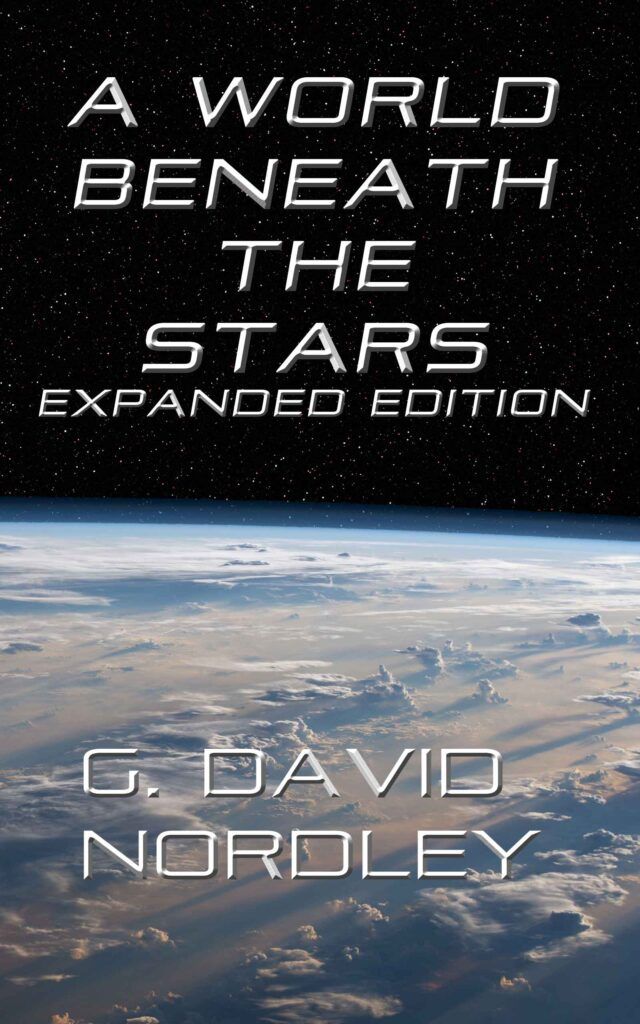

G. David Nordley, “A World Beneath the Stars (Expanded Edition)”, 266 pp, $ 14.99, pbk, Brief Candle Press, 2021.

Dr. G, David Nordley (Fig. 1; Gerry to his friends, of whom I’m glad to be one) has written seven books to date. Two of them are novels, The Black Hole Project (2015, Fig. 2) and To Climb a Flat Mountain (2012, Fig. 3), both in interstellar settings and with some parallels to my own work (see end Notes).


In 2001 he published After the Vikings, Tales of Future Mars (Fig. 4), and in 2014 began a series ‘Variation on a Theme’, story collections in particular settings, more interstellar stories in Among the Stars (Fig. 5), and Solar System ones in Prelude to the Stars (Fig. 6).


The cover of Among the Stars features a ‘Rocheworld’ like the one in The Flight of the Dragonfly, by our mutual friend Dr. Bob Forward (see ‘Connecting the Dots’, ON, 18th May 2025). There are more interstellar ones in Around Alien Stars (review, ON, 25th May 2025), and on his visit to us in Arran with his wife Gayle last year, he made me a present of the latest, A World Beneath the Stars (Fig. 7), whose special theme is that all the stories are set on Earth.
Or over it, in the case of ‘Hunting the Space Whale’, the only “story with a spaceship for readers to fly along in”, which needs some explanation. When the design of the Space Shuttle was finalised, discarding ideas like a winged flyback booster (to the great disappointment of British Aerospace) and a giant expendable booster, it was decided that the Orbiter’s three main engines would be fuelled by a large External Tank. Attention soon turned to the possible uses of the Tank, including an Aft Cargo Carrier for larger payloads, turning the Tank itself into a crewed space observatory (Fig. 8), building a 2-Tank space station (Fig. 9), or a 6-Tank orbital hangar for the Shuttle, an Orbital Tank Farm for USAF Orbital Transfer Vehicles (Fig. 10) or the much larger Free-Flying Factory which the late John Braithwaite and I designed (Fig. 11 – see ‘Project Starseed’, ON, November 20th, 2022).


All that ended when Senator William Proxmire, an enemy of the space programme and of science spending in general, got through a Bill preventing NASA from taking the External Tank into orbit in any circumstances.

After every launch, the Tank was discarded before the ‘stack’ reached orbit (Fig. 12), falling back into the atmosphere while the Shuttle continued on its less powerful Orbital Manoeuvring System (Fig. 13).

As one expert put it, at the 1985 Space Development Conference in Washington DC, “whenever we launch the Space Shuttle, we discover a new asteroid. It has refined metals, liquid oxygen and liquid hydrogen – and the first thing we do is destroy it”, what Gerry Nordley’s character describes here as “almost a parody of government waste”. I saw it happen once, when the Shuttle passed over Britain in late evening, with the Tank flashing orange as it tumbled and the white flare of the OMS burn above it.
In his timeline at the end of the book he puts the story in 2020, and therefore ‘alternate history by 2010’, when the Shuttle programme was going to end in 2011. When he first published it in 1993 it seemed likely that a small private spaceplane might be flying to orbit by 2020, but it hasn’t happened until now, with the first flight of the Dream Chaser on a Vulcan booster expected shortly. What happens is that the small company who’ve built it decide to salvage a Tank, since it’s no longer government property once it’s abandoned, and take it into orbit. From the title onwards the parallels with Moby Dick are explicit, and as the nearly empty Tank is virtually uncontrollable, the woman pilot fears for a time that she may share Ahab’s fate – though she does succeed in the end, which nobody can now.
The two preceding stories in the book are also alternative history. ‘The Stone Heart’ takes up the idea that before the extinction of the dinosaurs, one called the Troodon might have achieved speech and the use of tools. Their doomed struggle for survival is paired with the efforts of the palaeontologists who discover a dinosaur tomb to get their discovery accepted. ‘Voice of Ages’ imagines that in 1936, while coping with the Abdication, Winston Churchill finds himself asked for advice by a future civilisation at Alpha Centauri, facing an implacable enemy. A nice touch is that he believes it because he knew Alpha Centauri well from his time in South Africa. The story requires him to make some very hard choices, and illustrates the flexibility of time: when his message to the immediate future comes to light, it’s at a NATO Conference in St. Petersburg in 2040, which might have seemed possible when the story was published in 2006, but seems well-nigh impossible now.
‘Karl’s Marine and Spacecraft Repair’ also echoes something of mine, though never published (see end Notes). The action takes place on Gerry’s childhood summer haunt of Gull Lake in Minnesota, and has a section on handling a small boat in landlocked water in a storm, which reminded me of Edgar Allen Poe’s in The Narrative of Arthur Gordon Pym (see review, The Sphinx of the Ice Realm, ON, 25th February 2024). But like Poe, Gerry is definitely following the adage ‘write about what you know’. His central character is one of a number of maverick mechanics, scientists and inventors: the protagonist of ‘His Father’s Voice’ invents a way of recovering sound from damaged vinyl which is now in use (the clarity of some 1920s recordings I’ve heard recently on Radio 3 suggests something of the kind). ‘Democritus’ Violin’ involves achieving perfect reproduction of organic material, in this case (literally) a Stradivarius. ‘PC Software’ is about how AI takes over the copyediting of a men’s magazine, and ‘A Hundred Miles from Reno’ looks at how it might move into the oldest profession, in a darker view of the USA under rigid population control. ‘The Kubuto Effect’ is about the inventor of a way to make antimatter, which quickly attracts the attention of the wrong people, though he frustrates their attempt to steal it.
‘The Off Switch’ introduces Ed Miller and his friend Dick Princeton, another loner with a radio electronics lab half-way up a mountain, with a 20-inch telescope and a semi-sentient drone in the shape of a turkey vulture, indistinguishable from the real thing except that the feathers don’t move. It’s just as well that they know each other, because Dick, and only Dick, can save the Earth from a danger like the ‘external threat from interstellar space’ which I didn’t stop to explain in reviewing Around Alien Stars. Having done that, in ‘Flight of the Steam Dragon’ the pair of them rescue a girl who’s being held against her will by a religious cult, using the turkey drone and a more advanced one which is a fully articulated model of a pteradon – I stress ‘fully articulated’ because years ago I saw film, I think on Tomorrow’s World, of a fixed-wing, radio-controlled pteradon glider which did a creditable job of riding thermals as a cliff-dweller. Dick’s one also has a flame-thrower so it can play the part of a dragon. Although like ‘The Off Switch’ the story is partly humorous, Gerry wanted to make some serious points. “One is electronic UAV’s invulnerable to electronic countermeasures… and very hard to distinguish from actual flying animals – non-threatening in our protagonists’ hands, but keep in mind that technology is a word, not an actor, and has no moral sense” – something to bear in mind, in view of what’s being done with drones nowadays. ‘Run, Lagomorph’ brings Ed and Dick back once more, drones and all, to help a genetically enhanced, glowing, talking rabbit which has escaped from a research institute – no, I’m not making this up!
Another of our mutual friends was the late Arthur C. Clarke, and Gerry is happy to acknowledge him in several stories. ‘Harpoon’ is one, harking back to Arthur’s novel The Deep Range, and also to ‘Big Game Hunt’, one of his less funny stories in Tales from the White Hart and various essays, ultimately back to Hermann Melville’s description of a giant squid in Moby Dick. ‘Harpoon’ ties in with ‘The Off Switch’, where a galactic culture has raised the Star Trek ‘Prime Directive’ to an imperative which won’t let them intervene to save civilisations like ours when they’re in danger, and the ones who try to help us are criminalised like hunt saboteurs or anti-whalers. Here, a conservationist ship trying to do that receives a message from the giant squid, asking us to go on killing sperm whales, which are hunting them. “Here I want to trouble the morally comfortable”, Gerry added in 2016; “the unintended consequences of our interference with pre-existing ecological relationships… is a real one. And if it involves another aware, sentient species (or two of such!) it could be an ethical mess… It may not be that much a wonder, if true, that vastly more evolved (biologically and technologically) ETI, if they exist, leave us strictly alone.”

Tales from the White Hart is a 1957 collection of mostly funny stories told to science fiction fans and writers by a character called Harry Purvis (Fig. 14), and Gerry has recaptured the flavour of it in ‘A Wartime Draught’, where the same characters join forces to fool and entrap a German spy by talking about a supposed secret weapon. In ‘Last Call’ he imagines how they would deal with a situation like the Earth’s destruction in Clarke’s mood story ‘Transience’, in The Other Side of the Sky, which was set to music by David Bedford and sung by Sir Peter Pears. It also gives Gerry’s answer to critics of the Earth’s evacuation in Arthur’s first published story, ‘Rescue Party’, of which he wrote in the Preface to his collection Reach for Tomorrow (Ballantine, 1956), “a depressing number of people still consider it my best. If this is indeed the case, I have been steadily going downhill for the past ten years, and those who continue to praise this story will understand why my gratitude is so well controlled…” Re-introducing it in The Sentinel (Panther, 1985), he wrote, “Those who claim it’s their favourite story get a cooler and cooler reception over the passing years,” so I don’t know how he would have responded to this one. My one misgiving about it is that a British pub landlady would be more likely to say ‘Last orders’ than ‘Last Call’ (as in The Hitchhiker’s Guide to the Galaxy), and would finish with ‘Time, Gentlemen, Please’, which was the title of a last White Hart story by Arthur C. and Stephen Baxter in 2007.
There’s an interesting contrast between the two stories I haven’t mentioned, ‘Tin Angel’ and ‘Of Fire and Ice’. ‘Tin Angel’ is about the process of introducing a robot doctor into a hospital on a trial basis, encountering the same kind of knee-jerk opposition which the characters meet with in ‘The Stone Heart’ and ‘Democritus’ Violin’. ‘Of Fire and Ice’ by contrast has a live Irish terrorist subject himself to a duplicator in hopes to assassinate a future king of Britain. It’s set in the 2080s, so disparaging references are not to be taken to indicate His current Majesty.
Notes.
It sometimes happens that writers’ work overlaps. The late James White was upset by apparent resemblances between my first professional sale, ‘Derelict’, and his novel All Judgment Fled. There wasn’t much similarity, but I dropped a novel called The Coasts of Earth when he brought out The Watch Below, which had an identical plot structure. In one of my Glasgow Herald reviews, I hit a similar problem with novels by C.J. Cherryh and William Gibson. My story ‘The Moon of Thin Reality’ came out almost simultaneously with Larry Niven’s Ringworld, both of them set in Dyson civilisations. My Lance McLane story ‘The Phoenix at Easter’ overlapped Greg Bear’s The Forge of God, in which he gives me a mention, and both are about superdense objects penetrating the Earth’s crust, but we never discussed either beforehand. It happened twice to Arthur C. Clarke, who had to change the title of his story about a solar sail race, ‘Sunjammer’, to ‘The Wind from the Sun’, when Poul Anderson, writing as ‘Winston P. Sanders’, beat him to it with a story about a commercial solar sail hit by a solar flare (Fig. 15).

When Arthur and Charles Sheffield found they both had novels in the works about space elevators (The Fountains of Paradise and The Web Between the Worlds), they each wrote prefaces to each other’s books, to show there was no copying and no animosity.
Having read all Gerry Nordley’s books over the last four years, I was amused to see several parallels, particularly with my early work. In the late 1960s, inspired by Michael Bentine’s It’s a Square World, I worked with friends including Brian Gardiner, later of the British Antarctic Survey, on what the physics of a cubical planet would be like if one could exist. My story ‘The Square Fella’ had a title suggested by Drew Moyes of the Glasgow Folk Centre, for which we both should apologise to the shade of Brendan Behan. It finally appeared in abridged form in the Glasgow Herald on April 1st, 1989, in full in Starfield, Science Fiction by Scottish Writers, which I edited for Orkney Press that year, reprinted by Shoreline of Infinity in 2018. The story appeared again in The Other Side of the Interface (Other Side Books, 2021). But in To Climb a Flat Mountain Gerry had an earthsized planet with a square plate attached to it, whose physics were very much the same until my protagonist got out into space – it was good to see that we got them right, all those years before.
In The Black Hole Project there’s a sabotage attempt with long-distance messages claiming the project has been cancelled, and the same thing was attempted (three times) during the Glasgow Parks Astronomy Project, trying to stop the contractors from preparing the site for the next day’s helicopter operation completing the Sighthill stone circle.
The dilemma which Gerry raises in The Off Switch and Harpoon was like the situation in the first of my unpublished Timescale stories, ‘Starships High and Fast’, where Earth was under attack by a predatory group-mind culture and another one arrived to protest, ineffectually. The situation evolved in the follow-up novel ‘The War Fleet’, which nearly got published (twice), and in the spinoff Interface stories, which were published in Galaxy and If, now reprinted in From the Moon to the Stars and The Other Side of the Interface.
And finally… in 1970-71 my sister’s first husband and I worked on a series of stories about a character like the hero of ‘Karl’s Marine and Spacecraft Repair’, who helps out a stranded alien and then finds himself in the galactic directory. Our character was a car mechanic, not a boat repairer, but the situation in small-town America was virtually identical. My brother-in-law was to write the first story and I did write the second, but he lost interest when we were cut off from the US market by the 1971 postal strike, and that was the end of it. So I’m glad that Gerry’s version made it and has now reappeared in A World Under the Stars – maybe we’ll see more, let’s hope.


Leave a Reply