
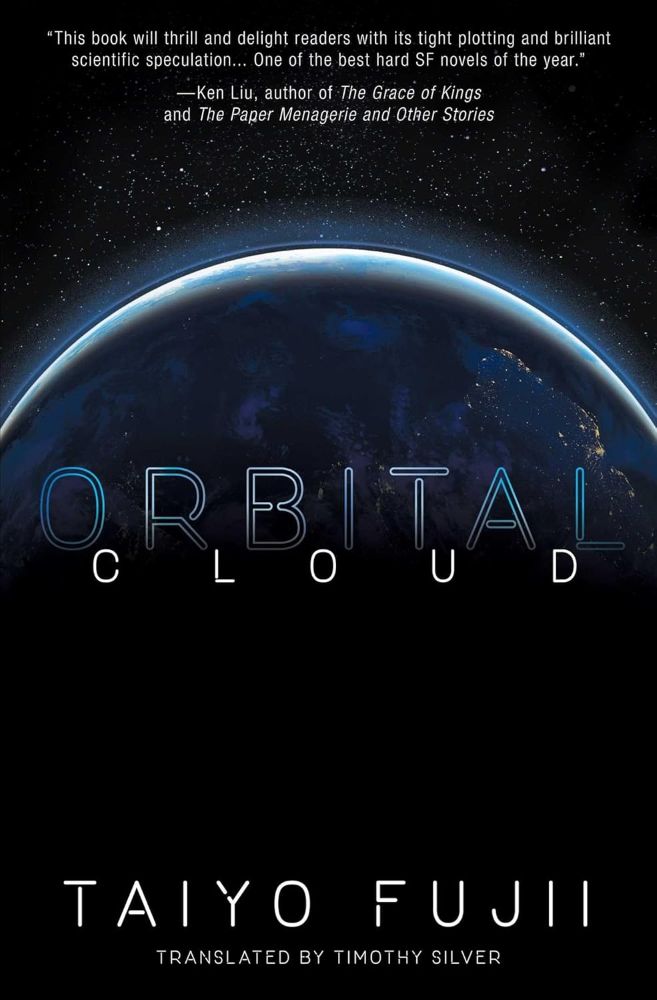
Review by Duncan Lunan

“Orbital Cloud”, Taiyo Fujii, trans. Timothy Silver, £10.99, trade paperback, Haikasoru, 820 pp., 2017.
First published in different form, Interzone # 271, July-August 2017.
Reader Mark Pezzati suggests, in a welcome comment on ‘Space Notes, July 2025′, 29th June 2025, that having pointed out the astronomical problems generated by the huge new constellations of communications satellites, I should also discuss their impact on the space debris problem. I’m working on that for July 13th, but as I plan to mention Orbital Cloud, my 2017 review of it is reproduced below.
Its translator deserves a special nod, because this is a highly technical novel even by the usual standards of hard SF, and when I wasn’t totally sure what was happening, it seemed due to my relatively limited knowledge of computing rather than to shortcomings in the translation. With events in space, and tracking them on the ground, I felt confident that I understood what was going on.
The translation is timely, because the Japanese original was published in 2014, and the main action happens in 2020. The preamble is in 2015, but out of world view in Iran, so in 2017 it was still just possible that the events could happen. North Korea would have to start launching the components of a space weapons system pretty soon, disguised as failed satellite launches, but the country’s recently failed missile tests at the time might almost make one wonder.
In 1992 and 1996, space tether experiments were deployed from the Space Shuttle (Figs. 2-7). The conducting tethers were intended to cut across the lines of force of the Earth’s magnetic field, to generate electrical power and also propulsive thrust, without using rockets. Both tests were partial failures, but those were due to manufacturing problems rather than flaws in the concept. A substantial number of tethers have been launched since from satellites, many of them failing but some completely successful.


In this novel the North Koreans, led by a rogue Japanese scientist, launch thousands of comparatively short, rotating tethers, which use the electromotive force to manoeuvre in clouds, rather like large flocks of starlings. Instead of shattering targets in violent collisions (Fig. 8), like the Soviet, US and more recently Chinese anti-satellite weapons which have been tested in space, adding to the space debris problem (Fig. 9), they converge on their victims and punch holes in them, to move them or disable them.


As cover for the tests they use the second stage of an Iranian satellite launcher, pushing it into an orbit which threatens the International Space Station and a prototype, inflated space hotel which is about to dock with it – clearly inspired by the Bigelow corporation’s BEAM module (Fig. 10) which is now docked to the ISS in reality (Fig. 11). The hotel’s billionaire backer and his niece are in it, gradually becoming aware of their danger, and their live reports from orbit are in counterpoint to what’s happening on the ground.


The erratic behaviour of the booster stage attracts the attention of another billionaire, a recluse with his own observatory and tracking station, and a private Japanese firm specialising in satellite forecasting. NORAD, the US agency tasked with tracking hazardous objects in orbit, is sidetracked at first by an ingenious cover story.

(After an initial controversy in which the tracking came close to cancellation, there’s now a worldwide network called the Space Surveillance Network [Fig. 12], in which Britain’s former Ballistic Missile Early Warning Station at Fylingdales plays a major part – Figs. 13 & 14.)


Realising that Western news agencies all use a commercial translation programme for English versions of the North Korean leader’s speeches, the villains infiltrate it with a special code disguised within an advert for cat food, turning one of the leader’s favourite blustering phrases into vague references to an orbital bombardment system called ‘the Rod from God’. Presumably the Leader himself is unaware of what’s happening. As only English translations are affected, the rest of the world is puzzled by the West’s apparently paranoid response. This does have a historical parallel: Kruschev’s ‘we will bury you’ speech, taken in the USA as indicating a ‘missile gap’ which had to be closed, apparently had no more significance than saying ‘we will dance on your grave’.
Meanwhile the tether cloud demonstrates its true capabilities by knocking out all five of Japan’s operational surveillance satellites. By the time the world realises the danger, the plan is that the North Korean-Iranian alliance will have achieved dominance of Low and Middle Earth orbit, denying their competitors access to it while allowing them to catch up in the space race.
Comparisons with The Martian are inevitable, and Orbital Cloud will undoubedly appeal to the ‘techno-geeks’ for whom Andy Weir considered himself to be writing. But a comparison with Michael Crichton would be fairer, because the conflict is between human beings, through machines, rather than man and machine versus the impersonal forces of nature. On that level, the plot has two less convincing elements, more like a thriller than SF. The rogue scientist, who’s changed his name but not his appearance, turns out to be the uncle of a key member on the Japanese company’s team, and once she recognises him, she can analyse and anticipate his thinking.

The second (spoiler warning) is that in the novel the USAF’s 1980s F-15 ASAT system (Fig. 15) has not yet been decommissioned, though it’s about to be, and when deployed against the supposed Rod from God, fortuituously it can knock out the tethers by electromagnetic pulse. That deus ex machina touch is perhaps unavoidable, since the tension has been screwed higher and higher by making the tether weapon appear to be unstoppable. It’s a relatively minor cavil about what was, for me, a thoroughly gripping read.




Leave a Reply