
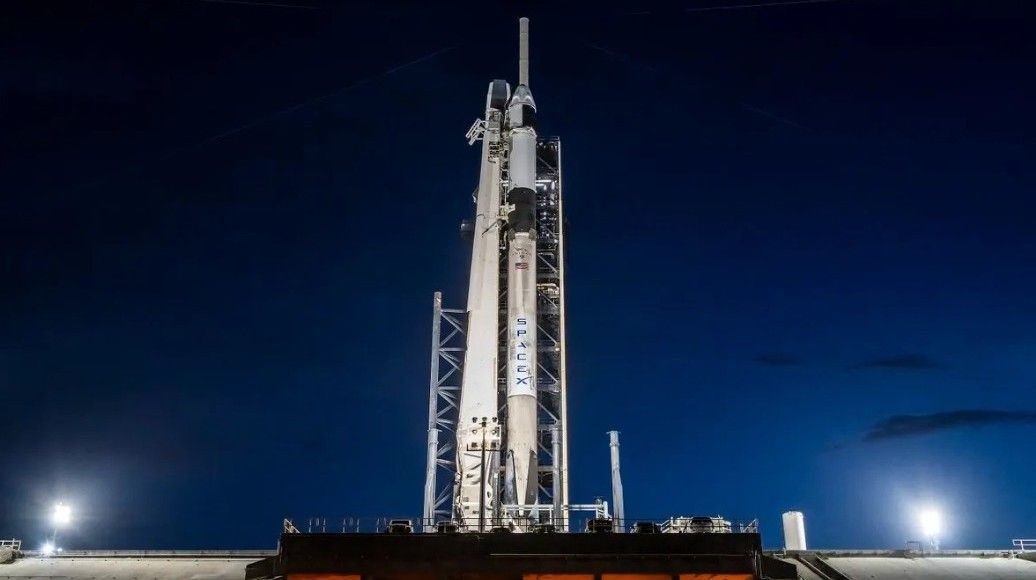
In a month mostly of delays and disappointments, the fourth Axiom mission to the International Space Station, on a new Crew Dragon named ‘Grace’, has repeatedly been postponed from June 11th, first by a leak in the Falcon-9 booster, on Pad 39A at Kennedy Space Center (Fig. 1), and then by fresh leaks in the Russian Zvesda section of the ISS.

Pressure has been holding in the access tunnel to it, indicating that the small repairs made have been successful, but NASA wanted more time to confirm it before burdening the interconnected ISS systems with more people. The run of delays ended on June 25th with a completely successful liftoff (Fig. 2), including recovery of the first stage (on its second flight) at Kennedy Space Centre. Docking took place next day as planned. The mission is expected to last 14 days, with over 60 experiments to perform, most from the participating countries.

Although Ax-4 is a private mission, NASA has confirmed its international importance, with US, Polish, Indian and Hungarian astronauts making up the crew, (Fig. 3).

Donald Trump’s views on that are not known, but Elon Musk has withdrawn his threat to cancel Dragon and Crew Dragon flights to the ISS, while nevertheless continuing his calls for the ISS to be deorbited. It was probably no coincidence that Boeing announced the coming readiness of the Starliner capsule for more flights, and Blue Origin announced continuing work on the New Glenn booster, on the day after Musk’s threat.

His plans for the Moon and Mars suffered an unexpected setback on June 19th, when Starship 36 (Fig. 4) exploded during fuelling for a static test in preparation for Flight Test 10 of the Starship/Superheavy combination (Figs. 5-7).


First reports indicate that the event was caused by rupture of a composite pressurised tank of nitrogen gas in the nose, used to drive the fuel and oxidiser through the pumps, rather than a fuel line explosion like the previous ones in flight. It’s not necessarily a showstopper – SpaceX tested a number of oxygen tanks to destruction during early Starship development – but as a Vespa mechanic said to me when one suddenly turned over on me in 1965, “It’s not supposed to do that”. There has been damage to the area around the test stand, and I have heard the stand itself described as ‘shredded’, so that will take some time to fix and no doubt there will be yet another Federal Aviation Authority enquiry before flights resume, so the target of 25 flights this year looks less likely to be achieved.

A recent discussion that I was in raised the possibility of sabotage. It has supposedly happened before, in 2015, when the loss in flight of the CRS-7 Dragon supply to the ISS was caused by use of an untested steel bolt, of industrial strength rather than aerospace-rated (Fig. 8), which was alleged at the time to have been due to an act of malice by a person in one of the subcontractors. Interestingly, Wikipedia doesn’t mention the accusation. But a story from 2023 has resurfaced, in which it’s alleged that as well as holes drilled in Soyuz spacecraft as attempted sabotage, a Russian EVA to fix a coolant leak on a radiator of the Nauka laboratory module discovered that multiple holes had been drilled in it, only then becoming serious (Fig. 9) – sufficiently so that a contaminated tether had to be discarded and a spacesuit had to be thoroughly cleaned before the airlock could be opened into the ISS (Fig. 10).


(‘Sabotage on ISS? Unexplained Holes on Space Station raise fears of something sinister’, Business Today, 24th June 2025.) It’s uncertain by whom this might have been done, why or even when, because Nauka was in storage for 14 years before launch in 2021 (Figs. 11-12), to the annoyance of the international partners. The damage hasn’t prevented Russia from saying that they want to move Nauka to their own space station in 2028, before the ISS is deorbited around 2030.


Meanwhile, just to keep watching the others in the race, China has successfully tested the pad escape system for their Mengzhou crewed lunar spacecraft (Figs. 13 & 14). They’re going for a human Moon landing by 2030, and although Donald Trump wants a US one sooner, it’s by no means certain who’ll win the race this time.


Despite the near-complete success of its first flight, the next one of Blue Origin’s New Glenn booster has also been postponed, to August 15th at the earliest. New Glenn is specifically intended to be a competitor with SpaceX’s Falcon 9, and with new satellite constellations in preparation, the competition may be intense. 27 of Amazon’s new KA-15 Kuiper constellation have just been launched by a United Launch Alliance Atlas V (Fig. 15), and as there aren’t too many of those left with their Russian engines, and Amazon intends to launch up to 3,200 satellites in 80 missions, there will be competition for those.


To coincide with the June 23rd launch Amazon’s list of heavy lift boosters to be used (Fig. 16) doesn’t include SpaceX’s Falcon Heavy, but features Atlas V as the smallest, New Glenn as the largest, and Europe’s new Ariane 6 as a third – a warning to US manufacturers that price and availability will be key factors in future. But meanwhile Amazon needs to launch half of its satellites by 2026, and all of them by 2029, to retain its current Federal Communications Commission license, so the pressure is increasing (Passant Rabie, ‘Blue Origin Delays New Glenn Again—and It’s a Bigger Setback Than It Seems’, Gizmodo, online, 10th June 2025)


In that context, it’s worth noting that Honda has indicated a future entry to the launcher stakes, successfully testing the launch and landing of a reusable booster (Figs. 17 & 18). The idea of ‘return to launch site’ looked pretty far-fetched when Elon Musk was testing it with his ‘Grasshopper’ back in 2013 (Figs. 19 & 20), but once he’d shown it could be done, it was only a matter of time before it was copied. Blue Origin attempted it with the first New Glenn launch, but the booster exploded during descent.


The addition of another 3,200 satellites to the 42,000 proposed by Starlink adds to the difficulties for the new Vera C. Rubin telescope (Fig. 21), formerly the Large Synoptic Survey Telescope, whose long-awaited ‘First Light’ took place on June 13th.

The unique feature of the telescope on Cerro Pachón in Chile (Fig. 22) is its 3,200 megapixel Somonyl Survey camera (Figs. 23-25), built by the US Department of Energy’s SLAC National Accelerator Laboratory, which will take a complete image of the whole sky every three days.


(It’s also called the Legacy Survey of Space and Time (LSST), which confusingly has the same acronym.) The first light image was of the Trifid and Lagoon nebulae (Fig. 26), followed by an image of the Virgo Cluster (see ‘Let’s Talk About the Neighbours’, ON, June 22nd, 2025), containing millions of galaxies in a single frame (Figs. 27-30).


The fast processing and comparison of images will allow any changes to be rapidly pinpointed and investigated: over 2104 asteroids were discovered in the first two days (Fig. 31), and that with coverage of just a small part of the outward view from Earth (Fig. 32). If ‘Planet 9’ does exist in the outer Solar System, it’s expected to be found within a year.


In addition to Starlink and the Amazon Kuiper satellites, above, Chinese projects Guowang, Qianfan and Geespace intend to launch tens of thousands of satellites, bringing the total in Earth orbit to around 100,000 in the next decade, which precisely overlaps the Rubin telescope’s current programme. Meredith Rawls, a research scientist for the LSST and an astronomer at the University of Washington, is working on the problem, and believes that satellite tracks can be removed from many of the images taken with only minor losses. But Prof. Noelia Noël at the University of Surrey is less optimistic, believing that 40% of the images taken will be affected, and although they will be stacked and irreparably damaged ones can be discarded, the cost in telescope time and effort will be massive. Reducing the brightness of orbiting objects to magnitude 7 would largely solve the problem, and Surrey Nanosystems is working on a less reflective paint for them, but while the main problem is reflection from solar panels that may not be enough. (Teresa Pultarova, ‘Satellite streaks: Can the huge new Vera Rubin Observatory function in the megaconstellation age?’, Space.com, 18th June 2025.)
On the First Light, Space.com’s Robert Lea commented “with 10 years of the LSST ahead of it, the future of Rubin and astronomy in general is bright”. (‘Vera C. Rubin Observatory reveals 1st stunning images of the cosmos. Scientists are “beyond excited about what’s coming”‘, Space.com, 23rd June 2025). But as ‘Vera C. Rubin Observatory is a joint initiative of the U.S. National Science Foundation (NSF) and the U.S. Department of Energy’s Office of Science‘ (Wikipedia), the NSF is a prime target for budget cuts under the Trump administration, and projects named after women scientists are particular targets, one can only hope that Lea is right. 1800 staff at NSF headquarters are to go, replaced by Department of Housing and Urban Development staff, and that is part of a proposed reduction from 300,000 to 90,000. One of the two LIGO gravity wave detectors is now scheduled to close, as is the Daniel K. Inouye Solar Telescope (only recently commissioned, Fig. 33), and neither NASA nor NSF have been represented at the American Astronomical Association’s 246th conference in Anchorage this year.

NASA has repeated that its priority is to put Americans on the Moon during Trump’s presidency, and nothing else. (Monisha Ravisette, ‘NASA’s been pulling out of major astronomy meetings — and scientists are feeling the effects’, Space.com, 26th June 2025.
And finally… less than a year after Britain’s Skynet 1-A reappeared 37 years later, where it was never supposed to be (see ‘Westwind and Skynet’, ON, 17th November 2024), and only weeks after Russia’s failed counterpart to Venera 8 fell back to Earth (see ‘The Sky Above You, May 2025′, ON, 1st May 2025), another ghost from the past has reappeared – Relay 2, a NASA communications satellite launched in 1964 (Fig. 34), operational till 1965, dead by 1967.

But on June 13th 2024, the Australian component of the Square Kilometre Array detected what appeared to be a Fast Radio Burst, very powerful and too short to be one of those observed to date from distant galaxies (see ‘Let’s Talk About the Neighbours’, above). But one of the purposes of the SKA is to locate FRBs in real time, so that other instruments can swiftly be turned to the aftermaths. This one turned out to be from precisely the location of Relay 2, passing in elliptical orbit 2,800 miles above.

As its name implies, Relay 2 never had the capacity to originate signals – nothing like this, at least. It may have been hit by a plasma cloud from the Sun (Fig. 35), but the Sun was quiet at the time, so it may have been struck by a micrometeorite with just the right energy to simulate an FRB with a cloud of plasma momentarily generated by the impact (Fig. 36).

Both explanations are statistically unlikely, but there are no better ones to date. (Robert Lea, ‘Astronomers thought a mysterious radio burst came from deep space. It was actually a dead NASA satellite’, Space.com, 25th June 2025.) It looks as if David A. Hardy’s benevolent gremlin ‘Bhem’, who likes to play tricks with satellites (Fig. 37), is working overtime at the moment.



Leave a Reply