
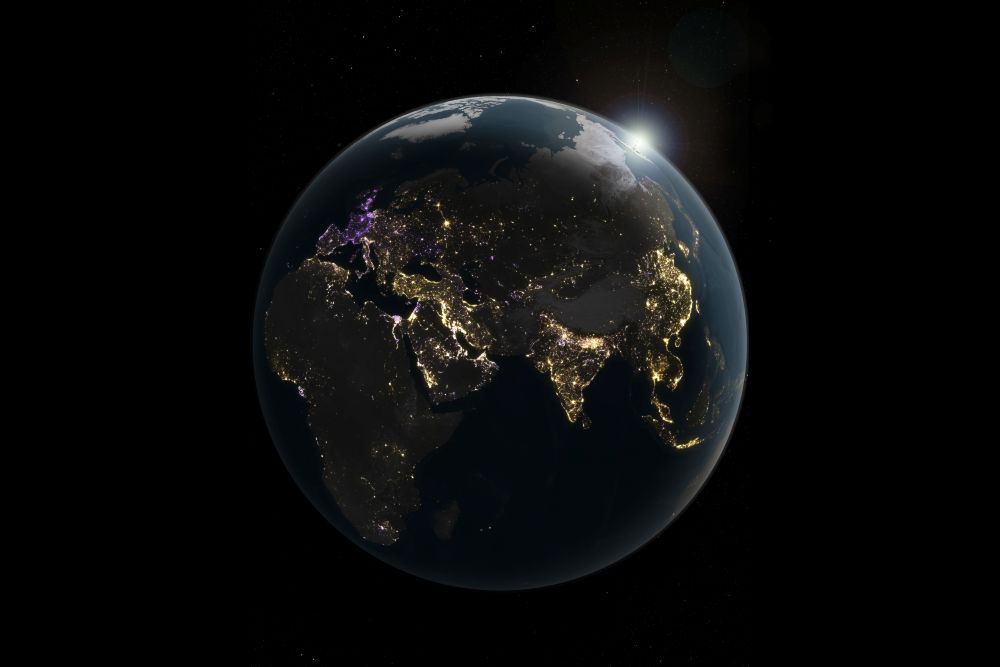
Data analysed from the Visible Infrared Imaging Radiometer Suite (VIIRS) Day/Night Band (DNB) instrument aboard the Suomi NPP, NOAA-20, and NOAA-21 satellites operated by the U.S. agencies NOAA and NASA, are capturing where the night time lights are dimming, and increasing over the planet.
An analysis of data from the VIIRS DNB satellite instrument covering the years 2014 to 2022 finds that night time lighting is increasing globally by about two percent per year.
The differences in light emissions are interesting. Christopher Kyba, Ruhr University Bochum explained:
“Although there has been a total increase of 16 percent worldwide, that does not mean that lighting is increasing everywhere. In areas where lighting increased, we found global emissions rose by 34 percent. This was offset by an 18 percent decrease in emissions from other areas.”

China and India became increasingly brighter due to urbanization during the analysis period, measured emissions from other industrialized nations tended to decrease, for example because they switched to LED lighting or introduced regulations to curb light pollution.
A dramatic decline in lighting was observed in Ukraine following the Russian invasion. France also dimmed significantly at night (down 33 percent), as many municipalities there turn off streetlights after midnight to save energy and reduce light pollution.
The satellites observe after midnight, typically between 1:00 a.m. and 4:00 a.m. local time. They image the entire planet nightly between 70° North and 60° South. A single satellite pixel covers an area of approximately 0.5 square kilometres. In this analysis, only areas with artificial light were examined; forest fires and auroras are detected by the satellite but were excluded from the analysis.
Christopher Kyba said:
“Artificial light is a major consumer of electricity at night, and light pollution harms ecosystems. It is therefore important to understand how both of these are changing.”
Kyba is leading a team that is proposing a state-of-the-art satellite for observing night lights to be selected for the European Space Agency’s (ESA) Earth Explorer 13” mission. This new satellite would be able to see much fainter lights than existing satellites and, thanks to its high resolution, would greatly reduce the current uncertainty about exactly what is changing.
“While the U.S. and China each have multiple satellites that observe night time light, there is currently no European satellite designed for this purpose,”added Kyba.
Click on this link to access, Satellite imagery reveals increasing volatility in human night-time activity, published in Nature.




Leave a Reply