
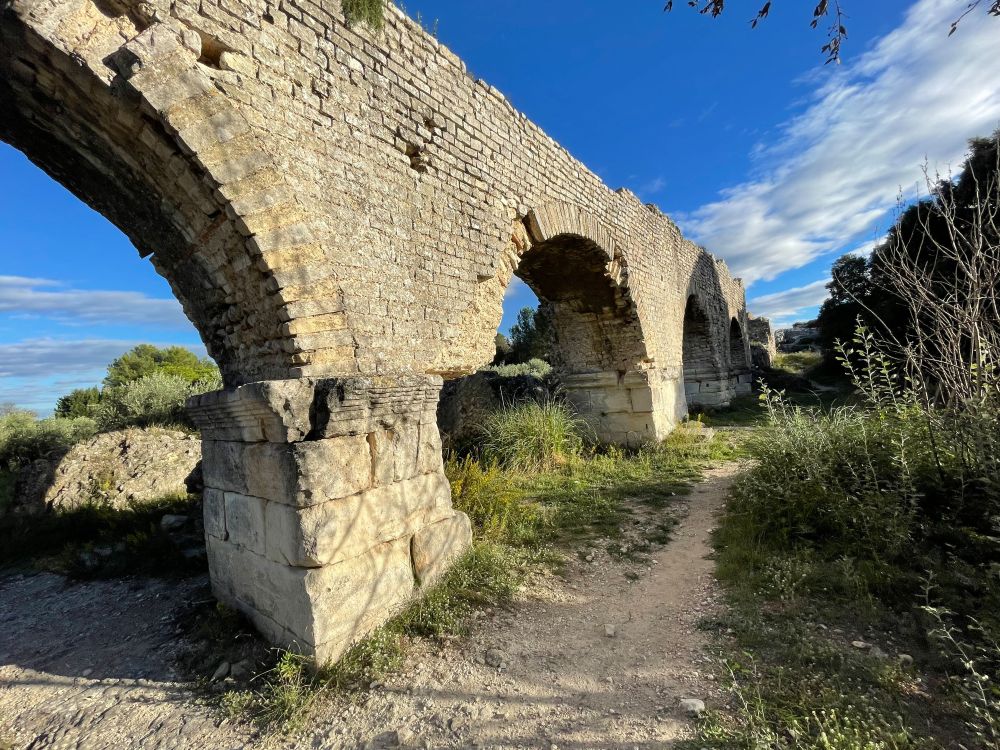
Roman engineering that built the Aqueducts continues to be deciphered by archaeologists.
The ancient aqueduct system of Arles in Provence, France, is being studied by researchers from Johannes Gutenberg University Mainz (JGU), the University of Oxford, and the University of Innsbruck
The Romans transformed the aqueduct over several centuries ensuring it could continue to provide water sustainably.

“Unlike previous studies, where we mostly dealt with a single aqueduct, here we investigated the complex water supply of ancient Arles, consisting of several aqueducts, a basin and connected water structures in the city,” explained Prof. Dr. Cees Passchier from the Institute of Geosciences at Mainz University, who participated in the study.
While some relationships between different elements of the city’s water supply system had been suggested for some time, the researchers have now succeeded in confirming the picture with solid archives from the Arles water system and proving the long-life cycle of the Roman aqueduct of Arles.
Initially from 3 BCE onwards, an aqueduct from the south flank of the Alpilles hills supplied the city of Arles with water. However, after almost a hundred years, an additional aqueduct was built from the northern side of the same hills, whose water joined that of its southern counterpart in an existing basin that was part of the original aqueduct.
With the opening of the northern aqueduct, the southern one took on a new purpose: it was now diverted to power a huge 16-wheeled complex of water mills at neighbouring Barbegal.
The research confirmed that the basin originally functioned as a header basin upstream of an aqueduct arcade bridge: such basins were inserted so that sand and other suspended matter could settle.
The northern aqueduct was then added later in an improvised manner, which can be seen from the architectural remains of its higher-level entrance to the basin. Another piece of the puzzle came from collapsed ceiling pieces of the Baths of Constantine in Arles, whose water supplier was so far unknown.

“We found aqueduct carbonates in these collapsed ceiling fragments that belonged to the northern aqueduct. Evidently, when the baths were built in the early fourth century AD on the orders of Emperor Constantine, the aqueduct was apparently restored and the chipped-off carbonates were used here as building material in the roof of the bath,” said Dr. Gül Sürmelihindi from the Institute of Geosciences at JGU who conducted the study.
In this way, the researchers were able to answer the previously unanswered question of how the bath was supplied with water and until when the Roman aqueduct was in use – at least until the time when the baths were built, since the carbonate cleaned out of the aqueduct was used in its construction, and most likely the aqueduct worked well into the fifth century AD until the arrival of invading Franks and Burgundians.
The role of large lead pipes from Roman time that ran across the bed of the Rhône River and were discovered in the 19th century was also debated for a long time.
In which direction did these pipes transport water?
The researchers were also able to solve this with the help of carbonates: deposits with similar isotopic composition to those found in the aqueducts in the north and south branches were also found in the lead pipes, confirming that an inverted siphon from the Arles aqueduct was supplying the Trinquetaille quarter on the opposite side of the river.
Prof. Dr. Cees Passchier said:
“Without the aqueduct carbonate archives, it would be impossible to reconstruct these relationships”.

“But because the deposits are heavily contaminated with clay, they cannot be dated using standard dating technologies. Instead, we analysed stable oxygen and carbon isotopes from the carbonates and cross-correlated the isotopic profiles to see the times of their simultaneous deposition,” added Dr. Gül Sürmelihindi.
“This allowed us to identify the same annual layers in the carbonates and thus determine their relative depositional periods and thus the historical timing of modifications and changes made to the Arles water supply system.”
Click on this link to access, The Roman Water Management of Arles as Read in Aqueduct Carbonate Archives, published in Geoarchaeology.




Leave a Reply