
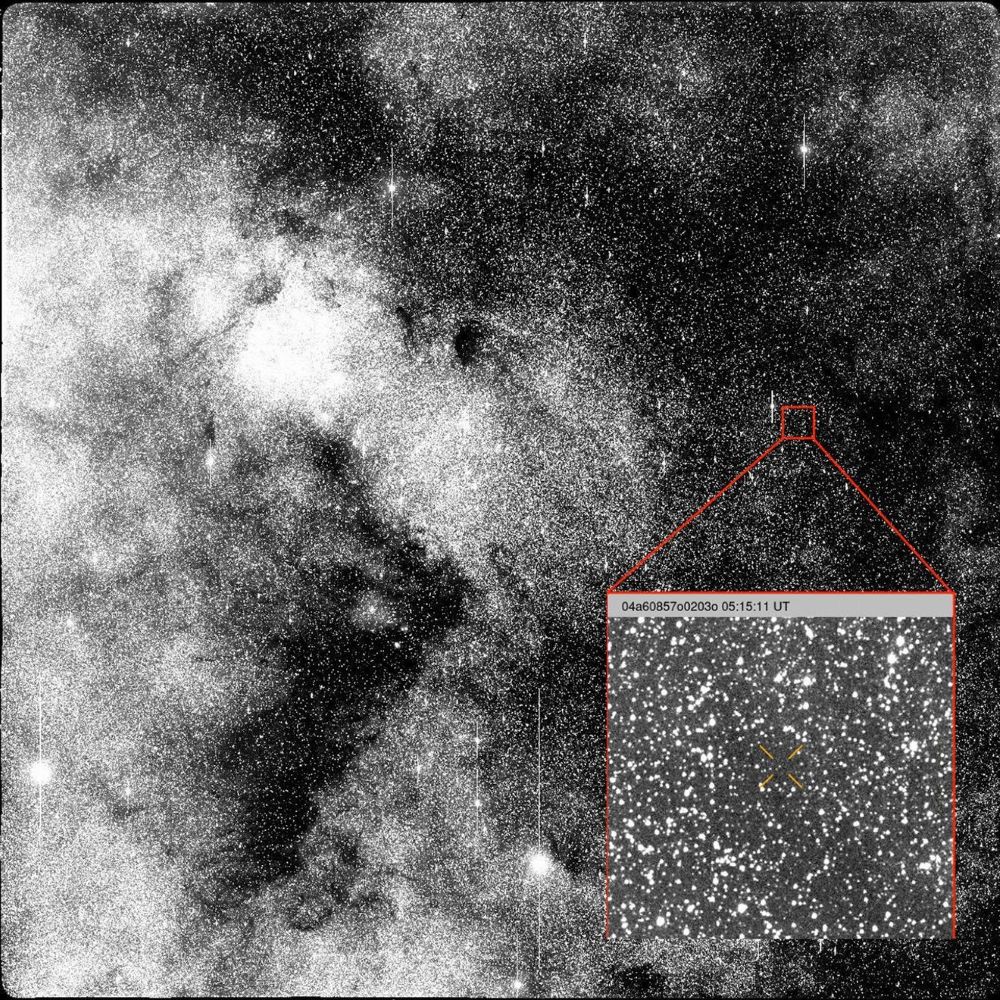
Another interstellar object is passing through the Solar System, the third since 2017, fourth if you count asteroid (514107) 2015 BZ509, which may have been here for billions of years (Matt Williams, ‘Oumuamua was Just the Beginning. Astronomers Find an Interstellar Asteroid Orbiting Retrograde near Jupiter’, Universe Today, 23rd May 2018). This one, also retrograde, is called 31/ATLAS UT 2025, discovered on July 1st by the Asteroid Terrestrial-impact Last Alert System (ATLAS) survey telescope located in Río Hurtado, Chile.

On discovery it was in the constellation Sagittarius (Fig. 1), 410 million miles from the Sun and already within the orbit of Jupiter. It will be at perihelion, closest to the Sun, on October 30th, at 1.4 Astronomical Units out, just within the orbit of Mars (Fig. 2).

Initial estimates made it 10-20 kilometres across, but it could be smaller if highly reflective, like the first such object. (‘Oumuamua was as reflective as polished metal – see ‘Oumuamua Part 1’, ON, 17th December 2023.) Hubble observations suggest it could be as small as 0.32 km, though if so it would be unlikely to be discovered so far from the Sun. First reports said that its origin could be in the ‘thin disc’ on the central plane of the Milky Way, later ones said the thick disc which surrounds that, above and below the galactic plane (Fig. 3).

Even then, it could easily be 9 billion years old, nearly twice the age of the Solar System, and that would make its composition very interesting. By the first week of August emissions of some kind had been observed, on the sunward side of the object (Fig. 4), and because no familiar constituents of comets have been detected, it seems likely that those are dust rather than gaseous.

(One of the oddities about ‘Oumuamua was that it accelerated away from the Sun, as if driven by light pressure, and no gas or dust was detected by satellites which should have been able to do so.)
On its current path, closest approach to Earth will be at 1.8 AU (170 million miles). But it will be invisible behind the Sun from September to early December, and Prof Avi Loeb, Adam Hibberd and Adam Crowl have suggested that at perihelion it could perform an ‘Oberth manoeuvre’ to set it on course for Earth, possibly for close surveillance or attack. (Dean Murray & Tom McGhie, ‘”Mystery alien spacecraft”could launch attack on Earth in November, says new study’, MSN News online, 31st July 2025.)
Prof. Loeb is quoted as saying that it’s ‘just five degrees from the Earth’, which is a garbled statement that its orbital plane is inclined at five degrees to the Ecliptic, the plane of Earth’s orbit around the Sun. While that would make a course change towards Earth comparatively easy, it’s almost exactly what would be expected for an object coming from a great distance in the direction of the Galactic Centre, in July. The Galactic Centre is in Sagittarius, just four degrees off the Ecliptic at its closest (Figs. 5 & 6).


But if so 31/ATLAS can’t be coming from the thin disc, because the plane of the Ecliptic and the Solar System is highly inclined to it (Fig. 7) – its ‘steep trajectory through the Milky Way’ indicates it’s from the thick disc, near its upper boundary (Figs. 8 & 9). (Robert Lea, ‘Astronomers say new interstellar visitor 3I/ATLAS is “very likely to be the oldest comet we have ever seen”’, Space.com, online, July 11th 2025.) Maybe that’s what some articles have meant by saying that it’s come from ‘the outer reaches of the Galaxy’, which it clearly hasn’t.


Another statement attributed to Prof. Loeb must also be garbled, because he’s quoted as saying that 31/ATLAS’s orbit is ideal for concealment behind Jupiter, Mars and Venus as it approaches. Fig. 2 doesn’t have dates, but Fig. 10 shows that Jupiter was on the far side of the Sun when the comet crossed Jupiter’s orbit.

It will never be hidden by Mars on its current path, let alone pass behind Venus. And its closest approach to Mars on September 24th will still be at a distance of 0.2 AU, 1,860,000 miles. There is a remote chance that it might be captured by the cameras on the Mars Reconnaissance Orbiter and others orbiting Mars (David Dickinson, ‘Inbound: Astronomers Discover Third Interstellar Object’, Universe Today, online, July 2nd, 2025.) But I’m not holding my breath, because when Comet Siding Spring (aka Comet McNaught) passed Mars at 80,000 miles in October 2014 (Fig. 11), most satellites saw nothing. Mars Orbiter Mission (MOM) saw it as a faint dot (Fig. 12), and the Curiosity rover (which has just completed 13 years on Mars) captured it as a streak on a time exposure (Fig. 13). It should also be noted that MAVEN and Mars Odyssey are scheduled for early shut-down among cuts to NASA’s science budget by the Trump administration, and may not be operational by the end of September.


Also, for the record, an ‘Oberth manoeuvre’ is most effective when performed very close to the object being flown past. The term is normally used for a velocity change, and Fig. 2 shows that to achieve an encounter with the Earth, by a retrofire beyond the Sun, 31/ATLAS would have to shed a lot of its 60 kps current velocity. It made me wonder if Prof. Loeb was thinking of putting it into a Hohmann transfer (a 180-degree turn around the Sun, changing from one planetary orbit to another, Fig. 14), which was first publicised in the 1924 book Die Rakete by Hermann Oberth (see ‘Oscar Schwiglhofer’, ON, 27th July 2025).


Fig. 15 shows a Mars-Earth transfer as a dotted line. But a Hohmann transfer between Mars and Earth would take 6-9 months, depending on the position of Mars in its elliptical orbit, so a retrofire in late October couldn’t threaten Earth in November, as per the headline. Accelerating at perihelion would straighten the path and miss the Earth by still more than at present, so that’s not the answer unless it could tighten the curve, using still more fuel by introducing a new velocity vector, directed towards the Sun (Figs. 2 & 15), and it would have to be very large, possibly another 60 kps.
Decelerating the supposed spacecraft would also reduce the damage it could cause (assuming an impact is intended), because the energy release is proportional to the square of the impact velocity. Conversely, accelerating into a new hyperbolic path would increase it, enough perhaps for even a 0.2-km object to become the equivalent of a Tunguska, Chicxulub event or worse.
It’s instructive here to compare the supposed threat to an analysis by Drs. David Asher and Nigel Holloway, addressing the concern expressed by Carl Sagan about misuse of asteroid deflection technology. They set themselves the task of devastating England with a 15-megaton asteroid strike on Telford. (Scotland would be sheltered from the worst effects by the Southern Uplands, in what nuclear technologists call ‘shadow effects’). Their chosen asteroid was 1998 HH-49, scheduled to pass Earth in October 2023, and a deflection in July 2022 would call for 10-15 nuclear explosions of 1-2 megatons each, at 1-day intervals, behind the Sun. The thesis was presented at a special day in the 2001 British Rocketry Oral History Conference at Charterhouse School, and Roy Dommett, a veteran of Britain’s independent deterrent program, asked, “If you’re going to all that trouble to attack Britain with the equivalent of 15 H-bombs, and use 15 H-bombs to do it, why not just use 15 H-bombs on Britain itself?” The only reason for using an asteroid would be to keep the operation secret, but secrecy seems far from certain. Such a large payload, equivalent to at least five intercontinental ballistic missile warheads plus a much larger ‘bus’ vehicle, could not be launched in secret and would have to be disguised as a civilian space probe. Even so, its outbound trajectory would be known and suspicions would surely be aroused in other nations after the catastrophe, even if Britain was no longer in a condition to investigate – and especially if it was done with a known object like 1998 HH-49, which ‘turned up missing’ at the same time as the spacecraft. (DL, Incoming Asteroid! What Could We Do About It?, Springer, 2013.) Even more so, if you’re going to such trouble to devastate Earth with 31/ATLAS, why not just launch it straight at the Earth and have done?
Again, the answer could be deniability, but given that everything from the Vera Zubrin Telescope downwards will be searching for 31/ATLAS when it comes out from the Sun, the objective wouldn’t be to conceal it from us – not that we could do anything about it, at such short notice. Rather encouragingly, it would suggest that there is some higher authority like a Galactic Federation, from whom the attackers have to hide their wicked plans, and who might detect and forestall them.
On a more benign possibility, if 31/ATLAS has come from the direction of the Galactic Centre, and it is to be deflected towards Earth, it might be the next stage of a survey operation begun with ‘Oumuamua, which came from remarkably close to the Apex of the Sun’s Way, where the Solar System is heading relative to the neighbour stars (see ‘’Oumuamua Part 2’. ON, 24th December 2023.) It appeared to have been hanging in our path, waiting for us. As ‘Oumuamua is heading in the general direction of Ross 248, which will be the nearest star to us by the time it gets there, it will be interesting to see where 31/ATLAS is going. Comparing Fig. 16 to Fig. 2. I would reckon somewhere in Gemini or Cancer.

Maybe there’s a ring or a cloud of outposts surrounding us, waiting for activation when our technology reaches a suitable level for study or Contact. In Sydney Jordan’s Jeff Hawke story ‘Here Be Tygers’ (Daily Express 8/10/71 – 1/2/72), there was a ring of such stations around the Solar System, bearing warnings to go no further because of murderous entities beyond (Fig, 17). Unfortunately the warnings turned out to be for incoming starships, because the killers concerned were us.

‘Here Be Tygers’ was reprinted in Starburst, January 1978, and in Jeff Hawke’s Cosmos Vol. 4 No. 3, June 2008, with Notes by Duncan. Duncan’s books including Incoming Asteroid! are available from bookshops or through Amazon; details are on Duncan’s website, www.duncanlunan.com.



Leave a Reply