
By Fiona Grahame.
Twenty sailed with The Flowery Land when she left the port of London on 28 July 1863 but this voyage and its aftermath was to shock Victorian Britain to the core.
The Flowery Land was a 400 ton barque carrying a valuable cargo of iron bars, bales of cotton and fine wines including champagne to Singapore. Captain of the vessel was the experienced John Smith of Cockleha’, Tankerness, Orkney. Joining him was his brother George as a passenger.
The crew consisted of: First Mate Carswell; Second Mate Taffer; 6 Manillans, Leone, Bianco, Duramo, Los Santos, Lacroix and Lopez; 1 Turkish/Greek, Vartos; 1 Greek, Carlos; 2 Spaniards, Williams and Paul; 1 Norwegian, Andersen; 1 Frenchman, Candereau; 1 Englishman, Early a cabin boy; 1 Malayan; and 2 Chinese, the cook and a boy lamp trimmer.
The British Empire exploited not only the lands and resources of its colonies but their people too. International trade relied on seafarers from the Empire, with those from India and the East known collectively as lascars. These men were paid a fraction of the wages of British seafarers and so for the shipowners employing lascars kept their costs down and their profits high. The mortality rate for these men, often clad in inadequate clothing for the voyage, was higher than even the rates experienced by British seamen.
Captain John Smith had traded many years in the China Seas with multinational crews. He was known to always have a brace of pistols by his side when he went to bed.
The harsh working conditions were made worse on the Flowery Land by the crew being given insufficient food and the cruelty meted out on the men mostly by the First Mate, Carswell. In one instance when George Carlos reported that he was too ill to work, Carswell had him taken from where he lay and tied to the bulwark for lashing. In this case Captain Smith intervened and had Carlos untied and taken below.
The voyage was, however, to take a tragic turn. During a night patrol, on 10 September 1863, Carswell was grabbed and beaten to death with handspikes. The murderers then turned their attention on the Captain, stabbing him to death. His brother George was also killed, beaten with handspikes. Their bodies were tossed into the sea.
Not all the crew participated in the murders and were left in terror that the same death would befall them should they intervene. Under threat of his life, the second mate, Taffer, who was the only one left capable of navigating, charted a journey which after 22 days took the Flowery Land to Montevideo.
The horrors were to continue. Those who had participated in the murders had opened up the bottles of fine wines and champagne and had been drinking solidly since the killings. As they approached land, they ordered George Carlos to drill holes in the ship to scuttle her. Small boats were put over the side but the steward, who was in one, was pounded to death when bottles and missiles were flung at him. As the ship sank, the cook and the boy were left below to drown.
Reaching Montevideo, the murderers went on the run. Second Mate Taffer and Frank Candereau escaped to raise the alarm with the authorities, and the men were soon rounded up. Two ships set sail for England, the steamers Brazil and Parana, carrying those accused of the murders and the witnesses. At this point it could not be established with any certainty how many of the men had taken an active part in the killings.
Ten men were implicated in the murders but 8 were put on trial on 4 February 1864, with 6 being found guilty. On trial were the Manillans: John Leone, Francisco Bianco, Mauricio Duramo, Basilio de Los Santos, Marcelino Santo Lacroix and Miguel Lopez (aka Joseph Chancis); the Turkish/Greek Marcus Vartus (Watters) and the Greek George Carlos.
Two men, Basilio de Los Santos and Marcelino Santa Lacroix were granted Royal Mercy after the intervention of the Spanish ambassador. Although found not guilty of the murders, George Carlos was sentenced to 10 years in prison for scuttling the ship.
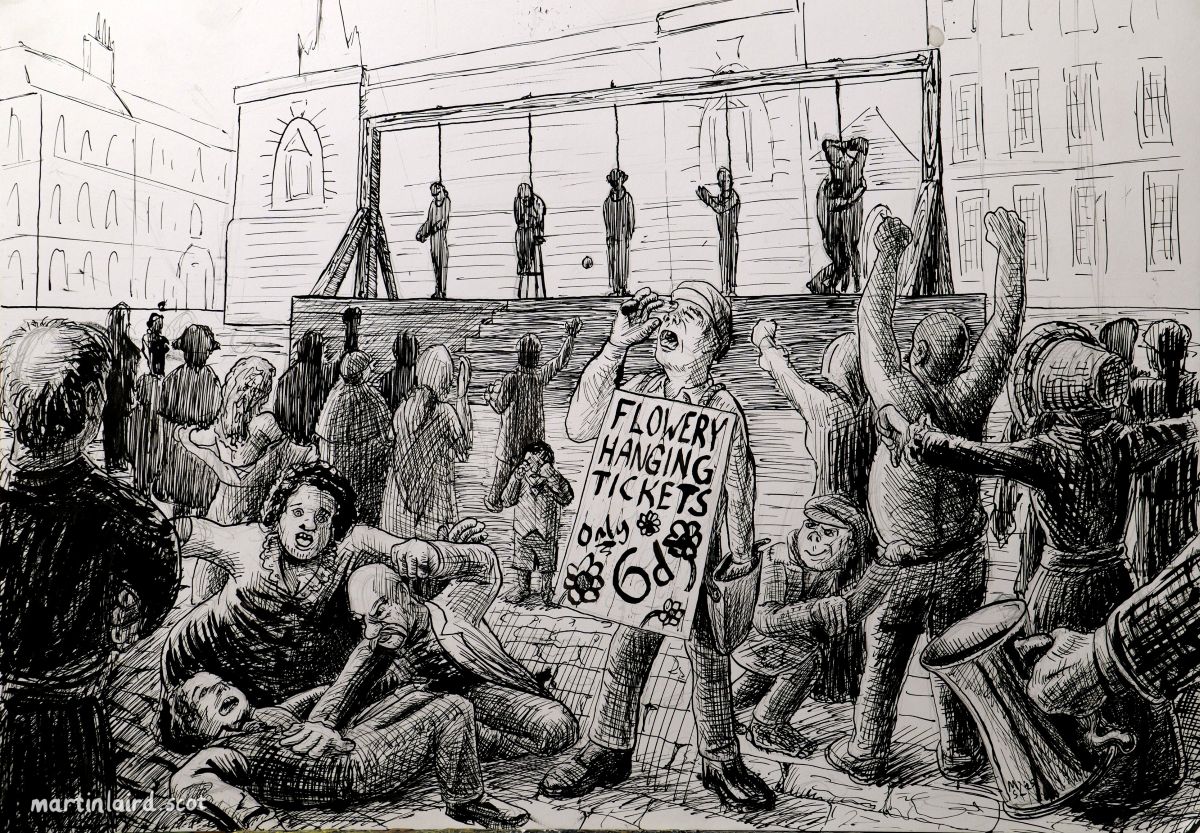
The witnesses at the trial gave lurid accounts of that bloodthirsty night and the five condemned men were to face a public execution. Crowds of 20 to 30,000 turned up for the spectacle. There had not been a multiple public hanging for decades and they thronged the streets around Newgate prison. Prime viewing sites commanded high prices and pickpockets roamed through the crowds making the best of the event.

The five men stood on a raised platform, although one was too weak to do so and was seated on a stool. The executioner, William Calcraft, at the allotted time, went beneath the platform and unbolted the trap door under each man. After dropping through, Calcroft had to grab the ankles of each man and swing on them to finish the job. It was reported that Durano’s rope broke and he had to be hung up again. Hanging is not quickly over and for some they thrashed about for half an hour. Lord Lennox later stated that he had never seen anything more disreputable than the demeanour of the crowd.
This great public spectacle of justice shocked many and questions were raised in the House of Commons about the use of multiple public hangings. Eventually this was to lead to a Royal Commission being set up. The hanged men were buried in Newgate. Carved on the wall were their initials B.L.D.L.W. the words ‘Ship Flowery Land, and the date of their deaths ‘February 23’.
On 26 July 1864 at The Tribunal of Commerce of the Seine, owner of the Flowery Land, M. Wemyssker, brought a successful action against 6 insurance companies and was awarded 37,950 Francs.
Sir Arthur Conan Doyle wrote a story, based on the murders, the trial, and the hangings. It was published, with illustrations, in the US syndicated Press on 19 March 1899.

Donate to The Orkney News
£2.00

Leave a Reply