
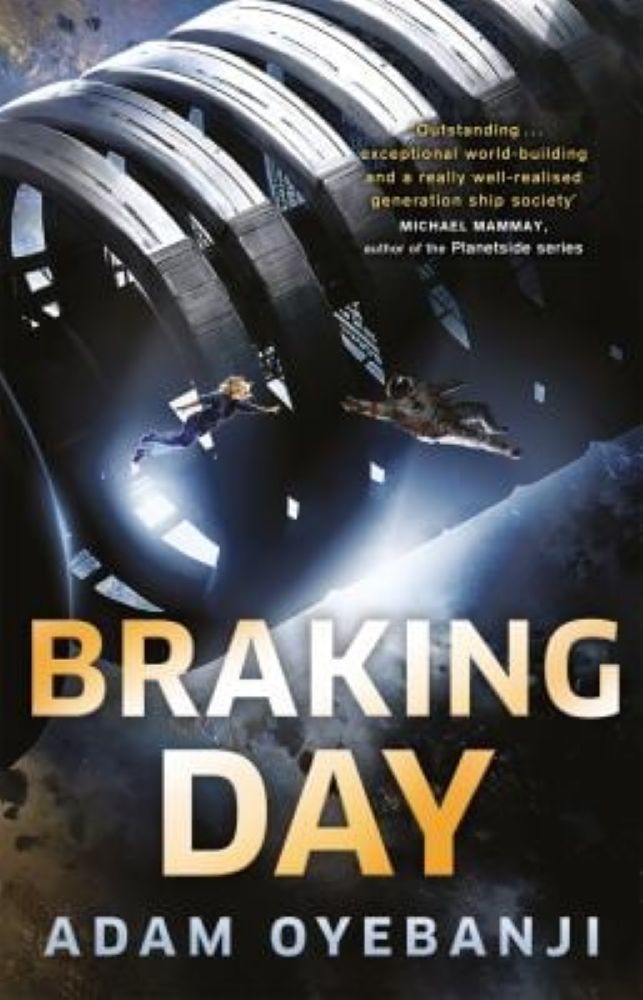

Adam Oyebanji, “Braking Day”, £16.99 paperback, 359 pp., Jo Fletcher Books, 2022.
First published in different form in Shoreline of Infinity 31, 6th June 2022.
After covering propulsion to the nearer stars in ‘Connecting the Dots’ (ON, 18th May 2025), I had meant to add some reviews of relatively recent novels of interstellar travel. Other things came up, but it’s not too late to do that now.
Braking Day is set in a fleet of three multi-generation starships (but see below), on approach to Tau Ceti. It’s not a ‘lost starship’ novel like Robert A. Heinlein’s Orphans of the Sky or Brian Aldiss’s Non-Stop: the characters know where they are, what they’re doing and what’s to happen next – the title is not a misprint. There are plenty of convincing details to confirm that: the Home Star (never Earth) is correctly placed in Boötes, as it would be on a voyage to Tau Ceti, the Destination Star, whose system is correctly described as ‘dirty’, filled with comets, asteroids and dust (see ‘Beyond the Pale Red Dots’, ON, 11th May 2025), so the approach is going to be tricky. There’s a lot of work for the engineers in readying the ships for the big day – the spin of the inhabited wheels has to be stopped and the main drive fired up for the first time in years. Understandably, with spares in short supply, their motto is “Try not to break stuff”.
The ships are big: they carry thousands of people, in counter-rotating wheels like Stanford Torus habitats (see the cover, and ‘The Fermi Paradox, Part 2′, ON, May 1st, 2022), enough to avoid the dangers of genetic drift in a small population after landing, and enough to absorb the losses of an impact in flight which has killed hundreds in one wheel and rendered another almost useless. Though not identified, the propulsion system has a big engine bell aft, acceleration is at a significant fraction of a gravity, there’s an intense radiation flux during it, there’s a long spine of fuel tanks between the drive and the habitat wheels, yet the subsequent radiation is low enough for the engine room (which has ‘sub-coils’) to be visited, even sabotaged (see below). By a process of elimination, it has to be beefed-up pulsed fusion like the British Interplanetary Society’s ‘Project Daedalus’ study (see ‘Connecting the Dots’). My one quibble is that all the colonists know about the Destination Planet is that it exists, is roughly Earth-sized and has comparable temperatures, with methane and ammonia in the atmosphere. Even for a planet as small as Earth, at 12 light-years’ distance we could tell most if not all of that, if not now then very shortly, with the ground- and space-based telescopes coming on line in the next few years.
In the 1967 discussions which led to my book Man and the Stars (Souvenir Press, 1974), after we had been briefed on ‘Life, as we know it’, by the late John W. Macvey of Saltcoats, the late Andy Nimmo argued that the ‘foreseeable mission’ based on near-future technology was unworkable, both practically and politically. An ‘acceptable’ interstellar colonisation mission would require not just preliminary reconnaissance but experimental bases, and rapid links to Earth to deal with unexpected contingencies – in other words, faster-than-light travel. We got a lot of flak for continuing the discussions regardless.
As in Edward Ashton’s novel Mickey7, (review, ON, 11th August 2024), now filmed as Mickey 17, what has motivated the launch of a foreseeable mission is the likelihood of totally destructive war on Earth, and in Braking Day there’s a similar situation. There are no messages from ‘the Homeworld’, nor any expectation of them, at any point. The conflict, which had reached a near-religious intensity, was between those who accepted the use of LOKIs, Loosely Organised Kinetic Intelligences (near-autonomous robots), and those who regarded them as a fundamental threat to the human mind and spirit. What most of the Braking Day characters don’t know is that there was a fourth ship, a lot larger and crewed by the pro-LOKI faction, also heading for Tau Ceti. The intellectual disagreement became hatred when plague broke out on the fourth ship and the fleet refused to accept refugees, even children, even when sent on one-way trips across. That ship has now gone dark, and the survivors aboard are planning a long-delayed revenge.
One detail on which our 1967 discussion group disagreed with John Macvey was his insistence that starships would need strict military-style discipline, including the death penalty for insubordination. Within the Braking Day fleet, this has polarised into a caste system of officers and crew locked in mutual contempt. The central character, Ravi, is ‘crew’, but has antagonised both sides by qualifying for engineer training – technically an officer’s post, but there are gradings even among those. The crew includes petty criminals like his father, who pushed his luck too far and got recycled – so most of Mickey’s family despise him, with only his dissenter cousin Boz still on his side, while his girlfriend, who’s an officer, is two-timing him and laughing at his aspirations behind his back. Actually she’s a member of a supposedly environmentalist group, who like their privileges the way they are and want the voyage to continue indefinitely – that’s why she conned him into a clandestine visit to the engine room.
Then he begins to have headaches, then visions and finally nightmares, caused by a dissenter in the hidden ship’s crew, who’s trying to warn him through his implants about the coming conflict…
From there on it gets complicated, and continues to the end as a page-turner which I won’t spoil. The only thing to mar my enjoyment was a set of increasingly coy references in the names. The hidden starship is called the Newton, so its core computer is referred to as ‘Isaac’ – fair enough. But on both ships, one of the principal families is called ‘Ansimov’; and one of the more prominent LOKIs is called ‘Olimaw’, as in R. Daneel Olivaw, the principal character of Isaac Asimov’s robot novels. It had me wondering if Ravi’s ship’s computer was called ‘Archie’ in tribute to the late Archie Roy, Professor of Astronomy at Glasgow Uni and himself a writer of SF and supernatural thrillers. But no, it’s because the ship is called Archimedes.


Leave a Reply