
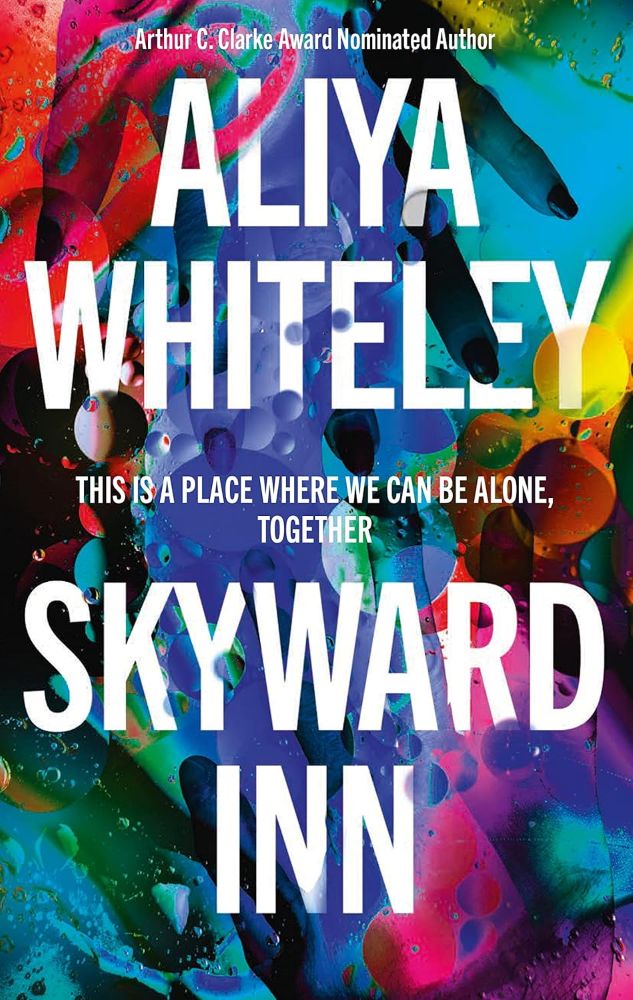

Aliya Whitely, “Skyward Inn”, £11.99 paperback, 253 pp., Solaris (Rebellion Publishing) Press, 2021.
First published in Shoreline of Infinity # 24, July 6th 2021.
The Times ‘SF Book of the Month’ says, “When it comes to misdirection, Aliya Whiteley is the very devil.” So it seems only fair to begin with a spoiler warning: I am going to discuss what this book is about, which becomes apparent to the reader only in stages, particularly in its second half.
The quote on the front cover reads, “This is a place where we can be alone, together”, and it’s highly significant. The concept of the group-mind, of which individual beings are units, goes back a long way in SF, though Arthur C. Clarke’s first story ‘Rescue Party’ was where I first came across the idea that such an entity might have a group consciousness. His Childhood’s End imagined humanity not only merging in that way, but discarding physical bodies to become part of a galactic Overmind, and although he described the event in lyrical terms, he had sufficient misgivings to preface the novel with “The opinions expressed in this book are not those of the author”. Nigel Kneale in Quatermass (the final book) and Colin Wilson in The Space Vampires (filmed as Lifeforce) both regarded the transition as a thoroughly bad thing, especially if achieved by seduction or compulsion.
‘Lifeforce’ (hyphenated or not) is a concept discredited in biology for more than a century, as Richard Dawkins devastatingly demonstrates in Unweaving the Rainbow, though it continues in media SF and fantasy such as Star Trek, Doctor Who and Torchwood. But it doesn’t have to be invoked to cause disquiet about the issue: for example, Lord Rees has expressed his fears that incautious use of biotechnology could lead to the release of a ‘grey goo’, defined on Wikipedia as ‘a hypothetical global catastrophic scenario involving molecular nanotechnology in which out-of-control self-replicating machines consume all biomass on Earth while building more of themselves’. Something very like it happens in Greg Bear’s Blood Music, although it turns out that the new biomass is evolving a new consciousness which may transcend humanity.
Or then again it may not, in whatever form it comes into being. In the 1975 discussions leading to the final chapter of my own Man and the Planets, the late Chris Boyce imagined it happening through physics, enthusing about the future potential of what he called ‘the mind-machine net’, in which all bodies (including artificial and mechanical ones) would be accessible to all minds. Reviewing the topic in 1981 before the book went to press, he had developed misgivings: “the spirit of the beehive is in this”. The late Ian Downie, one of the participants, asked, “What if the future of humanity is a merger, in which individuals become like cells in a single organism?” My reply was, “What if it isn’t – are we going to try it and see?”, and Bill Ramsay, another participant, commented, “Going to a singularity is always dangerous”.
The Skyward Inn used to be called the Lamb and Flag, and the change is significant, with the old values of the crusading Agnus Dei and the Cross of St. George being replaced by new emphases looking upward, out into space. The pub stands in the Western Protectorate, formerly Devon. Fifteen years earlier, a wormhole or similar portal called the Kissing Gate opened near us, giving access to an Earth-sized world called Qita. At first it seemed to be uninhabited, and the militaristic Coalition which runs Earth decided to colonise it and exploit its resources. The back cover tells us that “Skyward Inn, within the high walls of the Western Protectorate, is a place of safety, where people come together to tell stories of the time before the war with Qita”, but this is thoroughly misleading. Earth’s military task force of 30,000 was confronted by an equally large number of Qitans who simply faced them down; the apparent takeover was portrayed as a success, but the Qitans are pushing back. The Protectorate isn’t walled off and its inhabitants aren’t sheltering from a Qitan takeover; they’re against all forms of technology, with no transport except horses, no electricity and particularly no dependence on ‘Coach’, the individual computer linkups through which the Coalition runs the outside world. The Coalition uses the Protectorate as a setting for romantic films, and portrays it as idyllic in virtual reality promotions for tourism (which the locals don’t want). It’s a bit like the isolated England of Keith Roberts’s Pavane, which was far from idyllic when you got to know it, and neither is the Protectorate, as we learn about it from a disturbed teenager, estranged son of the Inn’s proprietrix, Jem.
Jem has been to Qita, spending ten years there, having been sent out to spread the message that humans really come in peace. She doesn’t understand much of what she sees, but having retreated to Earth and the Protectorate, she now runs the Inn with a Qitan, Isley, who ensures its popularity by producing Jarrowbrew, aka ‘the Brew’, which has become hugely popular because it really does take away your troubles, at least for a time. Having spent time in the West Country myself, I can easily see that happening. We come to realise later that the Brew is ubiquitous on Qita: the sea is made of it, the ground is saturated with it, and the Coalition has been drilling for it and exporting it to Earth in industrial quantities. It’s akin to the sentient Ocean of Solaris – the Qitans are born from it, and although they can develop enough individuality to fight among themselves, ultimately they are brought back and united with it.
Meanwhile there’s a disease loose on Earth, and the local councils in the Protectorate want to keep it out, but even there, strange things are beginning to happen. The ground liquefies around the graves of the dead, and the bereaved insist that they can communicate with them by touching it. Jem finds herself in telepathic contact with her son, who has run away to Qita and is still en route, but she shares his future, in which he’s sent out to follow her footsteps, seeing and learning a great deal more. By the time he will get back to the human spaceport, it and the industrial facilities will have been abandoned, the occupants fled or absorbed.
The Brew, now called ‘the liquid’, is overflowing the Protectorate, and the Coalition authorities think that it may be the source of the disease. The nearby inhabitants cluster at the Inn, on high ground, only to be absorbed into the growing pool in the basement. The vicar, discovering what’s happening, pronounces “Therefore what God has joined together, let man not separate”, before succumbing to its pull. Jem, who has intuitively avoided physical contact with Isley throughout, succumbs, rebels briefly, and bows to the inevitable as columns of liquid rise around her like natural space elevators. Coalition bombers are in the sky, but as in Blood Music, it’s much too late – the spaceport across the water at Swansea has a column of its own – and as she is absorbed, still regretful for the loss of her individuality, she realises that the liquid already pervades the Galaxy. Kissing Gates are this novel’s equivalent of the Overlords in Childhood’s End, sent to gather in candidate races when the time is right, as it now for us.
I keep thinking of the poignant moment near the close of Childhood’s End, when Jan Rodricks returns to the empty Earth, and realises while waiting for the finale that whatever his limitations, he is now the best pianist in the world. Musical performances – individual or collective – are not going to be improved by merging the minds of the players. If you’re in doubt about that, I wrote at the time, just listen to Saturday morning’s Building a Library on BBC Radio 3, comparing the different interpretations of the same pieces of music by different conductors, different orchestras, different soloists. The operative word is ‘different’. The same applies to writing and indeed to reading; the sameness of ‘perfect’ renderings of a symphony, in which the players were literally ‘all of one mind’, would be like the literary merit of a Reader’s Digest Condensed Book. Individuality does have its merits, and in these and many other kinds of experience, we have to say Vive la Difference.
Leave a Reply