
Reviewed by Fiona Grahame.

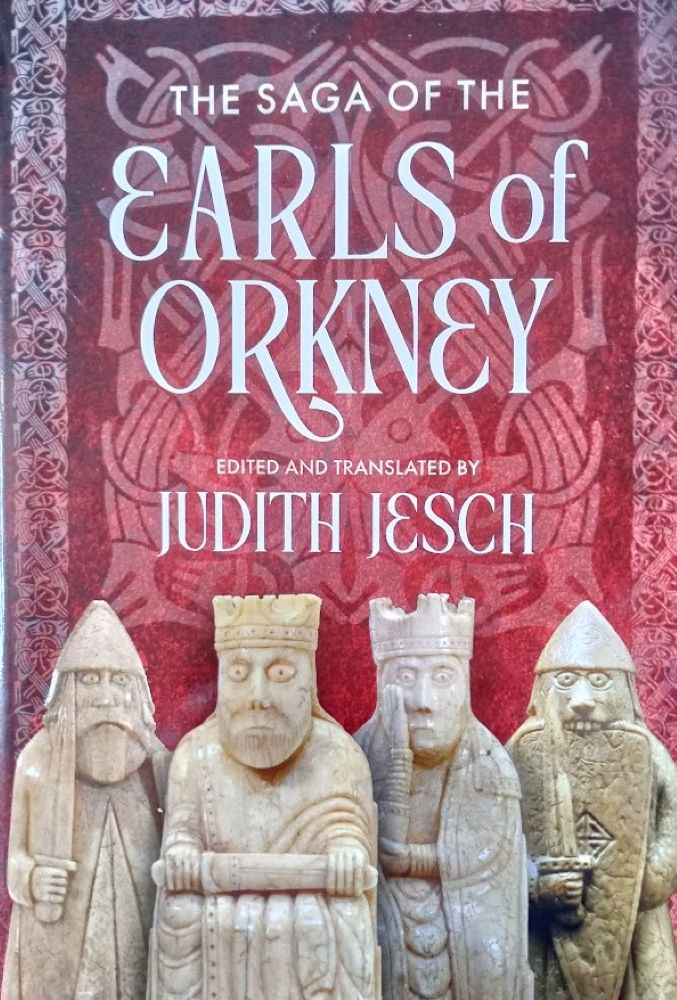
The Saga of the Earls of Orkney edited and translated by Judith Jesch has just been published by Birlinn, and here at The Orkney News we received a copy for review.
Many readers will know of and some will have read ‘Orkneyinga Saga – The History of the Earls of Orkney’. It’s a Penguin Classic having been first published in 1978 by the Hogarth Press. It is a translation by Hermann Palsson and Paul Edwards and the version most of us will be familiar with.
A new look at the Saga was long overdue and Judith Jesch has completed a meticulous work going back to what she describes as the ‘patchwork of manuscript fragments’, that survive. These too are not what was originally written down from the oral storytelling, but Old Norse Icelandic transcriptions from the early 13th Century. The earlier versions no longer exist, but miraculously, fragments from the later accounts do. It is these fragments that Jesch has gone back to for this 21st Century account.
One of the outstanding features is that Jesch has kept the personal names of those involved in the Saga as they would have been. The Anglicised names of the characters we became familiar with since the 1970’s translation are gone, replaced with the Old Norse (ON). This took a bit of getting used to because when I read I hear the voice in my head speaking those names. It doesn’t take long for the brain to adjust to these new inner sounds and I feel it is a strength in this translation helping to create the rhythm of the original ON language.
In the excellent notes preceding the text of the Saga Jesch comments:
” My sense is that twenty-first-century readers are much more tolerant of strange alphabets than might have been true of earlier audiences, and I have therefore chose to give Saga characters (many of whom were real people) their own names more or less as they would have been written by speakers of Old Norse.”

The title of this translation emphasises that this is a Saga about the Earls of Orkney. The early chapters establish the foundation ‘myth’ of the men who were to rule the Earldom, which included Orkney, Shetland, Caithness – and sometimes further afield. There are very few of the ‘ordinary’ folk of the Earldom featured, however, they do crop up in accounts of the miracles after the martyrdom of Earl Magnus. The other significant character who is not an Earl is Svein Asleifarson. His story is found in the latter half of the Saga, weaving in and out of several chapters. Svein shifts allegiances, seeks revenge of ills done to him and his family, is outlawed, then welcomed back, visits David the King of Scots, and eventually meets an end suitable for a Viking warrior as the last man standing hacked to death in a ditch outside Dublin city.
Various themes are repeated throughout the Saga : division of the Earldom, diplomatic negotiations, pilgrimage, revenge, sainthood, shifting loyalties, and inheritance. There are also the Norse tactics of setting fire to houses with your enemy within, raiding and returning home with riches, feasting, and praising your own deeds.
“After the battle, Earl Haraldr subjugated all of Caithness and went straight out to the Orkneys and praised his great victory.” Ch 109, p278.
Very few women feature in the Saga but those who do have an important role to play in their chapters. Women like Frakokk ” she and her sister Helga were extensively involved in ruling the land along with Earl Haraldr.” – Ch 54, p143.
Frakokk’s story takes in that of the poisoned shirt after which she is expelled from Orkney. She meets a fiery end at the hands of Svein Asleifarson.
There is poetry in the Saga, especially towards the later half of the book. Poetry is always difficult to translate, and Skaldic verse was there to be performed. It uses imagery which would have had deep meanings for those listening to it. Jesch comments that the poetry is older than the Saga itself and was composed by poets who lived, at least some of the time, in Orkney. On his pilgrimage across Europe and to the Holy Land the Saga tells us that 4 poets accompany Earl Rognvaldr. The Earl himself composes many verses on the trip.
Jesch has also retained the shifting tenses which occur in the narrative. I found that when you got into the flow of the translation that was not a problem for the reader, but like the use of ON personal names, adds to the rhythm that the telling of the Saga should have.

There are many places mentioned in the Saga, and one of the things which is fascinating is that we live in Orkney with those sites all around us. Readers in Shetland and Caithness will no doubt experience that same link with areas familiar to them. Where place names no longer exist Jesch has left them in ON but if they can be translated they are, grounding the reader in the landscape of the Saga.
The cover of the book features the iconic Lewis chess pieces, four of them, in contrast with the Penguin version with one. There is a lovely quality to the paper and Clays Ltd have done an excellent job in the printing and binding. There are notes, maps and genealogical tables. At the back of the book is a gazetteer by Colleen Batey with additional information about some of the places mentioned in the Saga and archaeological evidence at those locations.
Judith Jesch, Emeritus Professor of Viking Studies at the University of Nottingham, has recently been appointed as Visiting Professor to the expanding team of research staff at the UHI Institute of Northern Studies based in Kirkwall, Orkney.
Commenting Professor Jesch said:
“’I have followed with interest the work of UHI’s Institute for Northern Studies since it began as a Centre for Nordic Studies in 2007 and have been lucky enough to attend several of its annual conferences.
“The Institute does important work on the history, culture and heritage of the northern parts of Scotland and, especially interesting to me, on their Scandinavian links. The Institute’s international reach through its track record of remote teaching and online seminars is an attractive aspect of its work and it is a privilege to become more involved in this as Visiting Professor.”




Leave a Reply