
By Ian Cooper, from his excellent series Records of a Bygone Age, first published in The Stronsay Limpet and republished here with permission.
In last month’s article we left young Eday couple James and Rebecca Miller lodging in the passenger depot at Birkenhead waiting to board the ship taking them to their new life in Australia. James had written a letter to Rebecca’s parents from Leith and had then sent them another on their arrival in Birkenhead.
These letters home would have been greatly treasured by the family at the time and indeed were carefully looked after and passed down through several generations before eventually reaching Rebecca’s great grandniece Margaret Reid (nee Stevenson). Being aware of the Stronsay connection with Rebecca’s siblings, which we’ll come to in a minute, she thought this was a fascinating piece of local history that was well worth preserving and recording.

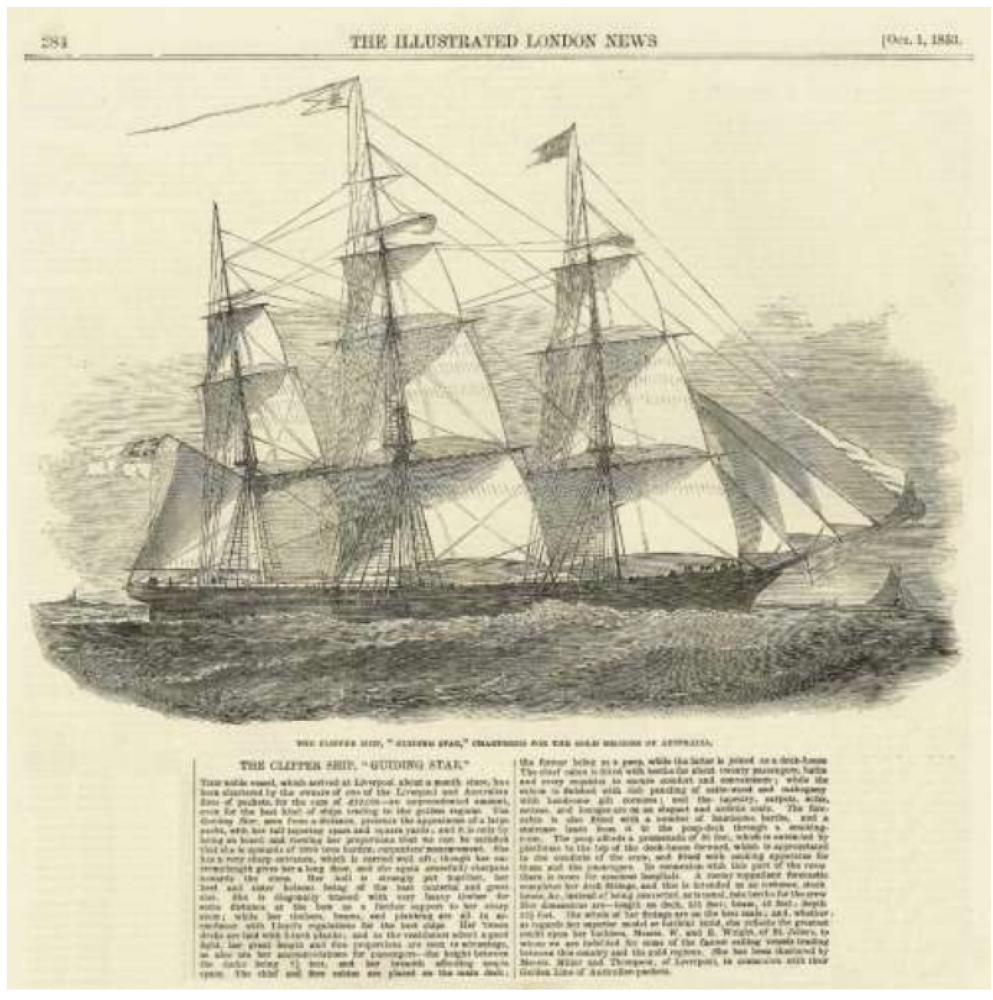
The ship James and Rebecca boarded on their way to fulfil their dreams of a new life in Australia was the full-rigged clipper Guiding Star. This 1470 ton, 233ft (71m) clipper, which had been built at St John’s in Canada just 2 years previously, epitomised all the best in design and safety, with passenger comfort being given higher priority than many ships of that time. Her previous voyage to Melbourne had been achieved in 70 days, this at a time when the average voyage time would have been in excess of 100 days, with the return journey being noted as the second fastest trip on record.

It was hoped this voyage would be of similar duration, with this prospect apparently even attracting a bet of £1,000 that she would reach Melbourne within 10 weeks. She departed from Liverpool on 9th January 1855 with a full complement of 62 crew, together with 481 passengers most of whom, like James and Rebecca, were emigrants heading for a new life in Australia and hopes were high for another fast passage.
The Guiding Star made good progress as she headed south, averaging about 200 miles a day, with her position being logged and later reported by ships she encountered along the way: the Speedy on 28th January; the Kate Hastings on 9th February and by the American ship Mercury on 15th February, where her Captain noted that she was heading due south and looked in good condition. This, sadly, was to be the last that was ever seen or heard of the Guiding Star.
It was common practice at this time for ships bound for Australia to sail as far south into the Southern Ocean as possible, enabling them to pick up favourable westerly winds to enable a speedier passage. While this made for the much sought after quicker passage, it also meant sailing dangerously close to the Southern Ocean icefields, with the ever present risk of encountering ice floes or icebergs in that area. The sailing ship George Marshall, bound on a similar route to Australia as the Guiding Star but about 36 hours ahead of her had, in fact, encountered and only narrowly avoided icebergs there on 19th February.
With ship to shore telegraphic communication still decades away it was some time before real concern emerged for the Guiding Star’s safety and it wasn’t until October 1855, nine months after her departure from Birkenhead, that these fears were first recorded in the newspapers of the time. In all probability it would have been some time after that before James and Rebecca’s families back home, waiting anxiously for a letter to tell of their safe arrival in Australia, would receive the tragic news.
Taking the known information into account, it was surmised that she must have encountered that same icefield as recorded earlier by the George Marshall, struck an iceberg during the night of 20th/21st February and foundered taking James and Rebecca, along with another 479 passengers and 62 crew to a watery grave.


I haven’t been able to find much information about James Miller but here we finally come to the Stronsay link to this story. Three of Rebecca Meil’s younger siblings moved to Stronsay: Margaret, who married James Shearer and lived at Housebay; Ann, who married Edward Chalmers, who lived at Huip and later moved to Aikerness in Evie, and Mary, who married widower Robert Croy in 1880 and moved to live with him at Lower Midgarth along with her daughter, also Mary Meil, and Robert’s three children from his first marriage.
Robert and Mary had two children together, Janet Craigie Croy and William Croy. William emigrated to New Zealand in 1909, working as a ploughman on his cousin’s farm there. He enlisted in the New Zealand Expeditionary Force in 1916 and, after training in Britain, was sent to France in February 1917 where he was killed in action on 12th October 1917. Janet, meantime, married William Dennison and moved to Fingeo where their son James Hamilton Dennison was born.
Mary Meil’s first daughter, Mary Meil, married John Miller Stevenson from Park of Housebay, and this Mary and John were the grandparents of Margaret Reid (nee Stevenson), originally from Kirbuster, who was the lady who had carefully preserved the letters. Being aware of the Stronsay connection with Rebecca’s siblings, she thought this would be of interest to the Heritage Centre here and kindly passed the letters on to us at the Centre, which has enabled us to research and record this sad tale.
Leave a Reply