
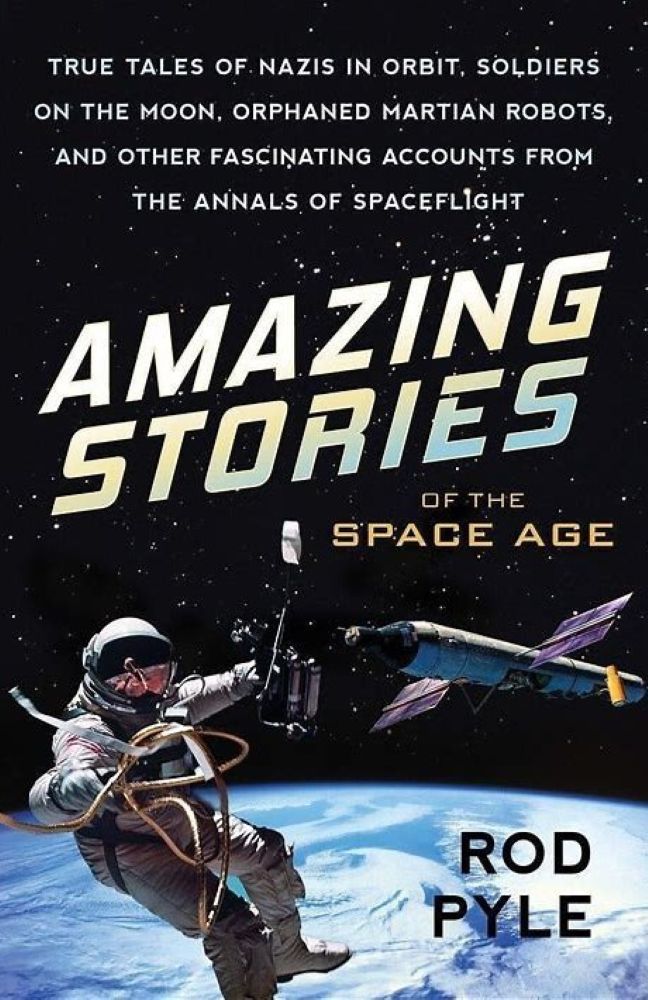

Amazing Stories of the Space Age: True Tales of Nazis in Orbit, Soldiers on the Moon, Orphaned Martian Robots, and Other Fascinating Accounts from the Annals of Spaceflight, Rod Pyle, Prometheus, 2017.
First published in different form in Concatenation, 15th September 2017.
Previously for Concatenation I’d reviewed Rod Pyle’s books Destination Mars and Curiosity. I liked the former, but because it was compiled from his interviews with Mars mission experts over the years, it required an effort to get past the descriptions of the people, how old they were, what they were wearing etc, to get to what they had to say. In Curiosity, there were plenty of facts, but the book was dominated by how Pyle had ascertained them and what his reactions to them were. So it’s a relief to find that in this book he lets the ‘fascinating’ stories speak for themselves.
I suppose it’s a sign of advancing years, that I knew many of them already. I had to remind myself that even in the mid-70s, there were adults who thought that US manned spaceflight had started with Apollo, because they’d been too young for the Mercury and Gemini programmes to register, much less the earlier rocket aircraft and balloon flights. For many readers, almost everything in the book will come as news.

Some of it actually was news. The cover story is of the USAF’s Manned Orbiting Laboratory, cancelled in 1969 but not fully declassified until 2015 (Figs. 1 & 2). It wasn’t totally secret at the time: it featured on a New Scientist cover in the late 60s, and there were details in Manned Spacecraft (Blandford Press, 1967), the first volume of Kenneth Gatland’s Pocket Encyclopaedia of Spaceflight in Colour.


One slight mystery there was that the cutaway drawing of it (Fig. 3) was clearly shorter than the photo of a mockup flown on a Titan III booster in November 1966 (Fig. 4), which Pyle doesn’t mention. (Another ‘fascinating’ fact is that the flight reused an early Gemini capsule, a detail not mentioned in the well-deserved applause for SpaceX’s reuse of a Falcon 9 booster at the time of publication.) Gatland said only that the rear section was a ‘laboratory module’. Perhaps it’s not too surprising that it would have been filled with a large telescope, as the Soviets must surely have realised – so why keep it secret all that time?
As Russian science writer Sergei Kapitza remarked, at the IBM ‘Science Revisited’ conference in London in 1990, if you want to know the capability of your enemy’s reconnaissance satellite, you can either spend 20 years infiltrating a spy into the programme, or you can give its dimensions to a first-year physics student who will work it out from the laws of optics. A comment of the 1970s on the Soviet space stations was, “What’s the difference between a military Salyut and a civilian one? It’s which way up the telescope is mounted.” It turns out that there was a proposed ‘Astronomy Mission’ version of the MOL in which the telescope was outward-looking; had it been flown and proved successful, it would have saved a lot of later argument about whether astronauts should service the Hubble Space Telescope, or could perform significant science on the International Space Station.


The Gemini programme also appears in Pyle’s account of the first real space emergency, when Neil Armstrong and David Scott had to abort Gemini 8 immediately after achieving the first space rendezvous (Figs. 5-7). Armstrong also featured, without knowing it, in a near-emergency after Apollo 11’s touchdown, when heat leaked to the ground from the Descent Stage faster than expected and a fuel line froze, threatening an explosion as pressure built up behind it. Heat leaking in turn from the descent engine solved the problem, and it was ironed out for future missions.

Had the Descent Stage exploded, it might have given reality to Sydney Jordan’s painting ‘If Eagles Fell’ (Fig. 8), where he imagined a surviving astronaut being rescued by the Soviet Luna 15 (as a group of American scientists from MIT and Caltech, visiting the Moscow Aviation Institute in 1990, were told that it might possibly have done – ( see ‘And Finally… Yes, We Did Go to the Moon‘, Part 1, ON, October 23rd, 2022). That would certainly have created an ‘amazing story’ if it happened, because the order from the White House was that contact with Apollo 11 was to be severed if things went badly wrong.

Before moving to Gemini and Apollo, Armstrong flew the X-15, the highly successful rocket aircraft which achieved more flights than all five of the Space Shuttles, and in much shorter time (Fig. 9). Pyle describes the proposed X-15B, to be launched on a cluster of Navaho missile boosters, which was mentioned by Scott Crossfield in his autobiography Always Another Dawn (Hodder & Stoughton, 1960), but has been dismissed in some quarters as a fantasy. Pyle shows that it was a serious proposition. But he doesn’t cover the proposal to air-launch it from a supersonic XB-70 (Fig. 10), or the proposed orbital version with a flat underside like the X-20 ‘DYNA-SOAR’ (which he does cover) and the Space Shuttle. (See ‘Rocket Aircraft, Part 2’, ON, 3rd December 2023.)

One thing I didn’t previously know about was the studies of hand weapons which would be used to defend the USAF’s proposed lunar base against attacking cosmonauts. Some were truly science-fictional, like the ‘Gyrojet Rocket Gun’, and some more suited to Harry Harrison’s Bill the Galactic Hero, e.g. the lunar Claymore mine with the instruction on it, ‘Front Towards Enemy’. Pyle also describes the handgun developed for the Soyuz spacecraft’s survival pack, to fend off wolves or bears in landings off-track in remote territory. He mentions the anti-aircraft gun mounted on the Salyut-3 space station, not tested until after the cosmonauts had left, but doesn’t go into the supposed laser weapon on the first Energia launch, about whose existence I have severe doubts.

Curiously, the Salyut-3 weapon isn’t mentioned in the July 2024 issue of the British Interplanetary Society’s Space Chronicle (Fig. 11), though it otherwise covers the mission in depth. Its existence was confirmed by cosmonaut Pavel Popovitch, who was commander of the only crew to serve on it, and it featured in Chris Hadfield’s novel The Apollo Murders (review, ON, October 25th, 2022).
As the sub-subtitle above shows, the book covers many more topics, and for each of them I could suggest more aspects still to be covered. In the coverage he’s given of ‘missions that never were’, half-forgotten ones, emergencies and sometimes failures of ones that are remembered, Pyle has shown that there are many more intriguing stories to be told, from the shadows of the space programmes on both sides of the former Iron Curtain.


Leave a Reply