
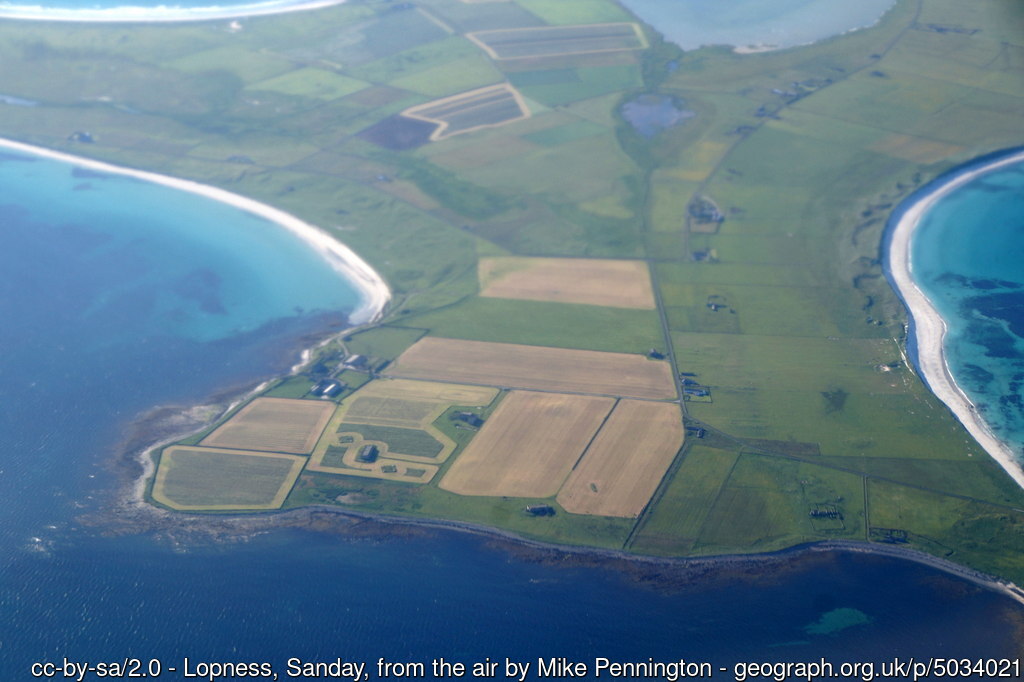
By Fiona Grahame.
This is a true tale of a crime which took place in the island of Sanday in the summer of 1805 but which was the culmination of generational grievance.
In June of 1805 William Strang, farmer, Lopness, Sanday, received Letters of Horning, of a debt it stated he owed to David Drever, Tacksman of Stove, also in Sanday. Letters of Horning were a legal device when money was owed and if not paid could result in a poinding when goods, furniture etc could be seized instead. Letters of Horning in Scotland were abolished by the Debtors (Scotland) Act 1987.

The debt was actually owed to James Scott of Westbrough who had recently died. Looking over his accounts, David Drever, as Tacksman, and Scott’s son in law, Hugh Spence, had discovered the unpaid debt of £75, 5 shillings, 3 pennies and a farthing.
David Fotheringhame, who farmed at Geramount, and who was David Drever’s uncle, had gone to Strang’s house in Lopness to deliver the Letters of Horning and to get the money owed. William Strang offered to write out a draft for an amount, now at just over £82. David Drever had given Fotheringhame special instructions in advance not to accept a draft – he would take cash or else Strang’s horses and cattle. As can be imagined William Strang would not hand over his horses and cattle. Fotheringhame returned empty handed to his nephew Drever.
The feud between the Drevers and Strangs had gone back decades, perhaps even more so. Certainly in their fathers time there had been disputes. The worst one came when the lease for Lopness, a very profitable farm, and which the Strangs had worked for a hundred years, came up for renewal. It was made public by the Proprietor that the lease would go to the highest bidder. Drever’s father who farmed at Newark put in the highest bid, however, the lease went to Strang.

The lease for Newark came up for renewal next, the farm which Drever occupied. Strang’s father applied for this too and according to David Drever, ‘by intrigued‘ got that lease. He turned out Drever, ‘who was through necessity compelled to sell off his stocking at a great disadvantage and retire to a small house in Kirkwall with his family.’
William Strang’s father died suddenly ‘in the Prime of Life’, leaving a widow, two infants, and six children by his first wife. William, aged 19, was called home urgently from his employment as a clerk for a London Mercantile House, to sort out his father’s affairs, and to take over Lopness.
His father had left many debts, which was not unusual for at that time it was the custom to rack up bills which would eventually be paid off when trading returns came in. David Drever, however, remembered how his father had been removed from Newark and was ready to take advantage of the situation young William Strang now found himself in.
David Drever had a reputation to be of a ‘turbulent and quarrelsome disposition, and a noted wrangler’. Whether or not this was true we may never know because the ill feeling that persisted in Sanday between the two families had supporters on either side calling each other out.
As Tacksman, David Drever raised William Strang’s rent from £120 a year, to £230.
It was under these circumstances of generational feuding and money owed that William Strang received the Letters of Horning from David Drever, and was threatened with the poinding of his horses and cattle.
Into Sanday arrived a letter for an order of Meal. It was placed by Kirkwall merchant George Omond on 15 July 1805, and delivered by James Muir, the Boatman, to David Drever. It should, however, have been delivered to William Strang as George Omond preferred his Meal. David Drever, opened the letter, he said accidentally, and on seeing it was not for him, decided it should go to its intended recipient. Now you might wonder why Drever did not then send a messenger with the letter to William Strang. Instead he sent a messenger to tell Strang that he wished to see him.
The messenger, James Cursatter, arrived at the House of Myre, where William Strang was at dinner with Jean Mainland. He informed Strang that he was to go and see Drever at Stove. William Strang was not going to be summoned by David Drever, and knew of no reason why he should leave his dinner and go there.
On James Cursatter’s return, David Drever sent another messenger who also returned alone. He then decided he would go himself and take the letter about Meal, hand delivering it to William Strang himself. He rode into the yard at the House of Myre and called out Strang to meet him outside. Strang was annoyed. He was at his dinner and in conversation with Jean Mainland. In the next room women were busy plaiting straw.
He reluctantly went out to Drever, picking up his riding whip as he did so. He knew of David Drever’s reputation.
What happened next has conflicting reports, but it seems that an argument developed. Drever dismounted from his horse and the two men squared off. At some point in this argument, Strang struck Drever with the handle of his whip, causing his lip to bleed, ‘profusely’.
David Drever subsequently brought a charge against William Strang for assault. Drever brought forward 12 witnesses to give evidence on his behalf, although only 11 were permitted. It was claimed that Drever’s uncle, David Fotheringhame, had ‘been a busy agent’ and gone around Sanday, prior to the Court Case, visiting the witnesses. One of those witnesses was, Jean Mainland, with whom Strang had been dining on the day of the crime. Had Fortheringhame coerced her to give evidence on behalf of Drever and ‘thrust words down her throat’ ?
After the assault took place, William Strang, was extremely upset by what he had done and was seen to be leaning against the stone dyke of the yard and crying. Nonetheless he was pursued through the courts by David Drever and the legal bills mounted up.
On 22 April 1806 Sheriff Officer James Tait served papers on William Strang to appear at the Tolbooth, Kirkwall, on 24 April 1806, to defend the charge against him.
The case continued all through 1806 and into 1807. It was finally decided by the Sheriff Substitute, William Rae Esquire, that William Strang ‘did illegally strike’ David Drever. Drever had his 11 witnesses and Strang could find none to speak on his behalf. Apparently neither Jean Mainland, watching through a hole in the wooden wall of the barn, or the wee boy James Gore age 9 who was in the yard, or Jean Scott who was in the other room with all the women plaiting straw, saw the assault take place.
William Strang was ordered to pay a fine of 15 guineas sterling and expenses. David Drever put in an expenses claim for £44, 13 shillings, one and half pennies. This was restricted by the Sheriff Substitute to £40 sterling plus the Dues of Extract.
Readers may be interested to know that in March 1808 a ‘Summons of Removing’ was issued by Lord Dundas & Factor against David Drever, Barbara Scott (his wife), Ann Angus (his mother in law) at Backaskaill, his tenants ‘of the pennyland of Sutherby and 12 pennyland of Leyland’, to ‘flitt and remove themselves, bairns, families, servants, subtenants, cottars, dependants, goods and gear’ by Martinmas 1808. When the summons was delivered by Sheriff Officer James Tait to Sanday, he personally handed it over to Drever’s wife, however, David Drever himself could not be found at that time. Ordered to appear at the Tolbooth, the Drevers failed to do so and were ruled against.
In 1810, a series of dreadful crimes took place when a farmer’s cattle and horses were repeatedly slashed and stabbed in the night. That farmer was David Drever at Backaskaill. The perpetrator of those crimes was never found.
David Drever was issued with another ‘Removal Summons’ by Lord Dundas & Factor in March 1812, and to make a payment of £5,000 sterling plus expenses.
Reference: Orkney Archive SC11/5/1805/053, Petition of Complaint – Assault, David Drever, Stove Sanday v William Strang (farmer) Sanday.
For more tales of True Crime, Orkney:


Leave a Reply