
Review for Orkney News by Duncan Lunan

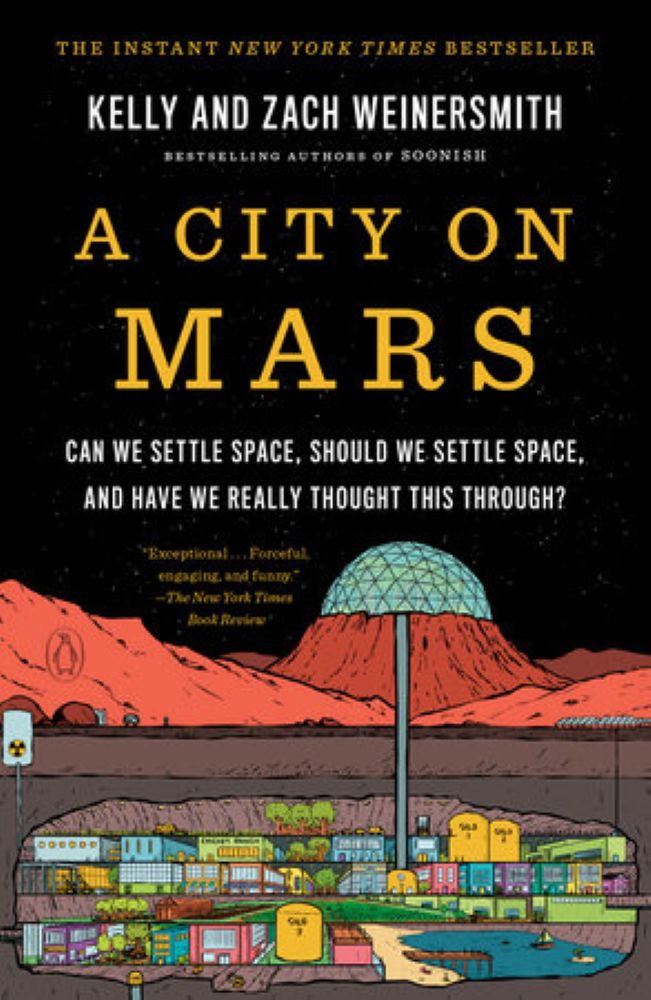
Kelly and Zach Weinersmith, A City on Mars, Can We Settle Space, Should We Settle Space, and Have We Really Thought This Through?, 388 + 48 pp, Penguin, 2024, £10.99.
When I first saw this book advertised, last year, it was billed as the definitive answer to plans for space settlement, particularly to Elon Musk’s plans to establish human beings on Mars within the, first half of this century, starting with sending humanoid robots during the launch window towards the end of this year.

To be fair to the authors, they were writing before the success of the Starship-Superheavy Flight Test 11 (Fig. 2), and after the current pause in testing, SpaceX will be back in February with bigger and better versions of both craft.


Most of the criticism I’m seeing now centres on the need to refuel Starship on orbit (Figs. 3 & 4), which has not yet been attempted, for lunar and planetary missions. But from the comments one would imagine that it’s probably impossible, whereas the Russians did it 40 years ago with Salyut 6. And it will need at least six refuelling flights for a lunar mission, more for Mars! Yet Wernher von Braun proposed to it with many more launches, in his plans for Moon and Mars missions in the 1950s, and Musk is planning to stage three or more flights per day for Starship-Superheavy, from three launch complexes of which the second and third are already under construction.
Having read NASA’s design studies for Moon and Mars habitats in the 1970s, what I was hoping for was a detailed engineering critique of more recent versions I haven’t seen, pointing out serious obstacles which have been overlooked. Will it be impossible to extend the toilets on the Space Shuttle and the International Space Station for use by larger numbers, or to grow plants in lunar or Martian gravity as was done in the Russian stations and the ISS? What we get here is often little more sophisticated argument than the repeated statement ‘Mars sucks’. There are pages quoting reviews which say how funny the book is, but endless sarcasm gets wearing.
A major question which the authors do address is ‘Why now’ – especially if we’re arguably not ready, and their case for much more biological and medical research, before trying, makes a lot of sense. But they pay no attention to the reply that it should be done now because it can be done. Three times before this, government agencies have built the vehicles which could take humanity into space, only for them to be cancelled for purely political reasons: Nixon’s hatred of the memory of Kennedy, Soviet pique at losing the Moon race, the collapse of the USSR. When Russia’s Energia programme was scrapped, there were people who said, ‘There may never be another chance’, and if the decisions had been left to governments and corporations, perhaps there never would have been. I kept being reminded of Nevil Shute’s concern, in his autobiography Slide Rule, that the golden age of British aviation was passing because the key decisions were being taken, not by bold individual entrepreneurs, but by committees taking their advice from accountants. We are in the position in the West that the microchip revolution has thrown up billionaires who can take humanity into space because they want to, asking no man’s leave for it. It may not be an ideal solution, but it seems to be working. If we wait for ‘the right time’ to take that very important step, that right time may never come.
So is that step important – is your journey really necessary? Here the Weinersmiths’ counter-argument is weakest, in my view. They claim that human exploration, particularly in hostile environments, like Antarctica, the sea-bed and Low Earth Orbit, has never done any good to anybody, and to prove it, the world is a mess. To use their favourite terminology, Earth sucks. People suck. Maybe they’re right. But to take just one example, to say that the Moon Race wasn’t preferable to ongoing nuclear confrontation, is questionable at least. Can we really say that cooperation in Antarctica and Low Earth Orbit has done nothing for human relations in other areas? I know that a lot of Americans think that way, that the USA should ‘go it alone’ as a matter of principle, that NASA commits treason by working with Europe and Japan. I’ve been interviewed by US radio stations who held such views as policy, and met people on the ground there who went a great deal further. But I’ve also met a great many people who don’t, and it seems to me it’s at least worth trying.
Coming back to specifics, of which there are a great many, another Weinersmith argument is that life in space is a great deal worse than we think it is, because astronauts lie – to keep their jobs, to get more flights, not to rock the boat. Whistle-blowers have sometimes been given a bad time. One example was the banning of G. Harry Stine from NASA facilities when he pointed out the folly of proposing to launch the Shuttle from California without an emergency landing site in the Pacific (see ‘Eyewitness to History (4)’, ON, August 14th, 2022). A more recent instance was Scott Kelly’s campaign for improved air quality on the ISS (see ‘Axiom Attic and Orbital Reef’, ON, February 11th, 2024). When he was on the ISS for a year and too valuable to remove, and had decided to resign afterwards, he went public with the issue, after which Samantha Christoforetti, who was on the ISS for part of Kelly’s stay, then felt able to back him up in her book Diary of an Apprentice Astronaut (Allen Lane, 2018), though Tim Peake didn’t in Limitless, the Autobiography (Century, 2020), though he too was on the ISS for part of the time. So yes, the Weinersmiths have a point. But as of March 2025 682 people had travelled to space, many of them for much longer than short ballistic hops or the early orbital missions. So it can’t be that bad – and one thing they persistently overlook is the ability of people to make the best of where they find themselves.


In both editions of his Profiles of the Future (1962 and 2000, Figs. 5 & 6), Arthur C. Clarke spotlighted a paper of the 1920s which annoyed him even in retrospect. Its author had proved to his satisfaction that space travel was impossible because ‘even using gunpowder, the most powerful explosive we have’, a single-stage rocket couldn’t reach the Moon. Indeed it couldn’t, but liquid-fuelled rockets had been in existence by then, after decades of prediction, and the theory of step-rockets had been established by Tsiolkovsky, Goddard and Oberth long before.


But in The Romance of the Moon (1928, Figs. 7 & 8) Mary Proctor, daughter of the prominent Victorian writer on astronomy, was not only taken in but added a blinding insight of her own. Lunar astronauts would die on arrival, she wrote, because advocates of space travel had ‘forgotten’ that the Moon had no atmosphere, and would asphyxiate when they opened the cabin door.
The Weinersmiths don’t come out with anything so blatant, but I kept thinking of Mary Proctor as I read their analysis of the difficulties of life on the Moon, Mars and space habitats. Yes it will be tough, especially in the early stages, and I don’t see the early stages being permanent, though some fiction writers have (e.g. the ‘Mayflower’ series by Ernest Taves, published in Galaxy 1972-73). But when they quite rightly point out the dangers of solar coronal storms and galactic cosmic rays, they don’t discuss any of the mitigating factors, or possible technical solutions, much less more effective ones ‘which, methinks’ (to quote Robert Burton in 1613), ‘some new-fangled wits should some time or other find out’. Quoting ‘Martian Dust Storms’ (ON, 23rd June 2024):
“Streams of protons from Coronal Mass Ejections are focussed and highly dangerous, and heavier nuclei within them still more so. During Apollo 16 there was one such event which did not hit the Moon, and the astronauts would not have survived it if it had. In the absence of a planetary magnetic field, the surface is exposed to solar particle storms, lethally dangerous without thick shielding. Cumulative exposure to high-mass, high-energy galactic cosmic rays has even worse effects on central nervous tissue, and it’s calculated that a minimum-energy mission to Mars and back would give astronauts aboard a lifetime dosage, forcing retirement before they lost enough brain cells for noticeable effects. Martian settlements will have to be built mostly underground, barring major developments in radiation shielding.
‘Every so often the media rediscover this problem, and a rash of articles appears saying that it proves Elon Musk’s plans to establish settlements on Mars are impossible. But as Graham Dale of the Scottish branch of the Mars Society pointed out, in a discussion project called ‘Building the Martian Nation’, the situation on Mars is different from free space. To begin with, the mass of the planet below cuts the radiation exposure in half right away (I made the same point about a mission to an asteroid in Incoming Asteroid!, 2013). Building the settlement beside a crater wall would halve it again – our choice was a lava-flooded crater on Lunae Planum which we called ‘Glesgae Sinus’ – not to be confused with any condition aggravated by passive smoking (Fig. 9).

Although Mars has no overall magnetic field, it used to have, shown by magnetic banding in strata south of Valles Marineris, detected by ESA’s Mars Express. There are also localised, residual magnetic fields, some at least of them over impact features, intense enough to generate local aurorae (Fig. 10); and over the north polar hood during northern hemisphere spring, there’s enough oxygen from water molecules, disassociated by solar ultraviolet, to give significant protection and perhaps even to form a temporary ozone layer.

So the Martian surface is not necessarily the death-trap that’s currently being portrayed. On the other hand, on May 20th 2024 the Curiosity rover recorded a solar radiation storm of such intensity that the particles are visible, as streaks and spots, in the images from the electronic cameras (Fig. 11).

‘That’s a situation where the only safe place is underground, and that’s something which SF writers foresaw long since. Sandi Cayless of Bridge of Allan has written three novels following the students and graduates of the ‘Sub Martis’ university of an underground Mars culture (Fig. 12).


The late John Brunner portrayed one much earlier in Born Under Mars (1967 – Fig. 13). Life in them is far from intolerable, and one interesting aspect of Born Under Mars is the return of heraldry. In medieval times, that not only portrayed one’s ancestry and showed your troops whom to follow in battle; it also demonstrated, even among illiterate knights (as many of them were) whose siblings and offspring you could court and marry without breaking the laws against consanguinity. In the relatively small population of a Martian settlement, John reckoned coats of arms could save a lot of time in forming relationships, and in fending off predatory would-be in-laws – a problem and a solution to which NASA and Elon Musk may not yet have given much thought.’
Nevertheless, the ‘Building the Martian Nation’ project foundered due to the instransigence of participants whose reply to every proposal was ‘The Americans won’t allow it’ or ‘The Chinese won’t allow it’. Canada and the USA did get it together despite such attitudes held by Britain, Spain and France, but a lot of lives were lost because no thought was given to planning for nationhood beforehand. I discussed that question in ‘The Ownership of the Moon’ (ON, June 18th, 2023) and Kelly and Zach Weinersmith do so in equal depth, seeing little improvement meantime. In fact they see every prospect of conflict over the resources of the lunar south pole, and if there is any reason to hold back from lunar development, that would be it. Though they don’t put quite as much stress on it as I did, they point out that such conflict is more likely to occur on Earth rather than in space – starting, I suggest, with the launch sites, which are isolated for good safety reasons but consequently are almost impossible to defend.




Leave a Reply to berniebell1955Cancel reply