
We entered 2026 with the state of the US space programme still very much in a state of flux. Jared Isaacman, initially rejected by Donald Trump, has been installed as NASA Director; and Congress has voted to reject the proposed cuts to the NASA budget, restoring all programmes except the Mars Sample Return, which is behind schedule and over budget. (It wouldn’t be the first time NASA has cancelled a project to which ESA is committed, but at least this time it would be at a comparatively early stage.) A similar vote in the Senate is expected. But the Acting Director of NASA has already implemented cuts to the Goddard Space Centre, without waiting for authorisation, so much of the damage to NASA’s Earth and environmental studies has already been done.


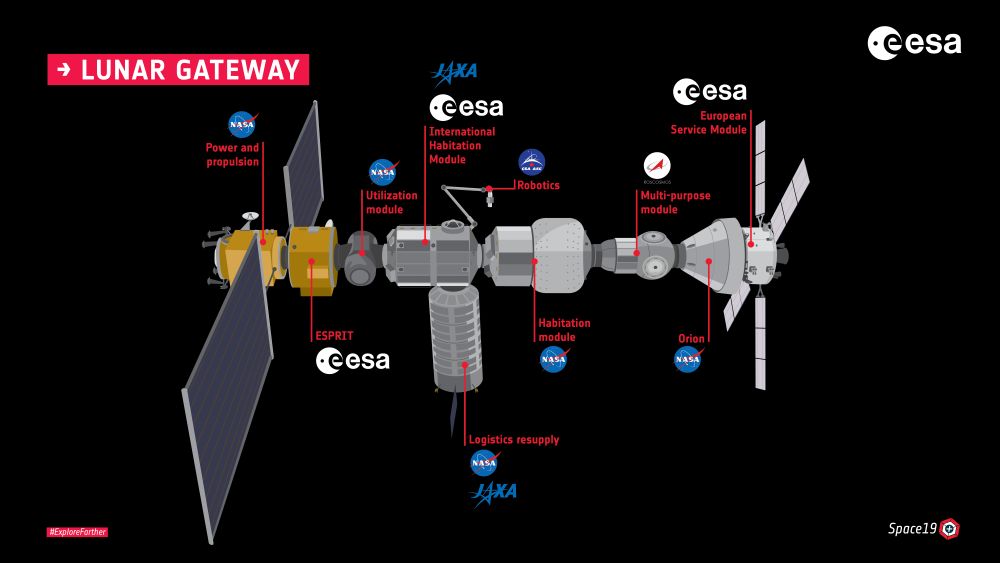
One thing which looks likely to survive the cuts is the Lunar Gateway space station (Figs. 1 & 2), work on which is already well advanced; the Thales Alenia HALO module arrived at Northrop Grumman’s plant in Gilbert, Arizona in April 2025, to be integrated with other components including an airlock supplied by the United Arab Emirates. The Trump administration wanted to cancel it, but as I’ve pointed out in previous articles, that would require the lunar-landing Starship to dock with an uncrewed Orion spacecraft as an essential part of the return from the Moon on future missions, and seems like a bad idea to me. It would remove the need for Artemis III to go to the same ‘rectilinear halo orbit’ as Lunar Gateway’s, which is to provide continuous communication with Earth as well as access to all parts of the lunar surface, and might therefore allow a fast return to Earth in an emergency, but at cost of removing other safety backups such as an extended stay at the Gateway if a return to Earth was prevented.
The first crewed lunar mission since December 1972, and the last not to involve Starship, is gearing up for launch with windows on February 6th-8th and 10th-11th. If both of those are missed, the next ones will be on March 6th-9th or 11th, and then April 1st, 3rd-6th and 30th. That one-month periodicity was foreseen by Sydney Jordan when he predicted the date of the first Moon landing almost exactly, for the Daily Express 10 years earlier (Fig. 3). Assuming that the Americans would try for a lunar landing on July 4th, he guessed that a last-minute delay might push it on a month.


The Space Launch System booster for the Artemis II mission was rolled out on 17th January (Figs. 4-6), and has been photographed from orbit (Fig. 7), by Chris Williams, currently the only US astronaut on the ISS since the early return of Crew-11 for medical reasons on January 14th (Figs. 8 & 9; the replacement Crew-12 launch is scheduled for February 11th).


The Artemis II crew has already been quarantined in hopes to avoid anything similar. Preparations for their launch are ahead of schedule, with a crucial fuelling test brought forward to January 31st , but postponed due to cold weather, moving the launch to February 8th (Fig. 10).


The spacecraft will make several orbit-raising burns on the Interim Upper Stage (Fig. 11), before separating from it and departing for the Moon on the main engine of its European Service Module. Unlike its predecessor, the spacecraft will not go into orbit around the Moon but will follow a free-return trajectory, ensuring a return to Earth after lunar flyby and bringing it back 10 days after launch.
Suddenly on January 27th there came the interesting suggestion that NASA might revive an asteroid rendezvous in 2029, before attempting a crewed mission to Mars. That idea goes back a long way: in their book Islands in Space, the Challenge of the Planetoids (Chilton, 1964), Dandridge M. Cole and Donald C. Fox argued for making near-Earth asteroids the target for Project Apollo, before the Moon. They can indeed be reached for low fuel expenditures, because such missions would cut out the lunar landing and return, but the durations would be in hundreds of days rather than a couple of weeks and the life-support challenges were far beyond what was then achievable.
Nevertheless, in the Obama Presidency the idea was revived and it kept the Space Launch System development going, until Donald Trump decreed in his first term of office that the return to the Moon had priority, with Mars in US sights beyond that. The US aerospace companies took the asteroid directive seriously, despite the lack of a target date: Bigelow, Boeing and Orbital ATK all had proposals, and Lockheed Martin developed a detailed study of a mission to an asteroid they called ‘Plymouth Rock’, using two Orion spacecraft (Fig. 12), drawing up detailed mission plans (Fig. 13) and building an approach and landing simulator in Colorado (Fig. 14).


British astronaut Tim Peake trained for it with US, Japanese, Canadian and European astronauts in Houston and then in Project NEEMO at the NOAA/Florida State International University Aquarius facility, 10 metres deep in the Florida Keys National Marine Sanctuary (Figs. 15-18).


One possibility, studied by Prof. Colin McInnes, then at Strathclyde University, was that a small enough asteroid might be brought intact into lunar orbit and be reached there by a crewed Orion spacecraft. (D.G. Yarnoz, J-P.S. Cuartielles, C. McInnes, ‘Easily Retrievable Objects among the NEO Population’, Strathclyde University, August 2013.)

NASA is still waiting for the Exploration Upper Stage which would make the SLS fully capable of achieving those aims for the Moon and Mars (Fig. 19), and with Elon Musk proposing to send Starships with robots to Mars later this year, it may never materialise. What has now seemingly been revived is a proposal by NASA personnel for a mission to a near-Earth asteroid, as a rehearsal for a Starship crewed mission to Mars (Fig. 20; Brent W. Barbee et al, ‘Prospects for Future Human Space Flight Missions to Near-Earth Asteroids’, 8th IAA Planetary Defense Conference, Vienna, Austria, April 5th, 2023.)

It would require the addition of a ‘man-rated’ version of the SpaceX Falcon Heavy to bring the crew to rendezvous with a Starship in orbit – something which I suggested might be desirable for a servicing mission to the Hubble Space Telescope (see ‘How Long for Hubble?’, ON, 12th May 2024). After several uncrewed dockings to refuel it, the Starship would carry a rendezvous vehicle to asteroid 2001 FR85, in an orbit close to the Earth’s around the Sun, taking up to 152 days to reach it, spend 16 days there and return to Earth using a Dragon capsule. Samples would be brought back, rather than the whole asteroid, which at approximately 60 metres’ diameter corresponds to the wingspan of a Boeing 747.


It’s not in a resonant orbit with the Earth, unlike asteroid 469219 Kamoʻoalewa (Fig. 21), the target of China’s Tianwen-2 probe now in flight, due to arrive in July (Fig. 22), but it will make 12 particularly close approaches to Earth in 2038-2080; still it’s not classed as ‘potentially hazardous’ because there are no possible impact dates within the available range of calculations.
There are several good arguments for doing this, apart from providing a thorough workout of the systems for a full-scale mission to Mars. One is that it would provide a very valuable rehearsal for the possibility of having to deflect a relatively small asteroid from Earth, someday.

In the discussions which led to my book Incoming Asteroid! What Could We Do About It? (Fig. 23; Springer, 2013), we set ourselves the question, ‘If we knew there was going to be an impact in 10 years’ time, what could we do about it?’ We supposed that three attempts could be made in the time, the first with laser-carrying probes powered by solar reflectors, and the second with mass drivers installed and maintained on the asteroid by the crews of 12 ships powered with NERVA nuclear engines, launched and fuelled by 36 Space Launch System boosters. If both attempts failed, there would be a range of further options as impact day approached, with nuclear weapons as a last resort. But if we have 6 years in which to revive the 1960s nuclear propulsion programme and ready the fleet for launch, Starships would now be the obvious candidates for delivery to orbit, and a successful asteroid mission already performed would be invaluable experience. To say nothing of how useful it would be for any future competition over extraterrestrial resources (see ‘The Ownership of the Moon’, ON, June 18th, 2023, and ‘A City On Mars’, ON, 11th January 2026).


The NASA studies for asteroid missions considered various methods of attaching to one, some more practical than others. Capturing it in a big plastic bag (Fig. 24), allowing only limited astronaut access (Figs. 25 & 26), seemed unpromising; but the idea of wrapping it in a net, cancelling its rotation (Fig. 27), had future possibilities.

The mass driver scenario of the Incoming Asteroid project involved 12 multiple units called MADMEN (Modular Asteroid Deflection Mission Ejector Nodes), designed by SpaceWorks Engineering Inc. of Atlanta, Georgia, each powered by an unshielded nuclear reactor (Figs. 28-30).


The original proposal was for them to be untended, and Jay Tate of Spaceguard UK agreed, but the majority of the group felt that this complex, previously untried technology would require constant attention by dedicated teams of engineers, like the reusable Space Shuttle Main Engines (which are now to be thrown away in the first few Artemis launches). The asteroid net would not only provide handholds, footholds and anchor points for tethers (Fig. 31), but could support an electrical grid powering all 12 mass drivers from just one of the solar collectors from the first deflection attempt (Fig. 32).


The proposal for a 2029 mission didn’t involve attaching to the asteroid, but visiting it with a transfer vehicle, which the article I saw said wasn’t currently available.


But the more ambitious versions of ‘Plymouth Rock’ did include the Multi-Mission Space Exploration Vehicle (MMSEV, Figs. 33 & 34), which could be used not just in asteroid missions, but on the Moon with a suitable wheelbase (Fig. 35).


A submersible stood in for it in the NEEMO project (Figs. 36 & 37). There have been multiple designs for future lunar rovers, but the versatility of this one commends it if the 2029 asteroid mission becomes reality.
Meanwhile China’s plans for the Moon are quietly moving ahead, with a lot less argument about method. Following a successful ground test of the Long March 10 booster in August 2025, first flight of the Long March 10A for space station crew and cargo supply is expected in 2026, possibly leading to appearance of a full-scale 3-stage Long March 10 in 2027, two of which will be used for the lunar landing attempt. Crewed suborbital tests of the Menzhou lunar spacecraft are expected this year, along with the Chang’e-7 mission to the strategically important Shackleton crater at the lunar south pole, and first flight of Long March 12, for lunar base delivery and supply (Fig. 38).

A City on Mars, by Kelly and Zach Weinersmith (reviewed ON, 11th January 2026), foresees serious disagreement and even conflict between the USA and China over the resources of Shackleton crater; as it stands the Artemis III Moon landing has slipped to 2028, and the Chinese date apparently from 2028 to 2030 (Andrew Jones, ‘China set for crewed lunar tests, record launches, moon mission and reusable rockets in 2026’, Space News, online, January 28th, 2026), but the delays give little excuse for complacency.
Incoming Asteroid! What could we do about it? (Springer 2013) and Duncan Lunan’s other recent books are available from bookshops and through Amazon; details are on Duncan’s website. www. duncanlunan.com.



Leave a Reply