

As previously noted in ‘Space Stations’ (ON, November 13th 2022) and ‘Space Observatories’ (ON, December 11th 2022), 1950s proposals assumed that telescopes in space would be located near space stations (Fig. 1), and frequently visited, for maintenance and removing images (probably on glass plates – Fig. 2).

The 1958 Russian film Blazing a Trail to the Stars, which I cycled to Ayr to see as a teenager, in the notorious Green’s Playhouse, portrayed a cosmonaut using a conventional telescope during EVA on the hub of a space station (Fig. 3), with the script saying that even in those unfavourable conditions, it was producing better images than much larger telescopes on Earth (Karl Gilzin, Sputniks and After, Macdonald, 1959). With the ever-growing hazard to the optics that even microscopic space debris would present, the enclosed tube (like the Hubble Space Telescope’s) looks like a better idea than the open framework of Fig. 1.

In the Jeff Hawke story ‘The Venusian Club’ (1967-68), Sydney Jordan showed a much larger space telescope, with attitude control jets instead of gyroscopes, and a cabin cum observer’s cage for maintenance, again from the nearby space station (Figs. 4-6).


At that time the US Department of Defence was pushing forward with a Manned Orbiting Laboratory (Fig. 7), which despite its name was primarily a manned spy satellite. There was a proposal for an Observatory version of MOL, which would have given most of its length to an astronomical telescope, but given the priorities of the Cold War, it’s not likely ever to have happened.

NASA’s project of the time was the Large Space Telescope, with a 3-metre mirror, to be launched by the Saturn V booster. Its chief advocate was Nancy Grace Roman, later known as ‘the Mother of Hubble’ (Fig. 8), after whom the WFIRST wide-field space telescope has been named, prior to its intended launch in 2027. After the cancellation of Saturn V in 1972 the project was scaled down to become the Hubble Space Telescope, to be launched by the Space Shuttle. In his book Echoes of the Ancient Skies (Harper & Row, 1983, Fig. 9), which I reviewed for the Glasgow Herald and the Bulletin of the Science Fiction Writers of America in 1984, Dr. Ed Krupp of the Griffith Observatory urged that the space telescope be named after Edwin Hubble, and that wish was gratified before the book came out.

In one major respect the HST was very different from the previous proposals. To allay the concerns of the scientific community, particularly about contamination of the optics, extreme care would be taken, minimising human contact and placing the telescope in an orbit far away from space station’s. There would be no thrusters on the telescope, with attitude control by gyroscopes. Prof. Malcolm Longair, Astronomer Royal for Scotland, was vehement in his opposition to repair missions, even after the flaw in the main mirror was discovered after launch. Speaking at the Astronomical Society of Glasgow in 1980, he said, “The biggest threat to the Hubble Space Telescope is the machismo of the astronauts”, to a ripple of applause from the Old Guard who still regarded human spaceflight as ‘no better than UFOs and science fiction’, as one of them put it to me at the time. Nevertheless the repairs went ahead, with complete success. After the loss of the Columbia, which was to have conducted the fifth and last Hubble repair, NASA originally announced cancellation of it, because, if a similar problem prevented the Shuttle from returning to Earth, it couldn’t reach the ISS and the crew would be stranded. Having reinstated the mission in response to massive international pressure, NASA had to have another Shuttle on standby in case a rescue mission was required (Fig. 10).


On that last repair, astronaut Mike Massimino no doubt proved Prof. Longair’s point. In his book Spaceman: An Astronaut’s Unlikely Journey to Unlock the Secrets of the Universe (Crown Archetype, 2016 – Fig. 11), he describes how he had to replace a power supply which was never intended to be serviced, and he was balked by a single threaded screw on the access panel. If he used force and damaged the telescope, he would be saddled forever with the name of the man who broke it. The best advice he could get from Mission Control was ‘Use your own judgment’. In the event, he pulled on the panel and snapped the offending screw, going on not just to replace the power unit but also all bar one of its 40-odd screws, each glued in place with a no-less-finicky washer, and now he’s known forever as ‘the man who broke into the Hubble Space Telescope’. Critics like Prof Longair would doubtless reply, “But he could have broken it.” I never take part in such arguments about the value of human spaceflight without thinking of the grandfather’s last line in Peter and the Wolf: “And if Peter hadn’t caught the wolf, what then? ”
The concerns at the planning stage, which were possibly excessive, are now coming home to roost. The space environment is not kind to moving parts, particularly metal ones, which have a tendency to shed their surface oxide patina and then stick, or even spot-weld. Tape recorders used to be first to fail, with gyroscopes often not long behind. There was great elation after the last repair, ‘Ten more years of Hubble!’ The Hubble Space Telescope has six gyros, but four had to be replaced even on the first servicing mission. 15 years after the last such mission, the HST is down to three, normally the minimum for scientific function, and one is malfunctioning. Hubble can operate with that, or in limited mode, down to just one. If things get to that stage it may be worth turning it nose-on to the line of flight to reduce drag (it has a cap which can be closed to protect the mirror – Fig. 12), and the biggest problem while waiting for rescue may be demands from nations below the flight track that it should be brought down at once, ‘just in case’.

It may be argued that we should cut our losses. In the absence of the Space Shuttle, the HST was never going to last forever, due to atmospheric drag. Having no thrusters means that it’s a sitting duck for space debris, unable to move aside to avoid a collision. The 1990 prediction that it would be lucky to last its planned 10 years may have been pessimistic, but could just as well have been right, and the problem is getting steadily worse (see ON 5th May 2024).
Hubble would be a major loss, especially now that it’s gained a new lease of life, working with the James Webb Space Telescope and with more space telescopes in the pipeline. But all those proposed or in preparation are specialised, as JWST is for infrared observations, and nothing corresponds to the Hubble’s unrivalled capabilities in optical wavelengths and the near infrared – in the West, that is.
China has announced the intention to launch a space telescope equivalent to Hubble, to be placed alongside their Tiangong space station, accepting the contamination possibility for the sake of easier maintenance, but possibly already with countermeasures in mind. The implacable opposition of US Congress and Senate remains a barrier to scientific cooperation, but other nations are evidently less reluctant to regard human rights as the ultimate stopping point when dealing with (currently) the world’s second largest space power. Did you notice that with the return to Earth of the Shenzou-17 crew, and their replacement by Shenzou-18, the Chinese programme has now exceeded all the Apollo missions in the lunar programme, and after four more flights it will have surpassed the number of Apollo flights altogether – with no accidents or hair’s-breadth escapes? And China already has a larger spacecraft in orbital flight testing, and unveiled its hardware for crewed lunar landings last year.

Given the prestige of Hubble, the US may be unlikely to let the cup pass into Chinese hands. The possibility of a Crew Dragon mission was raised by Jared Isaacman, billionaire backer of the Polaris private Crew Dragon missions. Isaacman gave no details, as of December 2023, but the National Science Foundation has discussed the idea of attaching Crew Dragon tail-first to a docking ring which was installed on the HST in 2009 in case it was needed in future (Fig. 13). But in that near-inaccessible orbit, all the previous problems will apply. Another is that Crew Dragon is designed specifically for ISS missions. Going to higher orbit, even a replacement gyro unit would be big, bulky and heavy fir it to carry – NASA prefers to use well established technology for critical hardware. More crucially, for HST repair it has to be caught and held fast. None of the currently available spacecraft has a remote arm. Step forward, Canada, this one has your name on it, not to mention your Maple Leaf! The arm will have to be strong (more weight), and lengthy – HST attachment points are half-way up the tube at least, at the centre of gravity. Maybe we could have a 2-ship launch, sending a cargo dragon as well, and dock the HST to the nose of it, since the nose cap is already removed for docking. In Fig. 13, its docking adaptor has been replaced by thrusters to raise the HST back to its intended orbit. But if the docking adaptor could be mounted at the nose, the cargo Dragon’s existing engine could be used to raise the orbit, instead of lowering it into the atmosphere as it does in current missions. After raising the HST’s orbit it would take longer to fall into the atmosphere than usual, but as long as it makes even a partial retrofire after separating from the telescope, that can be left for drag to take of.

Let’s face it, if Hubble can be saved, Elon Musk is the man to try it. A well-conducted repair could save the telescope for another generation’s worth of research, and perhaps help to assuage some of the grief which the Starlink constellation of satellites is causing for professional astronomers. My proposal could all be done by Falcon Heavy, which launched Musk’s Tesla roadster on first flight and more recently the Psyche asteroid mission (Fig. 14). Falcon Heavy isn’t currently ‘man-rated’ for human spaceflight, but as it’s composed of three Falcon 9s, side-by-side, which are man-rated, extending the category shouldn’t be too difficult. With its payload to Low Earth Orbit of 63 tons, it could carry both Dragons, mounted in tandem, and also the remote arm, the gyroscopes, and other instruments which need to be added or replaced. The two Dragons could perhaps be mounted nose-to-nose, but the crewed one would have to be underneath, and that would cause problems for crew escape if problems developed with the booster – not that they ever have. The only Falcon 9 to have failed to date was sabotaged by faulty components, and as Elon Musk said, in effect, “We thought we could trust all of our suppliers, but we’ll have to test much more rigorously from now on”.

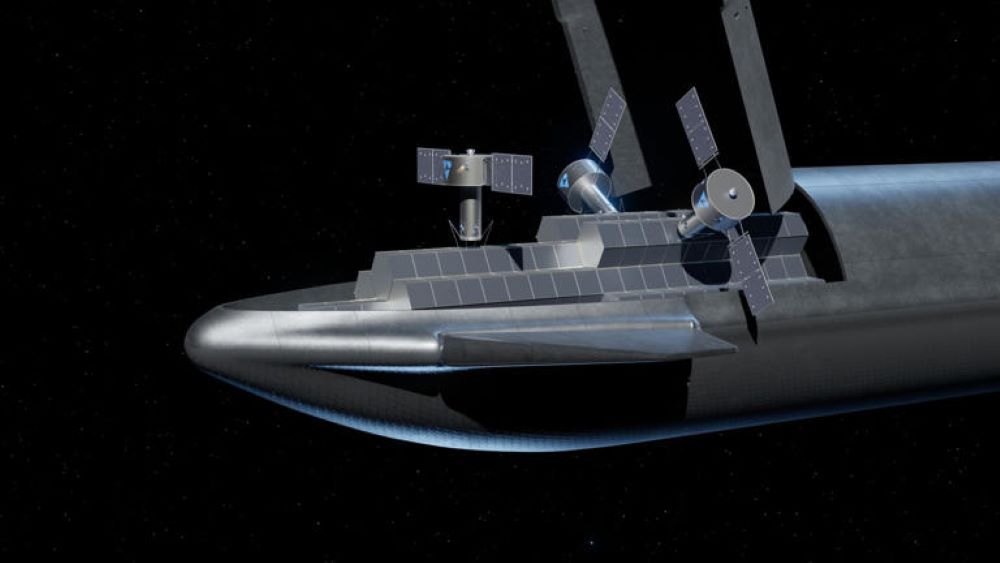
And then the wild card in the pack is the SpaceX Starship, which has a cargo bay big enough for a Hubble repair job (Fig. 15) and will undoubtedly have a remote arm. On the last launch of Starship the cargo bay doors failed to open fully, possibly due to icing, and recently released photos show that the bay doors have been repositioned for the next flight. We know what caused the last Starship to fail on re-entry (icing of attitude control jets), and why the Superheavy booster didn’t make it back through the cloud deck (only one braking engine fired out of three, doubtless under intense review). Static engine firings for both Starship and Superheavy were conducted in late March and early April, with another Starship one on May 8th, so a new launch date is expected shortly. When you look back at the huge progress which has been made since the announcement of the project in 2012 (as the Mars Colonial Transporter), after previous mention back in 2005 (as the BFR – work it out), having it operational, man-rated and good to go in the foreseeable future no longer seems so far-fetched.



Leave a Reply