
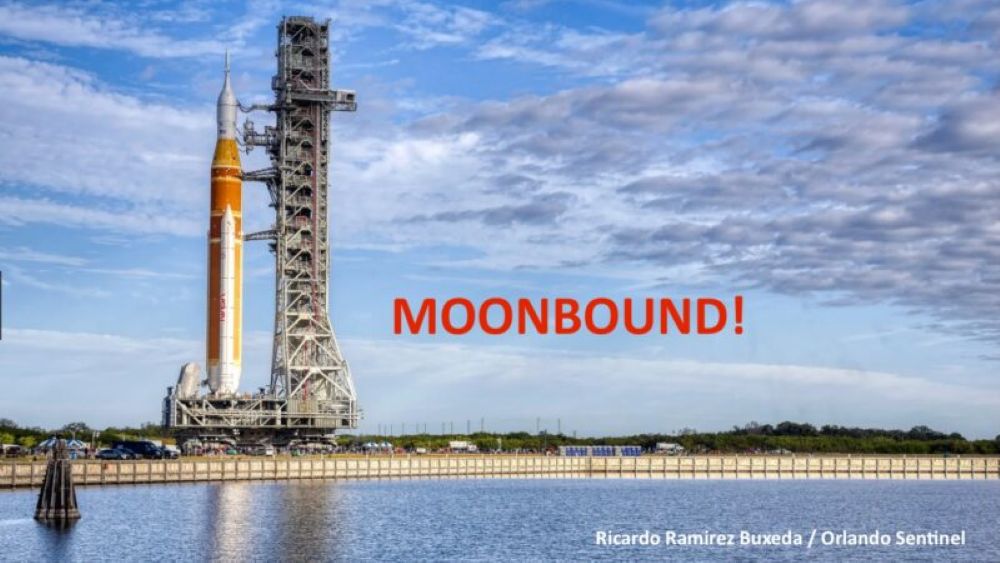
On January 17th, as promised, the Space Launch System booster and the Orion capsule for the Artemis 2 lunar mission were together rolled out to Launch Complex 39B at Kennedy Space Center (Figs. 1 & 2).


The first ‘wet dress rehearsal’ for launch was held on February 3rd, and was halted due to liquid hydrogen leaks like the ones which delayed the Artemis 1 launch in 2022. Although the problem generated much sarcastic press coverage, the fact is that liquid hydrogen is notoriously difficult to handle, and the problem was not in the rocket itself, but in the umbilical connection which keeps the tanks topped up during the final stage of the countdown.


The problem was duly addressed (Figs. 3 & 4) and a second wet dress on February 19th was fully successful, (Fig. 5), filling the rocket not just with liquid hydrogen and oxygen, but also with liquid helium, which pressurises the tanks for the pumps to deliver their contents to the engines.

On Saturday 21st, however, it was announced that a blockage in the helium flow system of the Interim Cryogenic Propulsion Stage (Fig. 6) was likely to prevent the planned launch on March 6th, and on February 25th the vehicle was rolled back to the Assembly Building to deal with the problem. As described in the February ‘Space Notes’ (ON, 1st February 2026), the Interim Propulsion Stage will have several relights on orbit, raising the Orion away from Earth before its Service Module puts it into a free-return around the Moon and back to Earth.


NASA has never been given the funding for the intended Exploration Upper Stage (Figs. 7-10), which would have allowed the SLS to land Orion directly on the Moon. Instead the spacecraft is to rendezvous in lunar orbit with a SpaceX lunar Starship, which will take them down to the surface and bring them back to the uncrewed Orion. While that plan does allow two options for the return to Earth, it now appeared that Artemis 3 in 2028 would precede establishment of the Lunar Gateway space station, whose first Habitation Module will be taken up by Artemis 4. I’d previously expressed my misgivings about that second lunar orbit rendezvous, and I wouldn’t have been surprised if Artemis 3 and 4 swapped roles before it all came to pass – sure enough, on February 27th it was announced that Artemis 3 would rendezvous in Earth orbit with a lunar lander, before an actual landing was attempted.
Critics continue to voice their doubts about whether the lunar Starship will be ready on time. However, Elon Musk has announced that the first launch of the Version 3 Starship/Superheavy combination will be in March, as promised, considerably larger than Version 2 and with uprated engines. Meanwhile he has reached agreement with the Florida authorities for up to 24 launches per year from Pad 39A, previously used for the Space Shuttle and for Apollo missions to the Moon, and with that and two active launch sites in Texas, he definitely means business. Meanwhile the competition is hotting up: Jeff Bezos has announced that he is giving up New Shepard tourist flights to concentrate on Blue Origin’s lunar programme, and Elon Musk has paused his plans for Mars meantime. NASA plans to use Blue Origin’s lunar lander in later Artemis missions (Fig. 12), and if SpaceX falls seriously behind, the flight order could change again.


Blue Origin is meanwhile having some problems with its BE-4 methane/lox engines on the United Launch Alliance’s Vulcan booster. In two of four launches to date, damage in the form of ‘sparks’ has been seen falling from the engines (Fig. 13), built by Northrop Grumman, indicating damage to their inner linings, and in the fourth launch on February 12th there was an actual burnthrough, producing a sideways plume which set the vehicle into an unscheduled temporary roll (Fig. 14).


In both cases the booster recovered and delivered its payload to orbit, and as the makers and commentators have said, that proves the resilience of the system; but still, as the agents for a well-known make of scooter said to me in 1965, after a new one turned over on me at 50 mph, “it’s not supposed to do that”. On February 25th, the Space Force announced a pause in national security launches on Vulcan until the problem was resolved.
The same announcement revealed that the main payload of USSF-87 was two Geosynchronous Space Situational Awareness Program (GSSAP) ‘neighbourhood watch’ satellites, to monitor other nations’ activities in geosynchronous orbit. According to Lt. Gen. Greg Gagnon, head of Space Force Combat Forces Command, the mission also included a prototype of a highly manoeuvrable satellite for orbital warfare, Mission Delta 9. “Their job is working on their manoeuvrers … so that they can deliver offensive and defensive capabilities that are precise and not imprecise. So, they’re working on driving that spacecraft in a way that we couldn’t drive spacecraft before.” Although it was described as ‘a first’, it should be noted that in September 2025 the Space Force conducted a ‘rendezvous proximity operation’ exercise with the UK’s Skynet 5-A as a target, and apparently with our collaboration (note the ‘United Kingdom Space Command’ logo on Fig. 15). Perhaps it was an exercise for removal of space debris; or then again, perhaps not.

Details are emerging about the response to a space debris strike on the Shenzhou-20 spacecraft, discovered during internal inspection before its scheduled return to Earth with its crew on November 5th. The damage to a window was a triangular patch, which at first glance was thought by taikonaut Chen Dong to be a fallen leaf which had somehow remained attached.

On November 14th the crew returned aboard the Shenzhou-21 capsule (Fig. 16), which had docked with the Tiangong space station on October 31st, and an uncrewed Shenzhou-22 was sent up on November 24th, with fresh supplies, along with a repair kit, docking three days later (Fig. 17).


After external inspection by the new crew on December 5th (Fig. 18), Shenzhou-20 returned safely to Earth, uncrewed, on December 19th (Figs. 19-21).


The Chinese authorities took care to point out that this system of backups has been in place throughout the programme, though never used till now, contrasting it, fairly enough, with the disruptions to ISS operations caused by leaks from Soyuz capsules, and still more by the problems with the Boeing Starliner.

The early return of the Dragon Crew 11 from the ISS had less drastic effects because it occurred only a month before they were scheduled to come back. The medical victim has now been identified as Mike Fincke (Fig. 22), an astronaut since 1996 and a veteran of four Space Shuttle missions. He has not revealed what the problem was, only that it required immediate assistance from his team-mates, who stabilised his condition with advice from the flight surgeon at NASA, after which it was judged that a return to Earth was advisable.


Crew 11 returned to Earth on January 15th (Figs. 23-24), and Crew 12 was launched to replace them on February 13th. In the intervening month NASA’s Christopher Williams continued operations as the only American aboard, with cosmonauts Sergey Kud-Sverchkov and Sergei Mikayev, and with no problems – worth noting in relation to the comments on international cooperation by Kelly and Zach Weinersmith in A City on Mars, and my reply (review, ON, 11th January 2026).
Meanwhile the independent report into the troubled flight of the Starliner has pulled no punches in its criticism of NASA and the principal contractor, Boeing. Aviation Week described it as more like the reports which followed the fatal flights of the Columbia and the Challenger, putting the blame squarely on poor design, poor workmanship and very poor management decisions which allowed those to go unchallenged (Irene Klotz, ‘NASA Leadership Lapse Compromised Safety In Starliner Crew Flight Test, February 26th 2026). “We failed them”, said NASA administrator Jared Isaacman of astronauts Barry “Butch” Wilmore and Sunita Williams, who saved the mission and achieved docking with the ISS despite thruster failures which denied them full attitude control. It’s deeply disappointing to find such repetition of the same bad practises which led to the Apollo 1 fire and the two Shuttle losses, which were absolutely damned in the Columbia report. (Columbia Accident Investigation Board: Report Vols 1 & 2, US Government Printing Office, August 2003.) I’m currently reading a new analysis of the loss of the Challenger, so there will be more to say about this later.
On a cheerier note, this year should see a worthwhile space rescue being performed by a satellite launch system originally devised for the US military.


The Pegasus airborne launcher (Fig. 25) was originally devised for the Department of Defence DARPA agency, and air-launched by NASA’s venerable B-52 (Fig. 26), later modified for launch from a Tristar by Orbital ATK (Figs. 27-29), with an upgrade to Pegasus XL in 1994, under whose auspices it launched payloads for NASA (Fig. 30) including the IBEX mission to study the outer reaches of the Solar Wind (Fig. 31) and the NuStar high-resolution x-ray telescope.


Pegasus last flew in 2021, but one more mission is planned for mid-2026. The spacecraft now in need of saving is NASA’s Swift Gehrels gamma ray observatory (see ‘Space Notes, December 2025’), launched in 2004, scheduled to end in 2024 when its orbit decayed, still operational and highly valuable, but destined to re-enter in late 2026. In September 2025 NASA signed a contract with Arizona-based Katalyst Space Technologies to build a boosting spacecraft, and the last Pegasus XL is expected to launch in the spring of 2026, or summer at the latest, rendezvous with Swift and raise its altitude (Fig. 32).

On February 11th Swift paused science operations and adopted a minimum-drag attitude to prolong its lifetime. Unlike the Hubble Space Telescope, Swift was never intended to be retrieved or repaired, so it has no docking ports and the rescue will be attempted by grappling with small flanges which were used for handling the satellite, prelaunch (Fig. 33). The clock is ticking and there’s a lot at stake, not just for Swift but for more possible rescues in future.

In assigning topics between ‘The Sky Above You’ and ‘Space Notes’ it can sometimes be difficult to decide where a story should go, and the latest breakthrough with the Perseverance Mars rover is an example. As Perseverance has continued its exploration of Jezero Crater and the Neretva Vallis formed by a river which flowed into it, billions of years ago, throughout, the controllers have gradually been giving increasing autonomy to the rover’s onboard navigation system, letting it pick its own route between obstacles at ground level. In summer 2024 there was a spectacular instance where the rover crossed the river valley with only one scheduled stop and no guidance from Earth (Fig. 34 – see ‘The Sky Above You, July 2024′, ON, 1st July 2024).

But since its landing in February 2021, the rover has been compiling its own map using images every few feet of travel, estimates of wheel slippage, and overhead imagery from orbiters. But ‘with the new upgrade, called Mars Global Localization, Perseverance can match its own panoramic imagery to orbital terrain maps onboard, calculate its precise position’ (to 25 cm.) ‘and continue along its planned route without waiting for Earth-based confirmation.’ (Sharmila Kuthunur, ‘NASA’s Perseverance rover now has its own ‘GPS’ on Mars: “We’ve given the rover a new ability”, MSN, online, 22nd February 2026.) In December 2025 the rover performed the second of two demonstration drives under AI control (Fig. 35).

The key point is that with continual ‘fixes’, Perseverance can keep track of its position without having to refer to Earth for advice – where the timelag alone can immobilise it for 4 to 40 minutes, depending on the distance between Earth and Mars at the time. It and future rovers will now be able to move around a great deal more quickly.

Elon Musk’s distrust of AI is well known, but with it now active on Mars, his hopes of an AI-free human settlement now look much less likely. Perhaps though there’s a cautionary note in Brian W. Aldiss’s novel The Eighty-Minute Hour (Fig. 36), which I reviewed for The Glasgow Herald in 1974. In it, the Earth had fallen under control of the computer which instigated the longer hour of the title for its own convenience. The human colony on Mars remained independent for the moment, but ‘Across the gulf of space, an intellect vast, cool and unsympathetic, regarded the red planet with envious eyes, and slowly but surely drew its plans against it.’
And finally… the penchant for giving ships and missions whimsical names began with Elon Musk’s recovery barges quoting Iain M. Banks, Just Read the Instructions and Of Course I Still Love You; it continued with Jeff Bezos calling his first New Glenn booster So You’re Telling Me There’s a Chance, and the next one Never Tell Me the Odds. But as Rocketlab (which began operations in New Zealand, but now launches from California) launches a hypersonic demonstrator called DART AE for the Australian company Hypersonix (Fig. 37), a Crocodile Dundee fan is somewhere in the works, because the mission has been named That’s Not a Knife (Fig. 38).


Duncan Lunan’s latest books are available from bookshops and through Amazon; details are on Duncan’s website, www.duncanlunan.com.



Leave a Reply