
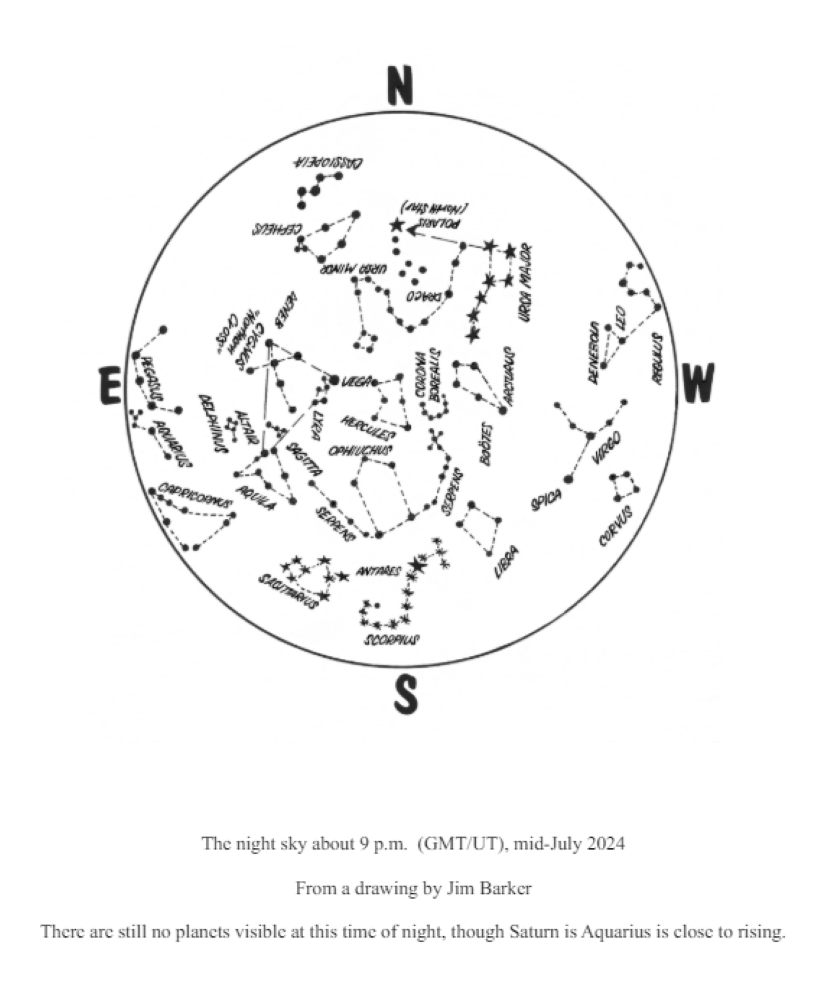
The Moon will be New on July 5th, and Full on July 21st. The Moon is near Mars on the mornings of the 1st and 2nd, and near Jupiter and the Pleiades on July 3rd. It’s near Mercury on the 7th, Uranus on the 15th and 16th, and Saturn on the 24th, all of these morning events, as the previous grouping of planets beyond the Sun disperses. After the Moon enters Last Quarter on the 28th, its waning crescent will pass Mars and the Pleiades again on July 30th, and Jupiter again on the 31st.

As predicted, the Chang’e-6 spacecraft delivered its samples from Apollo crater on the lunar Farside to Mongolia on June 25th (Fig. 1). I had wondered whether the return trajectory would be a slow working outwards from the Moon, like India’s Chandrayaan-3 vehicle earlier, but it was a single operation – the only doubt seems to be whether the departure burn was on June 20th or 21st. China has issued an invitation for international participation in analysing the samples, which are expected to yield major scientific results.

The planet Mercury is in the northwest sky in early July, south of the Moon on the 7th, setting before Leo, so off our map by 9 p.m., an hour before sunset in Ayrshire, so be very cautious looking for it. It’s furthest from the Sun on July 22nd, disappearing soon after.
Venus is still out of sight beyond the Sun.
Mars, still faint, will rise about 1.50 a.m. on July 1st, rising earlier and passing from Aries into Taurus during the month. Mars passes Uranus on the 15th and 16th, catching up with Jupiter in Taurus at the end of the month. Mars is near the Moon on the 1st and 2nd, again on the 30th.
On Mars, there are two major stories. The Insight lander, which was disabled by dust accumulating on its solar panels in 2022, is now being covered by dust much faster than expected – see ‘Martian Dust Storms’, ON, 23rd June 2024. And the other story is a truly remarkable traverse which has been accomplished by the Perseverance rover.
Perseverance had been making its way up the Neretva Valles, a river which flowed into Jezero crater about 3 billion years ago, when the crater was a lake. The rover was on the south rim of the valley, but headway was becoming difficult due to a field of boulders which were larger than expected. Its AutoNav system was failing to cope with finding a route between them, as witness the frequent stops by white dots on Fig. 2, which is an overview of the route from the Mars Odyssey orbiter. The target was on the other side of the river, a light-coloured area called ‘Bright Angel’ which might be where a tributary fed into Neretva Valles (Fig. 3).


Failing to draw level with Bright Angel, Perseverance’s controllers began looking for an earlier way across, and having found one, they decided to take a run at it. After looking downstream from ‘Overlook Mountain’ on May 27th (Fig. 4), the route led down a ramp to the valley floor, cutting through a dune field via ‘Dunraven Pass’ (taking a chance there) but avoiding the main fields of dunes on the river floor.

On the crossing the rover stopped only once, to take a mosaic of a protruding feature called ‘Mount Washburn’ (Fig. 5). Quite unexpectedly, in the middle of the hillside, not easy to get to, there was a bright, almost shiny rock which has been named ‘Atoka Point’ (Fig. 6). Spectroscopy suggests that it might be a mixture of pyroxene and feldspar, possibly formed in a volcanic magma chamber. Alternatively, it might be anorthosite, like the ‘Genesis Rock’ found on the Moon by Apollo 15. Either way, it’s not obvious how it got there: washed downstream, presumably, but still in an odd location, as the Genesis Rock was.


After crossing the river, or ‘fording’ it as some journalists put it, although it hasn’t seen water for billions of years, Perseverance found itself in a field of sharp, light-coloured ‘popcorn rocks’, of a type never seen before (Fig. 7); and by June 16th, it was on a bed of rock which had clearly been smoothed by water action (Fig. 8). The only difficult question is, how many samples to take and leave for future collection, when the sample retrieval programme has run over time and over budget, leading to serious reconsideration. But having reached Bright Angel, the Perseverance controllers are looking to go back over the river bed, because they’ve spotted another tempting target called ‘Serpentine Rapids’ on the south side, where they were to begin with.


Jupiter in Taurus rises at 1.30 a.m., near the crescent Moon on the 3rd, and near Mars, Aldebaran and the Pleiades in the morning sky towards the end of July, near the Moon on the 30th. The following night Jupiter reaches its ‘stationary point’, after which it begins to move eastward as the Earth draws ahead of it.


On June 26th remarkable new images of Jupiter from the James Webb Space Telescope were released, taken in July 2022, with closeups of the Great Red Spot (Figs. 9 & 10). Unsurprisingly the Spot itself appeared in blue, because the storm projects above Jupiter’s main cloud deck and is correspondingly colder. But over it there were turbulent features which have been identified as hotter hydrogen gas welling up from below. It’s thought these may be ‘gravity waves’, like those of breaking waves on Earth’s beaches, caused by turbulence as deeper currents encounter the GRS as an obstacle. This strikes a chord with me because I described similar effects in a story called ‘The Galilean Problem’, first published in Galaxy in 1971 and reprinted in The Other Side of the Interface (Other Side Books, 2021, Fig. 11). I can’t claim any credit for the prediction because my idea of the GRS was based on a suggestion by the Arran-based astronomer V.A. Firsoff. In his book Strange World of the Moon (Hutchinson, 1957), he suggested in passing that the Spot might be a huge blob of frozen gases, floating in Jupiter’s clouds because it was buoyed up by denser layers below. Noting that the Spot is lapped by surrounding airstreams at hundreds of miles per hour, I thought that it might be carved by waves, like the ones now suggested, into huge terraces on the upwind side. At least I wasn’t so far wrong with the physics involved.

As we now know, the Red Spot is a storm which reaches hundreds of miles down into the atmosphere of Jupiter, as well as several miles above it. It was supposedly first observed in 1637, and by Cassini from 1675 to 1713. But after that there were no further sightings until Schwabe’s 118 years later. A new study of its dynamics suggests that Cassini was incorrect to call it the Permanent Red Spot, and the one we have now may be another one. (Evan Gough, ‘The Great Red Spot Probably Formed in the 1800s’, Universe Today, online, June 17th, 2024.) During the 20th century the Spot shrank from three times the size of the Earth to only twice, and faded noticeably in colour; in one of his paintings for my Man and the Planets, 1983, Gavin Roberts assumed that it would have faded still further before human beings got there (Fig. 12). Indeed, for the last 20 years Jupiter has had a Little Red Spot which may be destined to replace the GRS, though it lost its colour after the first few years. (The colours are thought to be phosphorus compounds formed by solar ultraviolet radiation at high altitudes.) See ‘Jupiter’, ON, September 5th, 2021.

Saturn in Aquarius rises before midnight in early July, about 10 p.m. by the end, and is close to the waning Moon on July 24th.
Uranus in Taurus rises at 1 a.m., above Mars on the 15th and 16th , near the Moon on the 1st and 29th.
Neptune is in Pisces, rising about 11.p.m., and on July 3rd it is ‘stationary’ as the Earth begins to overtake it. Neptune is near the Moon on the 25th.
The Perseid meteor shower commences on July 17th, peaking in August. It’s also worth watching for noctilucent clouds in the north around midnight, and for aurora borealis, as the Sun gets nearer to the peak of its 11-year cycle of activity.
In ‘Space Notes – The Need to Save Chandra’, ON, June 30th, I highlighted the problem that NASA’s funding for the Chandra X-ray space telescope may be curtailed, starting in 2026. That’s not the only problem in x-ray astronomy at the moment.


On September 6th 2023, along with the SLIM moonprobe (Figs. 13-15), the Japanese space agency launched a joint project with NASA called XRISM, X-Ray Imaging and Spectroscopy Mission (Fig. 16).

XRISM is intended to fill the gap between the current x-ray telescopes (Chandra and XMM), and the European Space Agency’s ATHENA (Advanced Telescope for High Energy Astrophysics), a successor to Chandra which is planned for 2035. Operating in the ‘soft x-ray’ range, XRISM has two onboard ‘telescopes’, Resolve and Xtend; like all x-ray telescopes these have no lenses, focussing incoming x-rays using ultracold thermal detectors, mirrors and diffraction gratings (Figs. 17 & 18.) For a more detailed explanation, see Jackson Ryan, ‘’Absolutely gutted’: How a jammed door is locking astronomers out of the X-ray universe’, Universe Today, online, June 12th 2024). Both Resolve and Xtend were launched with protective doors, like the Hubble Telescope’s, but unfortunately Resolve’s has failed to open, limiting its operation to a much higher energy range than planned. At higher energies the door is no obstacle, but it blocks off the range of lower-energy x-rays to which Chandra has access.


The operators of XRISM are now faced with a dilemma, not unlike the ones which the astronauts faced in the repair of the Solar Maximum Mission and the final refurbishment mission to the Hubble Space Telescope (see ‘How Long for Hubble?’, ON, 12th May 2024). With three attempts by JAXA’s engineers to free the door having failed, the remaining option is to heat the telescope up again and try to shake the door loose. The track record for such operations is not fantastic. The Galileo Jupiter orbiter had to go through a limited version of its mission because three ribs of its high-gain antenna remained closed; the radar booms on ESA’s Mars Express refused to lock, and to reach the orbit required the spacecraft undertook and survived the risky option of flying its atmosphere correction manoeuvre backwards. One of the high-gain antennae on NASA’s Lucy mission is not fully open, though almost, and it just has to be hoped that it will survive the rocket burns to come without collapsing. Moving parts are always the bane of operations in space. As with the SMM and HST repairs, the controllers now have the difficult choice between operating the XRISM in limited mode for the next eleven years at least, or the risk of breaking the telescope altogether. I can only say, I’m just glad the decision isn’t down to me.
Duncan Lunan’s recent books are available through Amazon. For more information see Duncan’s website, www.duncanlunan.com.
You can download a copy of the Star Map for July here:



Leave a Reply