

The Moon is Full on March 3rd, and New on the 19th. On the 3rd there’s a total eclipse of the Moon over the Americas, Asia and Australasia, not visible elsewhere.
On the evening of the 19th there’s a chance to find the very young Moon, just 17 hours old, when it’s below and to the right of Venus immediately after sunset – but don’t look for it, especially not with binoculars, until the Sun has definitely set. The Moon is even nearer Venus on the 20th, at the spring equinox, and passes above Jupiter on the 26th. British Summer Time begins on the 29th, and early that evening the Moon occults Regulus, the brightest star in Leo. The disappearance will be in daylight, between 7.14p.m. and 7.20p.m. BST, depending on location, and the reappearance on the bright edge of the Moon will be between 8.15 and 8.25 p.m.. (These approximate times for London and the north of Scotland, are from the March edition of Astronomy Now, but a summary three pages later mentions only a previous such event on March 2nd, visible only from Russia and northern China.)
The planet Mercury is in the evening sky at the start of March, to the right of Venus, still setting at 7 p.m., but swiftly fading and getting lower, in conjunction with the Sun on March 7th.
Venus is now visible low in the west, very bright and setting around 7.30 p.m. by the end of March, near the Moon on the 20th. To avoid confusing it with a UFO, or with the Artemis 2 mission which might have been near the Moon at the time, ask yourself whether you can see two bright objects or just one, which is Venus. (Artemis 2 wouldn’t be visible even if it was close to the Moon at the time, but as of 23rd February, the possible launch dates in March were the 6th to the 9th, in which cases the 10-day mission would bring it back by the 20th, or March 11th with return on the 21st. But rolling back the booster on 25th February, to address a helium blockage in the Interim Upper Stage, means that an April launch is more likely.)
When I reviewed Derek Künsken’s The House of Styx, A Venus Ascendant Novel (ON, February 26th, 2023), the emphasis was on balloon-borne civilisation in the Venus clouds. But towards the end of the novel its protagonists find a strangely cold region at the bottom of one of the planet’s geological rift valleys, which turns out to be a product of alien technology and allows them to begin construction of a surface base in a tunnel. I’ve discussed the possibility of settlements in natural lava tubes below the surfaces of the Moon and Mars in ‘Lava Tubes’ (ON, 21st July 2024). As the whole of Venus has been resurfaced by volcanic eruptions, thought to have been about 10 million years ago, it was more than likely that Venus too would have them, but hitherto only one possible example has been detected.

But continuing study of the radar data from the Magellan orbiter in 1989-1994 has now turned up a very likely example on the western flank of Nyx Mons (Fig. 1), one of 1,600 major volcanoes and nearly a million smaller ones on the Venus surface (Sharmila Kuthunur, ‘Venus may have an underground tunnel carved by volcano eruptions’, Space.com online, 9th February 2026). It could be as long as tens of kilometres: surface collapse features extending from tens to thousands of miles may indicate much larger systems, and open up the possibility of very extensive future settlements, like the ones in Sean Williams’s The Sky Inside (review, ON, 3rd August 2025).
Mars is still not visible this month, and won’t be again until June.
In an updated version of my 2012 review of Rod Pyle’s Destination Mars (ON, 2nd November 2025), I once again expressed surprise that so little had been made of the discovery, by Dr. Chris McKay of NASA Ames Research Centre, that perchlorates discovered in the Martian soil by the Phoenix lander could account for the apparent absence of organic matter in the samples tested for life by the Viking landers in the 1970s, although all the other tests for life gave positive results. The explanation given at the time was that any organics must have been destroyed by an extremely strong oxidant, never identified. The results have now been reviewed by Prof. Steve Benner at the Foundation for Applied Molecular Evolution in Florida, and his conclusion is that all organic matter in the samples was destroyed by perchlorates when heated, which would explain why none at all was detected, although there should have been traces from meteorites even if there were no local ones in the soil – an oddity which I’ve never seen highlighted before. What the Viking instrument detected was a second burst of carbon dioxide, which was assumed to be a residue from previous tests on the same samples, and methyl chloride, which was assumed to be contamination from the prelaunch cleaning process. But Prof. Benner points out that methyl chloride is not a cleaning agent – and it was demonstrated in 2010 that methyl chloride and carbon dioxide are generated when organic matter is heated with perchlorates. (Keith Cooper, ‘Did the Viking missions discover life on Mars 50 years ago? These scientists think so’, Space.com, online, 10th February 2026.)
In the Destination Mars review, Rod Pyle and I quoted McKay as saying that the 20-year gap in Mars exploration, from the 1970s to the 1990s, might have been a major error in judgment. Prof. Benner and his colleagues take the even stronger view that all Mars life research in the last 50 years has been misdirected, and they call for the debate to be reopened at a much higher level. By coincidence, NASA has just announced that ongoing remote study of samples taken by the Curiosity rover in 2013 now indicate the presence of long-chain molecules which probably (stress probably) have been generated by life. (Paul Scott Anderson, ‘NASA says organics on Mars are hard to explain without life’, EarthSky, February 17th 2026.)

Exciting as all this is, one cautionary note is needed. Perchlorates weren’t found at the Viking sites either, ‘Not known, because not looked for’, to quote T.S. Eliot in Little Gidding. All we know at present is that they were found at the Phoenix landing site, nearer the Martian north pole and on the floor of the suggested Boreal Ocean (Fig. 2). Whether they’re all over Mars, including both Viking sites, remains to be seen.


More news from Mars is that the giant volcanoes on Mars, particularly Pavonis Mons in the centre of the Tharsis Ridge (Figs. 3 & 4), had long and complex histories, evolving from fault-fed systems (Fig. 5) like the ones on the early Moon (Fig. 6) to stationary hot spots feeding the huge cones we see today, with different types of lava, from different depths in the crust, in the different evolutionary phases (Paul Scott Anderson, ‘The most recent volcanoes on Mars were surprisingly active’, EarthSky, February 19th 2026).

The accompanying overhead view of Olympus Mons (Fig. 7) is credited to ESA’s Mars Express orbiter, but a previous article attributed it to ESA’s Trace Gas Orbiter, illustrating the discovery in 2024 of atmospheric frost on the summits of the giant volcanoes (Fig. 8; Paul Scott Anderson, ‘Spotted! Water frost on Mars volcanoes for 1st time’, EarthSky, June 16th 2024).

Continuing analysis of returned samples from the asteroid Bennu continue to produce surprises. At least 14 of the 20 amino acids used by life on Earth, and 19 other amino acids not used by life, have been identified in them, and clearly formed in cold outer regions of the Solar System if not still further away. As with most such material found in meteorites, both left and right-handed molecules are present, indicating a non-biological origin. But the two forms show a marked difference in the isotopes of nitrogen taken up by them – whether that has any significance for the left-handed preference of organic molecules on Earth remains to be seen. (Keith Cooper, ‘Asteroid samples NASA brought to Earth suggest life’s building blocks may be widespread in the universe’, Space.com, 11th February 2026).
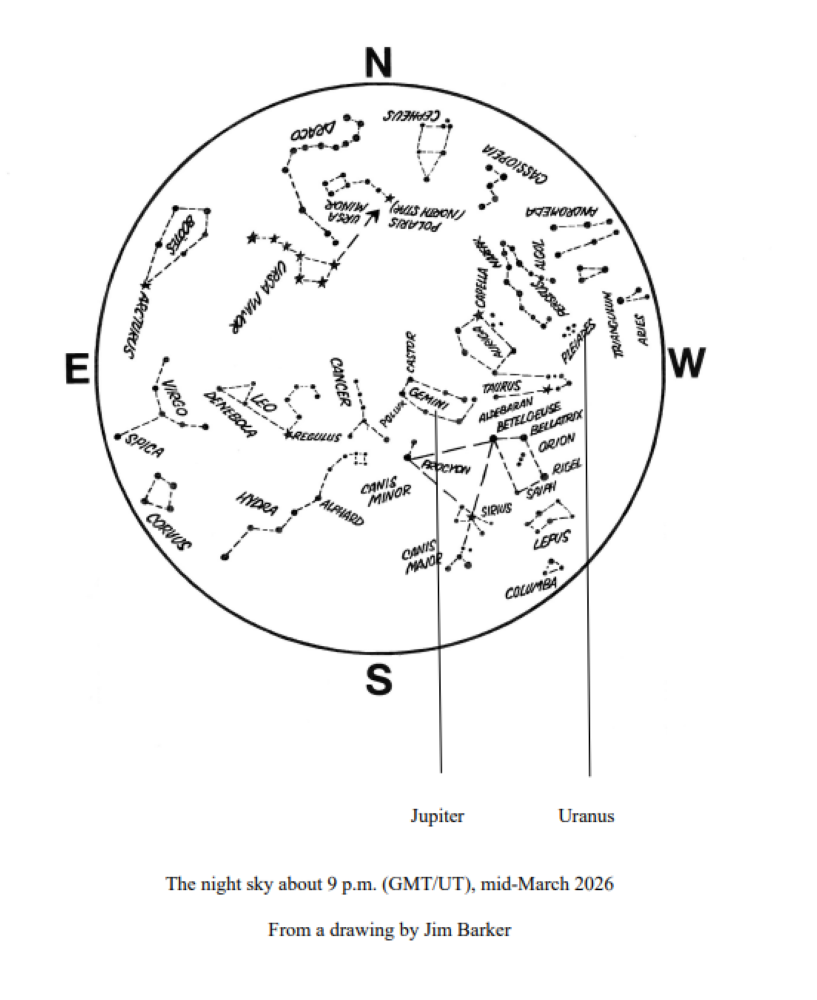
Jupiter is still brilliant in Gemini, high in the south at dusk, setting around 4 a.m., and passed by the Moon on the 26th. After being passed by the Earth in January, Jupiter resumes eastward movement among the stars on March 11th. On March 17th in mid-evening, about the time of our map, the moons Io and Callisto will be in transit across the face of Jupiter, followed by the shadow of Io to the left.
Saturn in Pisces sets about 7.30 p.m., passing above Venus (though very much fainter) on the 7th, less than one degree to the right of Venus on the 8th, and gone by mid-month. The conjunction with Venus on the 8th offers a last chance to see it, before conjunction with the Sun itself on the 25th, but as with the very young Moon above, don’t look for it until the Sun has definitely gone down.
Uranus, in Taurus, is still below the Pleiades and sets about midnight, near the Moon on the 22nd.
Neptune, in Pisces, is still very near Saturn, at its closest on March 7th, but will not be visible from the UK at the time. Neptune is in conjunction with the Sun on March 22nd, three days before Saturn.
In ‘Let’s Talk About the Neighbours’ (ON, 22nd June 2025), writing about the galaxies nearest to us, I wrote, “It’s also strange that the Local Group is virtually flat, with the three spirals on a diagonal plane… and the satellites orbiting them staying close to it – almost inviting collisions, and looking as if there have already been some. It’s as if there are unknown attractors out there, and they might be dark matter concentrations between the galaxies.’ I suggested that instead it might be due to long filaments of baryonic (ordinary) matter, tens of light-years long, like ones which had recently been detected between galaxies in the Shapley Cluster. But now a flat sheet of dark matter has been detected, 32 million light-years (10 megaparsecs) across, with the entire Local Group of 31 galaxies embedded in it including our Milky Way and M31 in Andromeda, our nearest neighbour (Fig. 9).

This ties in with the previous detection of areas of low density in intergalactic space (the Local Voids), which I showed in ‘Let’s Talk About the Neighbours’ and which turn out to lie on either side of the sheet. (Dave Adalian. ‘Milky Way and Andromeda held together by dark matter sheet’, EarthSky, February 18th, 2026.)

The report adds ‘The simulation even predicted the flattened distribution of far more distant galaxies in the Local Supercluster without knowing of its existence’. The Local Supercluster is less confusingly known as the Virgo Supercluster (Fig. 10), of which the Local Group is a member on the periphery (Fig. 11). As the presence of the dark matter sheet has been revealed by analysis of the Cosmic Microwave Background, we can expect the technique to be extended further, with further dramatic results.

Duncan Lunan’s recent books are available from booksellers and through Amazon; details are on Duncan’s website, www.duncanlunan.com.
You can download a copy of the March Sky Map here:


Leave a Reply